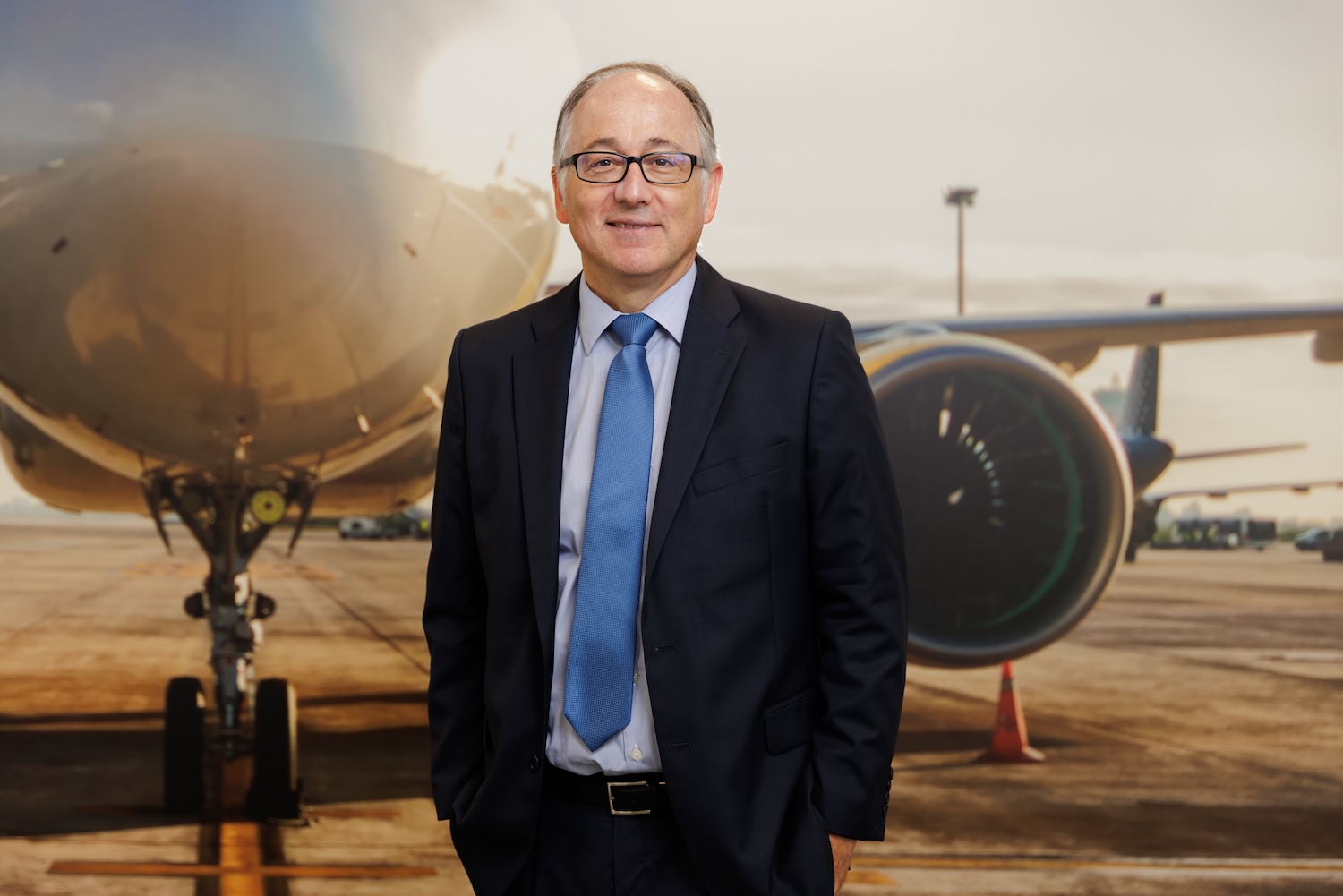
Luis Gallego piloted IAG, the parent of Iberia and British Airways, out of a crisis, toward a transformative future.
When Luis Gallego became CEO of Iberia in March of 2013, the Spanish airline had been losing money for nearly a decade and was heading into a painful restructuring. In a dramatic and immediate turnaround, Iberia returned to profitability and refocused on ensuring on-time flights and other aspects of the customer experience.
In 2020, at the start of the global pandemic that shut down air travel around the world, Gallego was promoted to CEO of IAG, the parent group of not only Iberia but also British Airways, Vueling, Aer Lingus and LEVEL. He led the group through the COVID ordeal, transforming it at the same time. Emerging from the crisis presented yet another crucial test of his leadership, one that demanded a transformative mindset.
“At that time, we didn’t know if corporate traffic would resume,” Gallego told us in a recent interview. “After all these Zoom and Teams meetings, would people get used to that?”
Since then, IAG’s recovery has been nothing short of spectacular. Traveler numbers now exceed 2019 levels. All five airlines were profitable in 2024 and approaching new operating-margin targets. IAG’s airlines currently have 601 aircraft, 259 destinations and 122 million passengers per year.
Gallego was born in Madrid and earned a degree in aeronautics engineering before joining the business side of the airline industry 30 years ago. Prior to Iberia, he was an executive with Vueling. In June of 2025, he was named Chair of the International Air Transport Association (IATA), where he has served as a boardmember since 2018.
Gallego spoke to Brunswick Review about IAG’s business model and culture, which emphasizes the operational independence of the individual airlines and an awareness of where support from group leadership can make a difference.
“We’re not an airline,” he says. “We don’t sell tickets. Even our name, International Airlines Group, is different from other models that have the name of an airline. IAG airlines have to compete for capital. It’s a model that creates tension by definition. But that tension is what helps the different airlines to be better every day.”
Did the changes you implemented at Iberia apply to the company as a whole? Is that approach replicable elsewhere in the airline industry?
We are in a different situation now compared to the situation with Iberia in 2013. The necessity to change is the same, but not to the same degree.
At that time, I was losing a million euros per day, every day. Our net promoter score was negative. People didn’t want to fly with us. We were one of the most disparaged airlines in the world. We had a very strong, immediate need to change the business platform. That wasn’t the case with IAG.
But having good results sometimes means it’s harder to convince everybody that you need to change. And we do still need to change. The world is very volatile. If you don’t adapt, you are going to die. Or at least, you are going to be in a weaker position in a couple of years.
“We have now embedded this transformation culture throughout IAG.”
When I started as CEO of the group in 2020, we launched a new department called Transformation, because we didn’t know how aviation was going to be after the COVID. We didn’t know if people were going to fly again or not, or if the corporate traffic was going to come back. The only thing we knew for sure was that we needed to be better, more efficient and more prepared. Through the transformation we launched thousands of initiatives.
In the end, corporate traffic has come back in volumes, around 70% of the volumes that we had in 2019. But premium leisure is very strong, better than the pre-COVID situation. And we are offsetting the decline of corporate traffic with the premium leisure segment—a sign of our flexibility.
We have now embedded this transformation culture throughout IAG. The methodology that developed through our transformation has helped us reach our current levels of profitability. So I think transformation is a must. It’s not a PR exercise. We do it because it works. We change or we die.
IAG manages independent company identities crossing Spanish, English and Irish. How do you manage such separate cultures across the business?
Our individual airlines are responsible for profit and loss, for their customers, for their brand. A long time ago, we decided that we were not going to do group level things that don’t add value—we do things only when we determine we have to. Even where they fly. We have some committees overseeing, just in case, but we know it is much more efficient for our airlines to compete for the capital. They preserve their identity and their cultural differences.
This worked very well during and after COVID. We did an analysis in 2023 to see if we needed to change the way IAG manages the airlines. And the conclusion was that the model delivers better results than the competition. There was some fine tuning that we needed to do to continue that level of outperformance, but the model was working.
Procurement is an area where we achieve value negotiating together with the group. We have more than 600 aircraft, we get better deals with the manufacturers if we do it together. Likewise, there are IT and cybersecurity functions that make sense to do at group level. But things that are very close to the customer, the airlines themselves do much better.
When I was CEO of Iberia, we had the freedom to do the things that we thought were best, but we also had the support of the group. I’ve always said that the transformation of Iberia would have been impossible without that.
Looking back, what lessons did you take from COVID? Is there anything that surprises you?
We anticipate crisis, but we didn’t expect something like COVID. And we failed to predict the recovery from COVID. We knew that aviation always recovers. But it came back faster than we thought. Some people were even asking if the surge we were seeing was revenge travel—a bubble that would burst. But COVID was more than five years ago. What we see now is here to stay.
COVID has changed the way we as a society approach travel. Travel means freedom. Everybody now has, in their top five priorities, to travel and to have experiences with their families. I know that’s something my family and I realized after two years in our house.
Now people can travel for reasons other than work. Or they can work from other places. They can combine leisure with business trips. It’s a new situation where we have less corporate traffic, but more leisure and premium leisure demand. That’s something we didn’t expect to see.
Spain, in particular, is a very important market for tourism. There are family ties, for example, that have led to increased travel between Latin America and Spain. That has emerged since COVID. A lot of people say now that Madrid is the new Miami. Wealthy people from Latin America are coming to spend time or to live in Madrid.
“We try to invest in things that are going to deliver a value for our business, or for aviation in general. We want new technology that can improve existing performance—the numbers, the revenues, the cost or the customer experience.”
What are your growth objectives and investment priorities?
We reviewed our strategy in 2023, as I said, and decided that we only needed to do some fine tuning. We needed to repair our balance sheet after COVID. We needed to be more efficient. And we wanted to put the focus on our brands, our core market. Not just hard assets, like new planes, but investment in aspects like customer loyalty. We’re putting, for example, 7 billion pounds in three years for British Airways and 6 billion euros in Iberia.
We have initiatives in every airline. At BA, for example, it’s improving the customer experience—that was a crucial point. We have moved the measure of punctuality to 10 points above where it had been last year in a difficult airport like Heathrow.
We also said, in that capital markets day, that we wanted our operating margins to be in the range of between 12% and 15%. Today Iberia and British Airways are in the top of that range and Vueling is around 12%. Aer Lingus had a strike last year and is taking more time, but it’s also coming into the range. All the airlines are moving in the right direction. We also have very strong partners, Qatar Airways is helping us build connectivity in the Middle East; Doha, for Asia, and American Airlines in the US.
So investing in our core, being more efficient and developing our relationships with our partners. And that’s all going very well.
What excites you most in sustainability? What does leadership in this area look like for aviation?
We know that we need to decarbonize aviation. We were the first group worldwide to commit to net-zero emissions by 2050. The problem we have now is that decarbonization has to happen everywhere and progress is mixed. In Europe, for example, we have a mandate for the use of sustainable aviation fuel. But Europe doesn’t produce sustainable aviation fuel—we have to import it from other places. Other regions have sustainable aviation fuel, but they don’t have mandates.
In the end, we need to have a global solution, because it’s a global problem. And we need to create a level playing field, because by definition, aviation is a global industry. So it’s not enough to try to solve this problem in only one part of the world.
But I think it’s an opportunity. In the short term, we are replacing our old aircraft with the latest technology that we have in the market. With that, we can reduce around 15% of the fuel consumption in the narrow-body planes, and up to 40% in the wide-body planes.
But for the midterm, the only solution we have now is the sustainable aviation fuel. And we need to develop the industry that can deliver what’s needed.
Is that a conversation that takes place among leaders of the industry?
Yes. We are having this conversation continuously. Everyone agrees that we need to decarbonize. But we have different regulations in different places. The challenge is to get everybody to work together to try to solve a global problem. We cannot save the planet by only addressing the issue in Europe.
“Now people can travel for reasons other than work. Or they can work from other places.They can combine leisure with business trips. It’s a new situation where we have less corporate traffic, but more leisure and premium leisure demand.”
How would you describe your leadership style? And what do you look for in the leaders that you promote into key positions?
I don’t like to talk about myself. But what I look for in the people here are people that are team players. You need to have people that understand the concept of the group.
I also want people who have change in their DNA, who want to change the status quo. Companies like Iberia or British Airways have done a lot of good things in their more than 100 years of history. But they need to change some things and they need to be willing to look at ideas outside their own organization.
We want to find people who can challenge every aspect, and who are not afraid of failing. I don’t want soloists—people who are very good, very intelligent, but can’t play in a team. It’s better to have people that make other people better. That’s the profile that I look for.
What are the leading trends in business air service that are foremost on your mind?
Sustainability, as we’ve discussed, is a leading trend. Also, artificial intelligence—we have identified nine domains of transformation and for all of them, we have AI projects. About 80% of the projects are related to technology. It will help, for instance, with the customer experience, predictive maintenance, handling a disruptive crisis and what we call the engine optimization system—the detailed monitoring to ensure the engines run smoothly.
We still have the challenge of disrupted supply chains. As you know, after COVID it was a big problem. With the situation with Russia and Ukraine, things are still difficult. We are seeing manufacturing delays delivering aircraft, with engine manufacturers as well, and other providers. Air traffic management has been reduced. So the geopolitical situation is a challenge.
But we are feeling positive. We are pushing for a single European sky. I think the opportunities are huge.
There is a lot of talk of innovative technology, electric vehicles, flying cars, robotics and such. Is that an investment area that IAG is watching?
We are always interested in trying to see the future of different technologies. But usually, we try to invest in things that are going to deliver a value for our business, or for aviation in general. We want new technology that can improve existing performance—the numbers, the revenues, the cost or the customer experience. I don’t want people doing things with robots that don’t increase value.
But the innovation team is working on things related to robotics—humanoids and technologies that can have a role at airports or in other places. So we are investing in things that we think can increase value in the future.
Could IAG’s model serve as a model for other businesses?
I think it would be a little arrogant of me to say something like that. We are different. I am prepared to learn from others. We are always looking at outside ideas—from a transformation viewpoint. We share best practices within the airlines of the group and we learn from each other. But we also always look outside the business, not only to other airlines but to what is happening in the world in general. We want the opportunity to learn.
Others have tried to replicate our model. But some people are trying to go in the opposite direction. There is more than one recipe for success. Our model is working for us. It’s working because we also have extraordinary people in the business that are making this possible. But maybe our recipe doesn’t work for everybody.
Meet the authors
-
Partner
New York
Kevin joined Brunswick in early 2017 as Editor of the Brunswick Review. In 27 years at the Wall Street Journal, he covered politics in London,… -
Director
New York
Carlton Wilkinson is a Brunswick Director and Managing Editor of the Brunswick Review, based in New York. He is an award-winning journalist, a music educator,…
You might also like
What’s Keeping Finance CEOs Up at Night?

Unlocking the Science of Healthy Aging