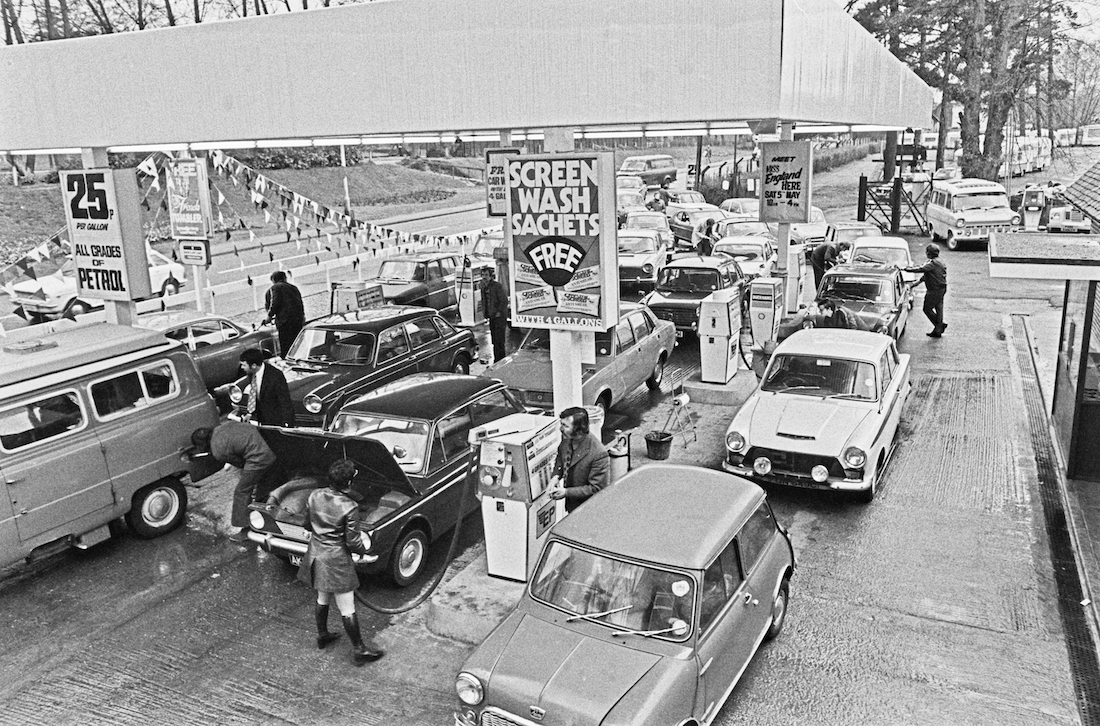
A new book about the oil embargo of 1973 lands in a not altogether dissimilar environment.
If I’d read the newspaper I tossed from my father’s gas-guzzling delivery truck in 1973, I’d have better understood the suddenly long lines inching toward filling stations in Kansas City, Kansas. At the time, as a 14-year-old, all I heard was talk of “Arab greed.”
Years later, however, in a college class focused on the evils of colonialism, I became convinced that the real culprit was Western oil companies. Why shouldn’t oil-rich countries take control of their own assets?
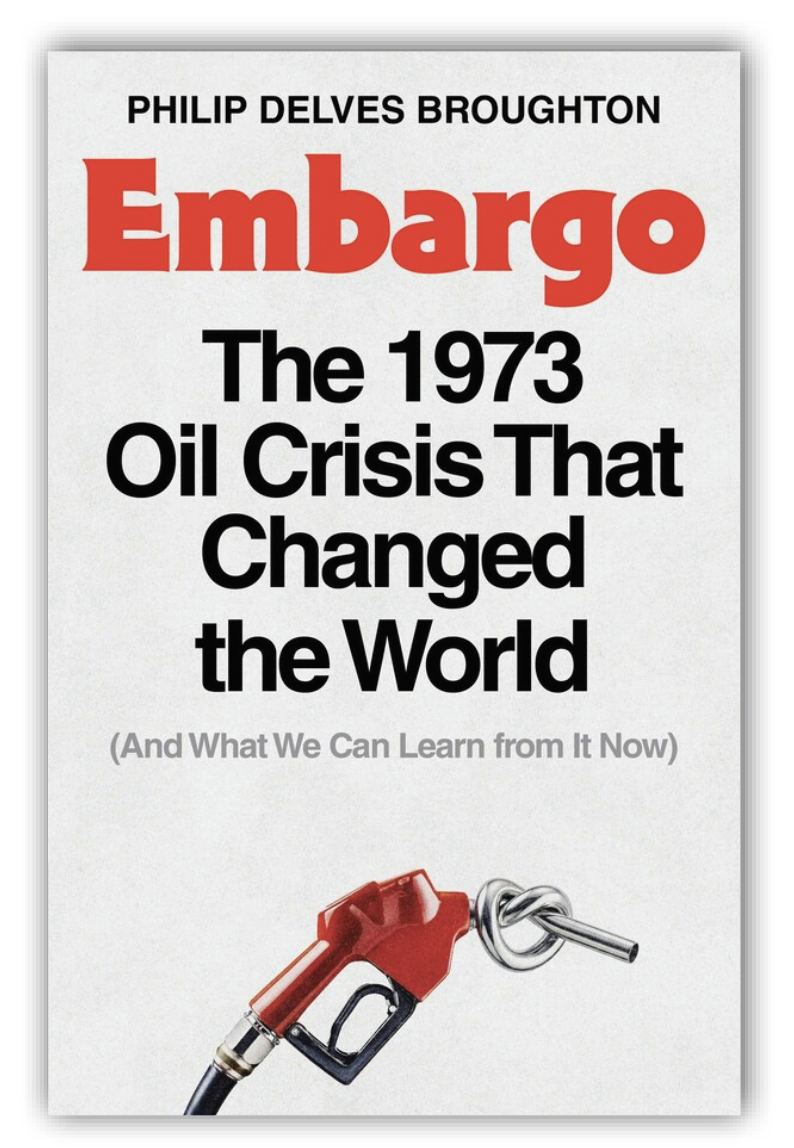
What I didn’t understand back then was that fluctuations in the price and availability of oil could not be explained in a single sentence or blamed on a single party. The topic is inherently complex, and made more so by politics and polarization. A true telling of the oil crisis of 1973 might disappoint anyone seeking a manifesto on behalf of Arabs, Israelis, Americans, Europeans, big oil or environmentalists, as evidenced by a new book called Embargo: The 1973 Oil Crisis That Changed the World (And What We Can Learn from It Now.)
The author is my former Brunswick colleague, Philip Delves Broughton, the author of four previous books, including How to Think Like An Entrepreneur, and What They Teach You At Harvard Business School. A British native and Oxford graduate, he began his career as a correspondent for The Daily Telegraph of London, where he served as a bureau chief in Paris and New York.
That the book emerges at a time when oil is back on the front page is a coincidence, Delves Broughton having started on the book three years ago. And though Embargo provides valuable context for current events, it also stands as an eye-opening history of 1973, one of the most consequential years in modern history. In September, Philip and I spoke about Embargo over coffee at his home near Gramercy Park in New York.

After writing a book for children, a memoir about Harvard Business School and a how-to treatise for salespeople, what turned your attention to oil?
Several years ago, I read a history of the commodities business called World For Sale, and I was struck by the section in it on ’73–’74. So much happened in a short period of time—the Yom Kippur War, the oil embargo, Watergate, the end of the Vietnam War, among other events. And what a cast of characters: Nixon, Henry Kissinger, the Shah of Iran, Saudi Arabia’s King Faisal, and a new generation of Arab leaders like Muammar Gaddafi and Saddam Hussein.And you had Arab countries seeking to take control of their own oil, which up to then had been found, extracted and exported by Western companies that paid these countries a royalty. These countries were starting to say, “We want more of this for ourselves,” and they were learning how to do it. Western countries and companies, meanwhile, were saying, “Not so fast.” Meanwhile, consumption of oil was skyrocketing in the West, particularly America, which at that time was importing about 17% of its oil from OPEC countries.
So the Arab countries knew they had leverage. After Egypt and Syria launched a surprise invasion of Israel on Yom Kippur, the holiest day on the Jewish calendar, the West was essentially issued an ultimatum. Don’t come to the aid of Israel if you want to keep importing oil. With Israel facing defeat, Nixon decided to send machine guns, tanks, fighter planes, whatever Israel needed. And that’s what triggered the Arab countries to start an embargo.
What part of that story do you think has been under-told?
From reading about the period, and from talking with people from Saudi Arabia in particular, it struck me that the story of the ’70s has been told very much from the US perspective and Western European perspective. And there have been fabulous histories written by Israeli historians of the Yom Kippur War and that period. But very little from the Arab perspective. What were they trying to accomplish here?
One of the main characters in my book is King Faisal of Saudi Arabia, who’s this extraordinary figure, born in 1906, just short of 30 years before the creation of Saudi Arabia by his father, Ibn Saud. King Faisal’s youth is that of a Bedouin, living in encampments with his parents, crossing the Arabian Peninsula on camels. He ends up being one of the world’s richest men. The modern world comes to him, seeking his country’s oil, yet in many ways he is a character from an earlier world. He sweeps through hotels in Geneva surrounded by Nubian bodyguards with swords in their belts in order to hold negotiations with oil executives from New Jersey. That contrast really struck me. He’s a big character, and an imperfect character; the words that come out of his mouth are anti-Semitic. This was a man who was trying to create a new state, trying to modernize his country at an extraordinary speed, trying to make the most of the asset under the sand that belongs to his people.
In 30 years from 1932 to the ’60s and ’70s, Saudi Arabia goes from overwhelmingly Bedouin, a nation of desert dwellers on camelback, to being one of the richest per capita countries in the world. It goes from being totally ignored to King Faisal receiving 21-gun salutes wherever he goes. Presidents want to meet with him. In Saudi Arabia, meanwhile, there are conservatives, radical Islamists who are very opposed to this pace of change. How does he manage that? In many ways, he’s a character in the center of the book.
What lessons might we take from 1973?
One would be, you mess around with oil supply at your peril. If the goal of the embargo was to push the US to lead negotiations between Israel and its neighbors, it had unintended effects. In Japan, for instance, the embargo accelerated a move away from heavy industry to light manufacturing. It’s much less fuel-intensive to make a Walkman than to make enormous industrial equipment. The same thing’s happening now. European EV sales are up almost 40% the first half of this year.
Another big lesson is that we need to stop thinking about these regions as being only about oil and energy. They’re crying out for development of all kinds at every level, and are we really helping them? Or are we only ever interested when it becomes an issue of energy?
In researching this, what was your biggest surprise?
I’d say the lack of understanding of the Arab interests. I’m not talking, by the way, about Western oil companies. Until Americans found oil in Saudi Arabia, that country earned most of its money from pilgrims to Mecca and Medina. Ibn Saud was grateful for the royalty his country received for something he hadn’t known was there.
I found the executives of these companies to be interesting characters. They tended to be engineers, very practical people. They were tough to negotiate with. But what I found is that generally they weren’t racist, imperialist, colonial. They were just tough negotiators.
It was in Washington that there was a serious lack of understanding. In Washington and across Europe, government never really understood what these regions wanted. Government still doesn’t. These regions want to develop diversified economies without the constant flaring of conflict. What they want is economic development, and respect.
Meet the authors
-
Partner
New York
Kevin joined Brunswick in early 2017 as Editor of the Brunswick Review. In 27 years at the Wall Street Journal, he covered politics in London,…
More from this issue
Crisis
Most read from this issue

The AI Disconnect
Bridge Over Troubled Water
You might also like
Intelligence Report
The un(Just) Transition