
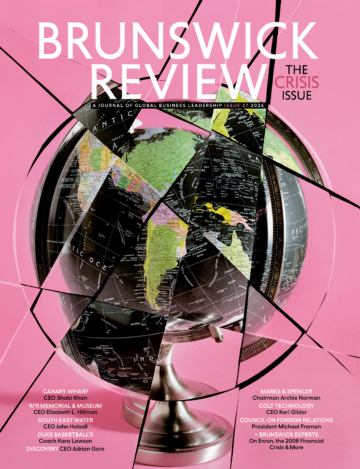
Legendary corporate turnaround leader Archie Norman, Chairman of Marks & Spencer, shares his views on how boards can prepare for a crisis.
Over the Easter weekend of 2025, Marks & Spencer, the British retail institution revered and relied on for well over a century, found itself in a very modern crisis: a ransomware attack. Critical systems were suddenly inaccessible and operations disrupted across its more than 1,000 stores. Online sales were halted.
All of this came as the retailer was working through a multi-year turnaround. The cyber incident put progress at risk and yet, just over a year on, the retailer has bounced back and continues to recover its position as a British icon.
Archie Norman is no stranger to a crisis. He gained recognition in 1986 for his assistance in helping Woolworth’s leadership fend off a hostile takeover from rival Dixons Stores Group. Since then he has specialized in turnaround stories, serving as Chairman of many well-known companies including Energis, Asda, Lazard and Australia’s Coles. Prior to joining M&S, his leadership at ITV contributed to “a near-fourfold rise in the broadcaster’s share price” according to the Financial Times. Aside from business, Norman also served as a Conservative Member of Parliament and played a leading role in restructuring and reviving the party in the aftermath of their heavy election defeat in 1997 to Tony Blair’s Labour Party. He remains the only person to have served simultaneously as a Member of Parliament and chairman of a FTSE 100 company.
Archie Norman sat down with Brunswick Partners Bella von Bohlen and Owenna Griffiths to discuss his advice for leaders facing a crisis.
When the story of the cyber breach became public, your critical stakeholders—employees, customers, shareholders—really rallied behind you in a way that I think many of our clients would be envious of. How were you able to build that trust before crisis struck?
Everyone wants to call themselves a trusted brand or a trusted company. But real trust is hard to build. It accumulates over years; you can’t just switch it on like a light bulb. Where companies get into difficulty is when they confuse trust with approval.
A lot of boards and chief executives are highly reputationally sensitive. They mistake perceived success, or continuous approval, for trust. And because the media is now so relentless, they become led by what they say publicly, even when they might want to use a different dialogue with employees and other stakeholders. Chief executives don’t want any ripples on the surface of their achievement. That pushes companies towards a Panglossian view of the world, which is fine until something goes wrong and people say, “Where’s my trust?”
Trust is different from approval. It’s about predictability; consistently doing what you say you’ll do, recognizing your weaknesses and being seen to act on them.
Too much corporate communication still reads like PR. It is self-promoting, and therefore incapable of acknowledging difficulty. But business is all about difficulty; we create value by overcoming it. If you never acknowledge the difficulty, it is hard to get credit for overcoming it; and when you do hit a bump in the road, it comes as an uncomfortable surprise.
“Business is all about difficulty; we create value by overcoming it.”
So our hallmark here at M&S, and the way I’ve always liked to work, is to start with the unvarnished truth. We are straight-talking. We don’t represent M&S as anything other than what it is, not even to our customers. We acknowledge there is work to do. Even today, our supply chain is well behind the market; that is an opportunity to upgrade. We need to invest more in our systems. We inherited a lot of stores built long ago, so we have to tackle that as well.
The value business leaders deliver isn’t running the perfect business. Any old fool can run a perfect
business. The value is in improving the imperfections.
That openness can feel counter-intuitive. You will always have advisors telling you to be more guarded. But if you want to maintain trust, people have to see that openness. Over time, they come to know you as straight-talking. They know they can rely on what you tell them. And hopefully that leads to a place where you are consistently under-promising and over-delivering.
How should leaders handle the initial announcement of a crisis? You have said before that employees come first.
All of your messages have to be synchronous.
For store colleagues, you obviously tune your communications into their life in the stores. They’re on the front line and hearing from customers much more than we are. When your shelves aren’t full or something, that’s making customers’ lives difficult. They’re going to have to explain it. So you give them what they need to say and give them confidence that you’re backing them, that you understand what they’re going through. You want them on your side. If they are, you’re halfway there.
So communicate with your own colleagues first, your customers second, then shareholders and media. And with the media, when you’ve got a crisis, be transparent but measured, don’t make it more of a story than it already is. The media wants you to go on air; they want more and more of it. But sometimes you have to take the oxygen out of the story.
The best way to do that is to brief the editors, outline the information you can share and put limits on the coverage they can expect. You don’t want them to worry that they’re missing something. Otherwise, the editors will tell the reporters, “Go find out everything you can about this.” So you want to get ahead of that. Make an effort to have them reasonably informed, but don’t go into details that you can’t respond to. It won’t be enough for everyone, but it will help.

In the past you have described COVID as having been an exhilarating time and you developed a mantra within M&S, “never the same again.” Since all businesses will have to deal with a crisis of one sort or another sooner or later, what are your tips for “not wasting a good crisis”?
We shouldn’t pretend these things are good, of course. A crisis can destroy net value, destroy people too. People burn out. So we shouldn’t sound too exhilarated.
But this was something Michael Barber talked about in his book Instruction to Deliver about his time in Tony Blair’s administration. They learned that government responds best when you have a crisis. All of a sudden, the departmental barriers drop away, and you can make things happen. That’s normal for organizations. The budgetary constraints, the protocols, the hierarchical stuff—in a crisis it just drops away and the change-makers, the activists, come to the fore. It brings out the best in some people—not everyone, but people who tend to be very good in a crisis.
You also find out a lot about people. If you come out of it successfully, there’s a bonding effect. You’ve been in the trenches together. You had to stay up all night. You worked together and you got an outcome.
You recently said that no one is ever prepared for a crisis, or as you put it, the first whiff of gunpowder. If a chief executive or chair is reading this interview and has just smelled gunpowder, what would your advice to them be?
When it looks like a crisis is emerging, go to the end point and work back from there. If you start planning for the length of the crisis, whether it’s six months, or 12 months, you’ll start to do the right things. If it turns out that it was just a bump in the road, not the crisis you thought it was, nobody will remember that you ever over-responded.
We all like optimists but hope can be your enemy. Hope is, “It’ll be all right next week” or “It’ll go away.” Hope is, “Somebody will find a solution.” That has two effects.
Firstly, it means you fail to plan for the real depth of the problem and to be radical about it. And secondly, it leads to serial disappointment. As the crisis doesn’t resolve, people will continue to be disappointed, the morale drops and you start to lose people.
Admiral James Stockdale was a US vice admiral who was held and tortured in a North Vietnamese prison for over seven years. He’s written about the experience. One of the points he makes is that the optimists, the boys who thought they were going to be released soon or next year, never made it. The people who said, “We’re probably here for six years. We’re going to have to work our way through it. We’ll get out eventually, but we’re here for a long time”—they were the people who survived. He actually said that when they got a delegation from the US, a cleric would come to see them, and that led to depression. It raised hopes and then they were dashed. They call it the Stockdale Paradox.
It’s better to say, “Let’s assume it is going to be a long, hard road. Let’s plan for that and be resolute about it.” It’s not that you don’t have confidence, and it is important to be unswerving in your conviction: “We’re going to get through it.” But then you map the long journey.
“We all like optimists but hope can be your enemy.”
People will follow you through any hardship. They’ll endure any amount of difficulty and stress, as long as they believe you are going to lead them to the sunny uplands. But what’s really demoralizing is saying, “It’s going to be all right next week,” when it just isn’t. You want to offer a sense of mission and purpose. “We’re on a crusade. It’s going to be a 12-month crusade.” You’re relentlessly realistic. That prepares you to do all the right things.
The first thing is you form your team. When you’re in a crisis, you have to acknowledge that most of us haven’t been through whatever crisis it is. So, call up the A team. Who in the world has handled this? Get the best people in the world.
Then organize your board and your executive team so they are undistracted and focused. When there is a crisis, everyone wants to be involved in everything. One of the things you’ll find very quickly is that you’ve got enormous meetings, huge numbers of people meeting for hours a day. You can’t do it that way. You can’t get anything done.
Break it down to your inner team—a small team who are command and control. Divide the work up into workstreams. Then your main crisis management team only meets once a week or whatever to coordinate. If you organize for that right at the beginning like that, you’ll get ahead of things, otherwise you’ll find yourself overwhelmed after 10 days.
In a crisis, how can the chair best support the company and the chief executive?
My view of the role of the chairman is, I’m here to make M&S win. I want the chief executive to win. My role is between half a day a week and seven days a week, depending on what happens. As chairman you’ve got to be prepared for that. If a crisis happens, you’re on.
It doesn’t mean you’re stepping into the chief executive’s shoes. They are running the show. But you lift things off them to enable them to handle the business and steer the ship through the crisis. And you need to bring the board with you, to make sure they have stewardship but create the space for the team to execute.
A healthy chief executive relationship is one where you have a high level of transparency, of trust. You can have conversations that you wouldn’t have necessarily in normal executive life where it would be OK to say, “I think we screwed up on this.”
Boards in a crisis have a very high appetite for being informed. But equally, they can’t be in the room for all the decisions. So it is the chairman’s role to arrange a highly active briefings schedule. The chief executive is flat out managing his team. You want to declutter his diary. The chairman can help with that, lift stuff off the chief executive, deal with stakeholders. Just being there and not overshadowing. That’s important.
There are times when the chairman can also be therapy. Somebody turns up in a meeting and they’re looking white as a sheet. You think, “Crikey, we need to get them home.”
Be the person who looks after people.
Meet the authors
-

Partner
London
Bella is a Partner in Brunswick’s global Litigation and Disputes practice, as well as the firms’ broader Cross-Practice Crisis Group. -

Partner
London
Owenna advises organisations and senior leaders on media, communications and reputation, drawing on extensive experience in broadcast journalism and editorial leadership.
More from this issue
Crisis
Most read from this issue


You might also like

Directors Learn Their ESGs

Creating the Future at Canary Wharf