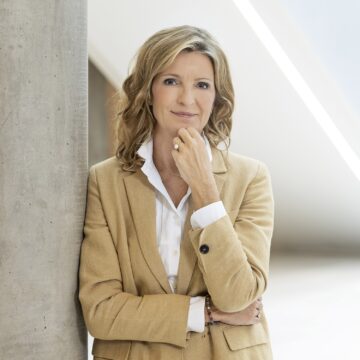

CEO Shobi Khan on the continuous, deliberate process—amid a pandemic and the rise of remote work—of turning 130 acres of commercial London real estate into a community of homes, schools, parks and entertainment options galore.
Sea Lanes, Canary Wharf’s 50-meter open-water swimming pool, opened at Eden Dock in 2026.
When Shobi Khan took over as CEO of Canary Wharf Group in October 2019, he inherited Europe’s largest urban regeneration project: a 130-acre district on London’s eastern waterfront, built over three decades on old docklands. For most Londoners, Canary Wharf had been synonymous with two things: offices and finance. People commuted to Canary Wharf, worked, then left. Five months into Khan’s tenure, the pandemic seemingly imperiled the entire model.
Yet Canary Wharf had been laying the groundwork for its own transformation since 2015, when it broke ground on its first residential towers. The pandemic proved that bet prescient.
Today, roughly 5,000 people call Canary Wharf home, the majority of whom do not work there. The commercial customer base that was once largely financial services now also spans technology startups, science companies, education, government departments and professional services firms.
Canary Wharf also features apartments and hotels, more than 90 restaurants, a 1,200-seat theater, an Olympic-sized open-water swimming pool and 16 acres of green space. Annual footfall surged from roughly 50 million before the pandemic to 76 million last year, with 80 million expected this year.
Khan came to London after spending three decades working in American real estate, where he held senior roles at Equity Office Properties, GGP and Bentall Kennedy. An American who recently obtained UK citizenship, he spoke with Brunswick Partners Nina Coad and Kevin Helliker about what it takes to turn a commercial district into a community, and why the transformation is far from finished.
You took on this role just before the pandemic. What was that crisis like from your seat?
It was a combination of external pressures. The pandemic accelerated working from home, companies questioned how much space they needed, interest rates increased, real estate values fell and inflation increased significantly.
But the bigger issue was perception or should I say misperception. For 25 plus years, many people saw Canary Wharf as somewhere you came to work and then left. Some assume we transformed into a mixed-use district because of COVID, but the evolution was already underway. We started residential construction in 2015, those homes came online in 2020 and 2021, and the Elizabeth line opened in 2022. Success was always going to come. The question was when, not if.

How would you describe what Canary Wharf has become?
It has become a city within a city. We have evolved from being seen mainly as an office district to being a genuine mixed-use destination, with more than 90 restaurants, hotels, a theater, open-water swimming, padel, kayaking, 16 acres of parks, more than five kilometers of boardwalks and over 100 pieces of public art.
The customer base has changed too. Financial services remain important, but we now have government, science, technology, education and professional services firms alongside a growing residential community of approximately 5,000 people on the estate and 150,000 within a mile radius.
Is there anything comparable to this globally?
There are comparisons, such as La Défense, Hudson Yards and Rockefeller Center, but the scale is different. At 130 acres, Canary Wharf is multiples larger. Our greatest advantage is managing this place and being surrounded by water, which was originally home to the docks, hence the name Canary Wharf.
We also learn constantly from other places. The Chicago Riverwalk influenced Eden Dock, Copenhagen shaped our thinking about canals, Japanese city centers offer lessons in pedestrian design, and the Miami Design District and Bryant Park demonstrate the power of art and programming.
In having 130 acres we can experiment. We started a winter lights program 10 years ago that’s become an annual tradition in January. We keep trying things, seeing what works, and evolving.
Delegations now visit regularly from China, the Middle East, Australia. There’s rarely a week when someone doesn’t ask to come for a tour. They’re trying to build developments at this kind of scale, and they want to see the blueprint.
Are residents mainly choosing Canary Wharf because they work nearby?
Only about 30% of residents also work here, which surprised us. The majority are 25 to 40, but the community is broader than that, with students, young professionals and empty nesters.
A key difference is that we develop rental units, not for sale, modeled on the US multifamily approach. That has helped create a neighborhood, not just a residential product.
“Our philosophy is simple: Engage with the water, do not turn your back on it.”
You’ve talked about Canary Wharf’s proposition as a “three-legged stool.” What does that mean?
I think of it as the Canary Wharf Ecosystem. It has three parts: best-in-class buildings, the 130-acre estate, and the community that brings it all to life.
First, we design and deliver the right space for each office customer, retailer or resident, from layout and amenities to sustainability requirements. Second, we offer the wider place: parks, water, restaurants, hotels, event space and public art. We assist companies in numerous ways—finding event space, organizing team activities, finding accommodations for project teams or colleagues, hosting holiday parties, et cetera. Third, we build community, through networks such as Wharf Connects, a young professionals network, our Annual 5K run, dragon boat races, charitable partnerships and our app, which now has more than 150,000 people actively engaged each week.
That community piece feels like a response to the isolation of modern life.
I think the pandemic reminded people how much they value being together. Our footfall is now consistent seven days a week, and on Fridays, it is only about 15% below the rest of the working week. In many other districts, the drop is more than 50%.
People come here to work, but also to live, shop, eat, swim, see a show and spend time with other people. And the results speak for themselves—retail sales are the highest ever, more than 40% higher than 2019. My wife says it feels like Christmas every day because of the energy of the place.
How do you go about attracting major tenants in a competitive market?
We do not want to be just a landlord. We want to be a partner. We have a dedicated customer experience team focused on understanding what customers need for their people, their clients and their business. We help them deliver it, so they can be more productive and focus on their core business.
The momentum has been building. Revolut, Europe’s most valuable private company, was founded in 2015 at Canary Wharf. It recently expanded into a new HQ here. HSBC decided to stay when it was considering leaving. Then Zopa, a unicorn fintech, moved here. Then Visa announced it was relocating its headquarters from Paddington. JPMorgan committed to building a new headquarters, potentially the largest office building in London. Barclays acquired their building, PwC is relocating from Charing Cross. Once we get people on site, they usually have an “aha” moment. They see what Canary Wharf has become and want to be part of the community.


You’ve invested heavily in the Eden Dock waterfront, which generates no income. How do you justify that to investors?
Eden Dock was complex and took several years. It sits on TfL land, uses Canal & River Trust water, required planning permission and involved significant investment. But we saw it as both a public benefit and a long-term value creator.
Three years ago, it was underused. Today people gather there at lunchtime, we have buskers on Fridays, and Sea Lanes, our 50-meter swimming pool, opened with more than 30,000 visitors in its first month. Our philosophy is simple: Engage with the water, do not turn your back on it. Having Brookfield and QIA as shareholders is a tremendous benefit. They’re astute, long-term-minded investors who understand how to create value over time.
Before London, you held senior roles at Equity Office, GGP and Bentall Kennedy. What did those experiences teach you?
Each role prepared me for a different part of Canary Wharf. Equity Office was primarily an office company, Bentall Kennedy invested in many sectors including residential and hospitality, and GGP was primarily retail. Canary Wharf brings all of these sectors together.
The biggest lesson, though, was culture. In a complex business with development, construction, office, residential, retail, property management, an innovation incubator and 1,300 employees, everyone has to collaborate under one brand. Engagement and empowerment are not one-off exercises. They are continuous.
How do you do that practically?
We create regular moments of connection: quarterly town halls, summer gatherings, affinity groups, running clubs and sporting clubs. We want people to connect around shared interests, not just job titles.
Most importantly, we have a clear purpose: bringing people together to enhance their lives, now and in the future. That applies to the office customer, the resident and the visitor, and it guides how we make decisions.

You studied molecular biology at Berkeley before moving into business. Has that scientific background been useful in real estate?
Yes. Science teaches you to break down problems, look at evidence and work through complexity. That mindset is very useful in real estate.
But technical analysis is only part of leadership. Emotional intelligence matters just as much, if not more, especially when you are bringing people with different priorities together around one direction.
After serving on the board of the Chicago Public Library Foundation, you now sit on the board of the British Library. In a digital world, what’s the future of a physical library?
My love of libraries started when I was a kid going after school. I think libraries are facing the same question that retail and offices faced: if everything can be digital, why gather physically?
The answer is that people still want to be together. They want to touch history, see original documents and experience knowledge in a place. The British Library is an extraordinary institution, and its collections are irreplaceable.
You were recently on CNBC talking about London’s prospects. How confident are you in the UK’s economic future?
The UK has extraordinary strengths: world-class universities, ambitious graduates, the rule of law, a time zone between East and West, and London, which remains one of the great global cities.
The challenge for any government is how to turn those strengths into growth, by giving businesses and individuals the confidence to invest. Growth is what creates opportunity for everyone.
“You cannot put an office building next to retail and
residential and call it mixed use. You have to create an
environment where people want to spend time.”
You’ve written that growth at Canary Wharf requires a “sense of place.” What do you mean by that?
You cannot put an office building next to retail and residential and call it mixed use. You have to create an environment where people want to spend time, not just occupy space.
That is what we try to do at Canary Wharf, and it is relevant to growth more broadly. If you want people and businesses to invest, you need places that give them a reason to belong.
What does growth look like from here?
We still have significant capacity, with another five to seven million square feet of potential development on top of what already exists: roughly 17 million square feet of office, 1.2 million square feet of retail, approximately 4,600 residential units and four hotels.
We also have a growing science and technology pipeline. Revolut started here and became a major success, and there are others such as AviadoBio, Myricx, Fuse Energy and Revolut spinoffs. We can support a company from one desk to a million square feet, while providing the infrastructure, community and environment they need to grow.
What qualities have mattered most in leading through all of this?
Grit and resilience. Things will not always go your way, so you have to absorb setbacks, find another route and come back stronger.
I come back to what I said when we opened Eden Dock in 2024: I believe the best way to predict the future is to create it. If you want to go fast, go alone. If you want to go far, go together. This is a team sport, and nothing meaningful gets done without a great team and I am fortunate to work alongside 1,300 dedicated and engaged colleagues.
Meet the authors
-

-
Partner
New York
Kevin joined Brunswick in early 2017 as Editor of the Brunswick Review. In 27 years at the Wall Street Journal, he covered politics in London,…
You might also like
Barista in Chief

Health & Nature: A Critical Intersection