Brunswick research reveals a 40-point gap between how leaders and employees experience AI at work and highlights an unexpected workforce segment that could help close it.
Nearly six in 10 US employees use AI at work at least a few times a week. Only 8% reject it outright. If you are measuring adoption, the numbers look excellent.
But adoption is a poor proxy for transformation. It tells you whether people are using a tool, but not whether they understand where their organization is going, what role they will play in getting there or whether the future being described has a place for them in it. Brunswick research among more than 2,000 US employees and 65 senior leaders—a roughly even split between senior management and executive leadership at companies with 250 or more employees—reveals a sizable disconnect between workers and leaders on all of these fronts.
Ninety-two percent of leaders, for instance, believe AI will create new opportunities, a belief only 53% of employees share. Ninety-five percent of leaders say their company communicates openly about AI’s benefits, while only 57% of employees feel the same. Across measures of company communication and AI strategy, leaders consistently feel their organizations are significantly further along than employees do.
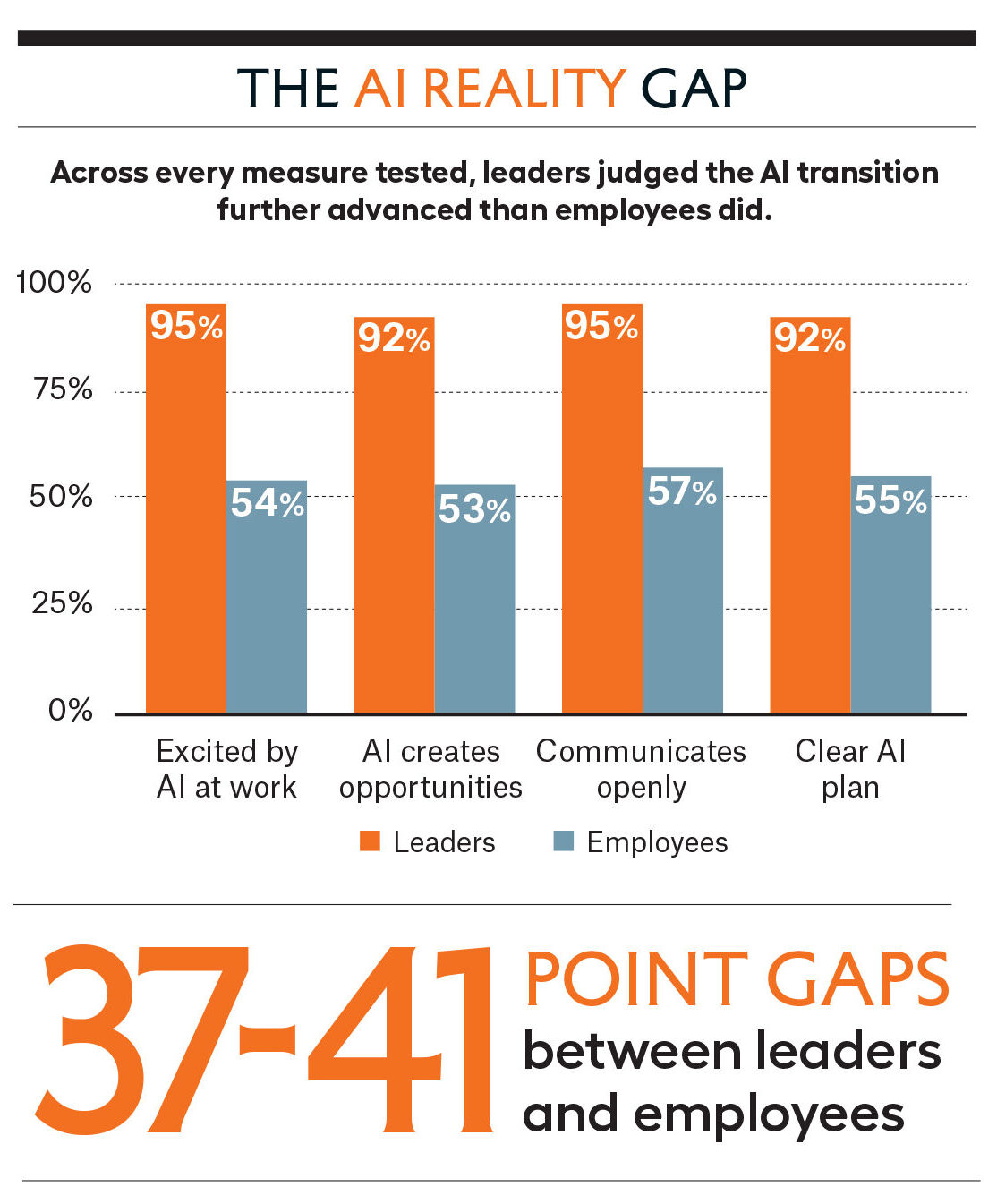
Leaders who believe their workforce is aligned have no reason to change course, nor can they fix a problem they do not believe exists. Our research highlights a number of meaningful gaps between AI adoption and AI transformation, and points to an unexpected group that could help close it.
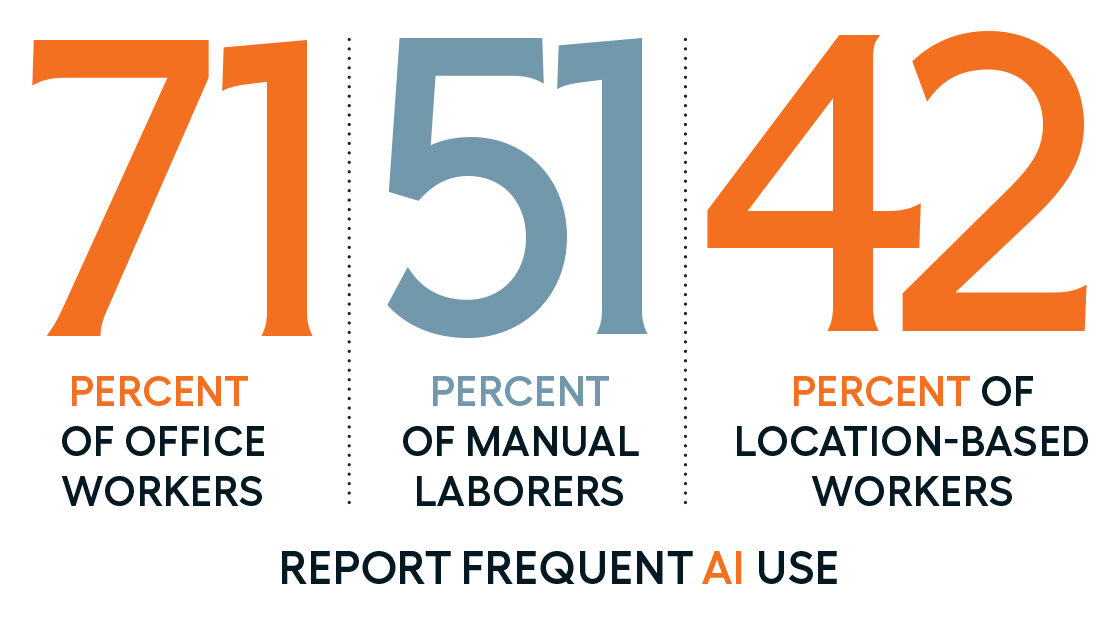
AI is reaching nearly every kind of work: 71% of office workers, 51% of manual laborers and 42% of location-based workers report frequent AI use. What varies sharply is how workers feel about it.
Two responses from our research capture the distance. One leader described a future of “opportunities in strategy, innovation and leadership, focused on integrating AI into business solutions.” An office-based employee, on the other hand, told us: “I believe that AI will eventually eliminate my career and thousands of people like me will be out of jobs.”
Leaders are not wrong to be enthusiastic. They are responding to real signals: investor expectations, competitive pressure, early productivity gains. But enthusiasm, once it becomes the basis for strategy, has a way of filtering out inconvenient data. When your AI roadmap depends on workforce readiness, there is a natural gravitational pull toward believing your workforce is ready, rather than listening closely enough to learn otherwise.
Meet the Motivated Middle
Most people assume digital natives (i.e. younger employees) would be leading the charge on AI. Our research found it’s mid-career employees.
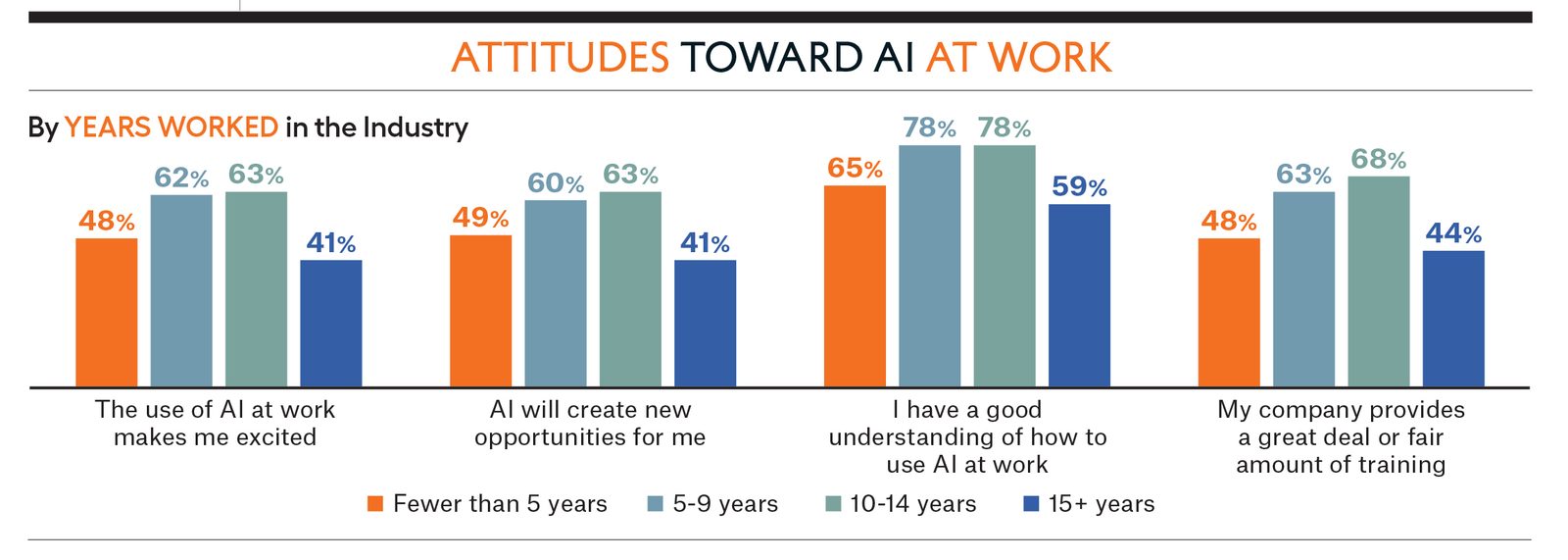
Employees with five to 14 years of industry experience consistently reported the highest levels of AI use, excitement, confidence and perceived training support. Sixty-seven percent use AI frequently at work, compared with 52% of those with fewer than five years of experience and 48% of those with 15 years or more. On understanding how to use AI at work, mid-career employees hit 78%, against 65% for early-career workers.
AI fluency, it turns out, may depend less on digital nativeness than on the combination of technological comfort and accumulated professional judgment. Mid-career employees are experienced enough to know where judgment matters and where shortcuts are possible, while still open to changing how work gets done. Early-career employees report lower confidence and less enthusiasm than their mid-career colleagues. They have the technical fluency but lack the professional context to know where to apply it. Later-career employees, meanwhile, bring deep expertise but report lower excitement and perceived support. They know the work better than anyone. The challenge is making AI’s relevance to that work tangible.
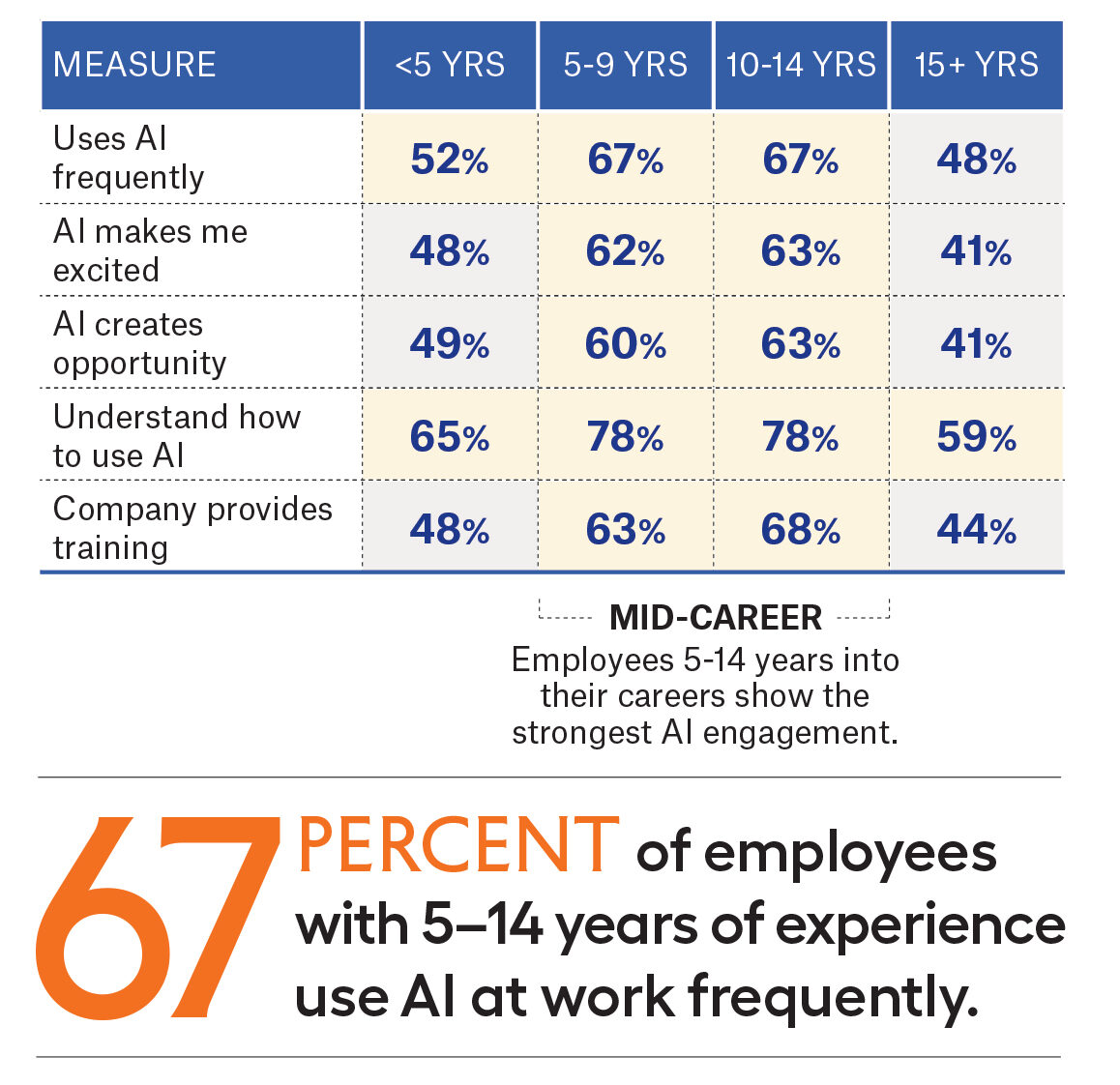
This “motivated middle” sits close enough to the work to identify credible use cases, test new approaches, mentor colleagues and translate enterprise ambition into daily practice.
The real opportunity is what happens when these employees move beyond advocacy into ownership: choosing the tools, refining workflows, coaching people around them. An early-career employee is more likely to experiment with AI when a trusted colleague five years ahead of them is doing the same. A later-career employee is more likely to engage when someone who understands their work can show them a specific, practical application.
But the motivated middle cannot carry this alone. Employees across career stages are telling leaders what they need, and the picture is consistent. When we asked what employees most wanted to hear from their companies about AI, nearly half pointed to gaps in communication about policies or plans. They asked for plain-language explanations of how AI could make everyday work more efficient. They wanted clear policies, ethical guidelines, practical applications, training and a view of what comes next.
Give Employees a Place in the Story
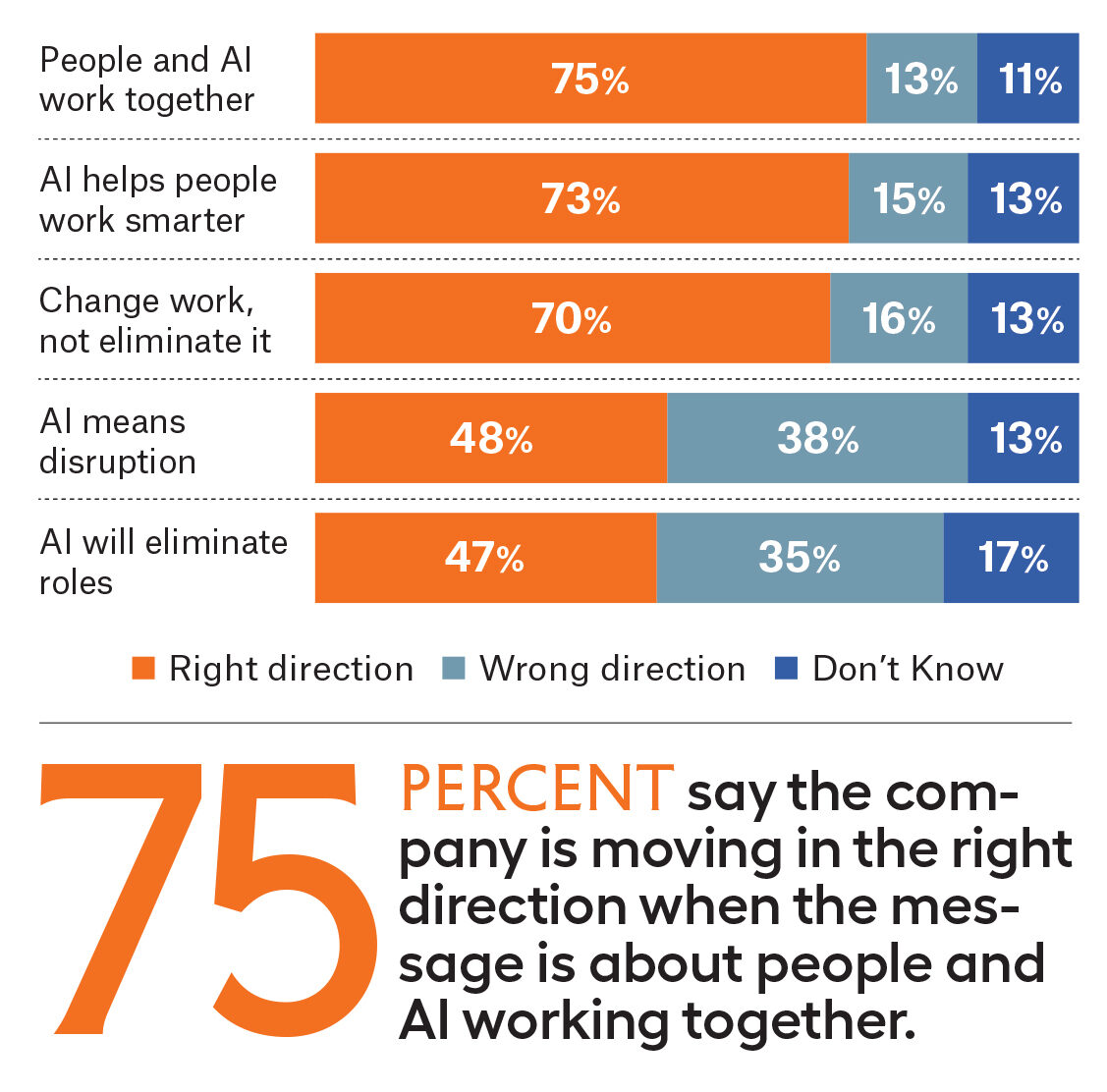
We presented five messages about AI and asked whether each would make employees feel their company was heading in the right or wrong direction. The best-performing message framed AI as a partnership: humans bringing empathy, ethics and creativity, AI bringing speed and scale. Seventy-five percent said it would make them feel their company was on the right track. Messages that led with disruption and job elimination landed below 50%.
The difference came down to whether employees could see a role for themselves in the story being told, or whether they were simply being warned about what was coming. Employees need to see a credible place for themselves in whatever future is being described, including an honest account of what remains uncertain. When leaders do not yet have every answer, they should say so. Employees do not expect leaders to avoid difficult truths. They want to know where they fit within them. A narrative grounded in honesty, participation and practical steps invites people to shape—not merely prepare for—what comes next.
The first phase of enterprise AI was dominated by a question: What can this technology do? The next will be defined by a different one: What can our people do with it?
How to Lead the Next Phase of AI
- Don’t mistake usage for transformation. Measure whether employees understand where the organization is going and their role in getting there, not simply whether they are using AI tools.
- Close the reality gap. Understand where leadership ambition and employee experience diverge. Measure clarity, confidence and readiness across the workforce rather than assuming communication delivered equals clarity received.
- Mobilize the motivated middle. Involve mid-career employees as co-creators, testers, peer mentors and translators of AI in real work—not simply as messengers for leadership.
- Differentiate the journey. Early-career, mid-career and long-tenured employees are experiencing AI differently. Each group needs guidance and training designed for where they are, not a single rollout calibrated to the most enthusiastic adopters.
- Be specific and transparent. Give employees practical policies, examples, training and a clear view of what is coming. When the path forward is uncertain, say so. Tell employees where their experience and judgment can shape what happens next.
Meet the authors
-

Partner
Chicago
Monica is a trusted advisor to Board and C-Suite executives during moments of change and transformation. -

Director, Insight
New York
Kaylan is on the Insight team where she uses opinion research and media analytics to inform corporate communications strategies. -

Account Director
Dallas
Elizabeth is an Account Director and part of the firm's Insight team. She is based in Dallas.
You might also like

Moyo on AI

Engine of Progress