Gulf management responds to crisis with speed, agility and innovation.
Jebel Ali Port opened in February 1979, the same month the revolution in Iran reshaped the region. From its first day, Dubai’s great gateway has operated in the shadow of the same question: What if the narrow waterway that carries the Gulf’s prosperity one day closed?
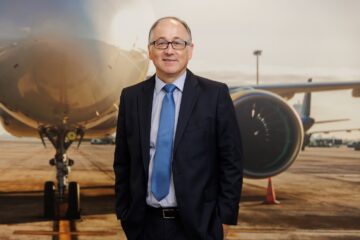
“We have been preparing for this kind of disruption since 1979,” says Daniel van Otterdijk, Group Chief Communications Officer of DP World, the global ports operator and owner of Jebel Ali, the ninth-largest container port in the world.
For nearly half a century, the preparation was never fully tested. Then, on Saturday, February 28 this year, two days after the port’s 47th anniversary, it was.
When the UAE was attacked by Iran, and supply chain disruption hit the Strait of Hormuz, the businesses that rely so heavily on the waterway to move, produce and supply the country’s essential imports and exports were tested to their limits. This is in a country that imports around nine out of 10 of the meals on its tables.
The experiences of some of the UAE’s largest businesses show that while extensive plans were in place for such an eventuality, much had to change in real time given the enormity of the crisis. From major energy companies like ADNOC to the huge community of small and medium-sized enterprises, management teams had to move with unprecedented speed and agility, developing solutions in real time and forging new stakeholder relationships at all levels to resolve issues and relieve supply bottlenecks.
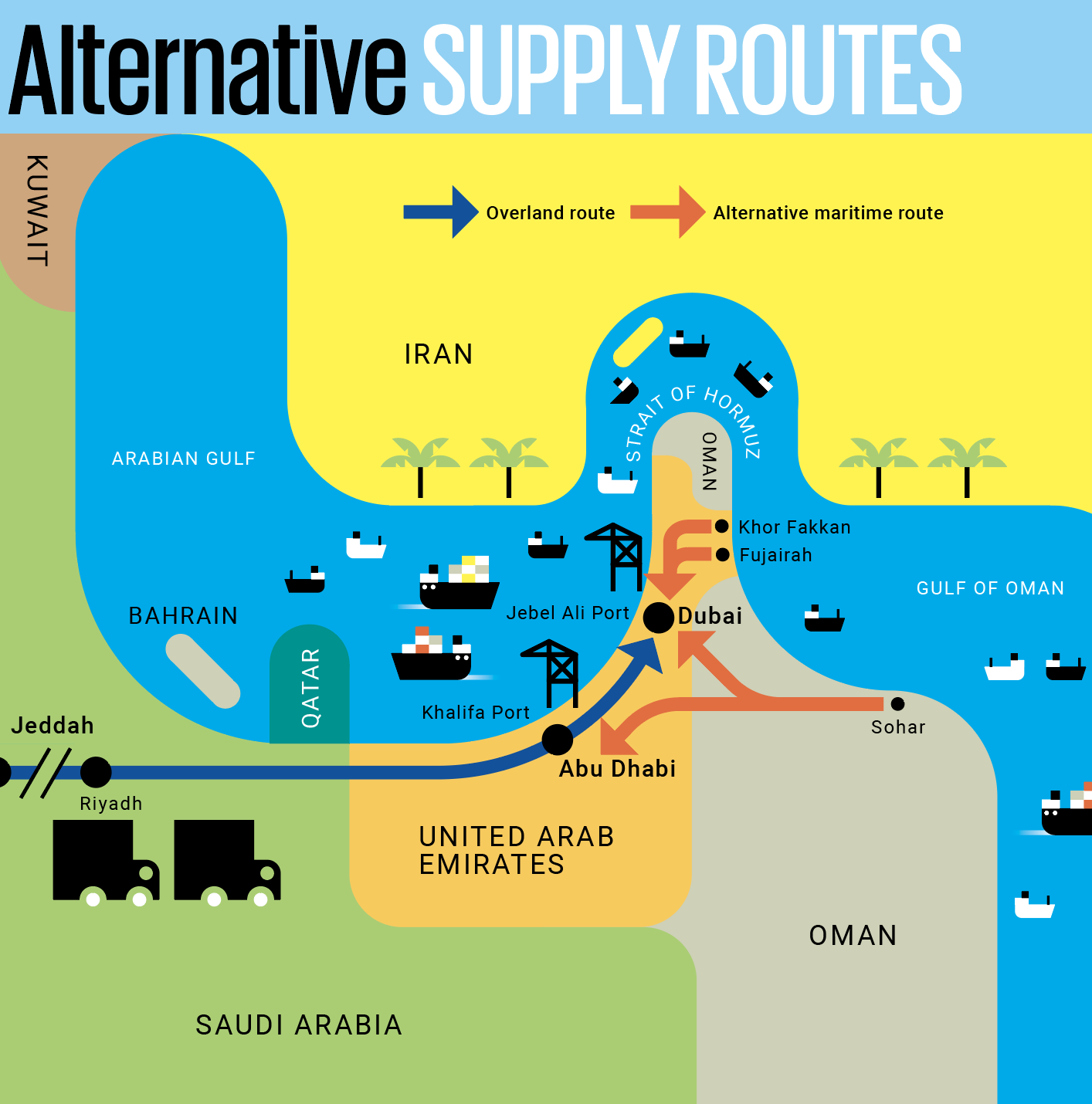
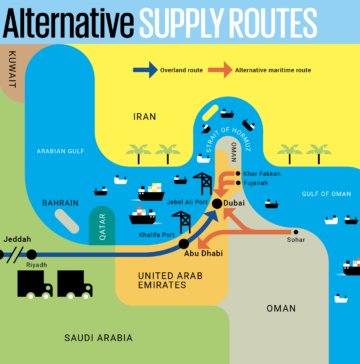
At DP World, decades of scenario planning meant that on Day One the group already had a framework for action. But with the waterway closed, Jebel Ali was operating at a fraction of its normal capacity. DP World’s opening move was a question put to customers: “What do you need?” Within days, it was looking to ports outside the strait, including the small Fujairah port on the Indian Ocean, as well as routes through Oman and across the wider region. Its global network allowed cargo, and in some cases customer activity, to move elsewhere.
DP World also built up substantial trucking capacity of its own to keep cargo moving across the peninsula. That challenge alone was enormous.
“You can’t just go to a shop and say, can I have 700 trucks, please,” he says. What began as an emergency logistics response has created a new line of business, with van Otterdijk saying the added capacity now generates revenues that helped offset part of Jebel Ali’s losses.
Emirates Global Aluminium (EGA), which produces and supplies roughly 4% of the world’s aluminum, started increasing inventories in July 2025 just after the 12-day war. They increased inventories of strategic materials such as bauxite and alumina by an average of 10 days, creating room to respond if established supply routes were ever disrupted.
While doing this and continuing to honor contracts, EGA also had to keep its smelters going. Alumina, the core ingredient of aluminum, normally travels from a nearby port, the Khalifa Port, by dedicated conveyor to the smelter. Now forced to arrive in the Gulf of Oman’s east coast ports, it had to travel by road. Poured into ordinary tipper trucks, the fine white granular powder drained through the gaps, so crews sealed them with tape, then foam, then a reusable rubber seal, learning by trial and error and shaving valuable time off every loading.
“In the beginning, it was going quite slowly,” Simon Storesund, EGA’s Chief Supply Chain Officer, says. “But as you try, you learn, and you improve.”
Similarly, when hundreds of trucks backed up at the border, EGA worked with port and customs authorities on both sides to simplify procedures and dramatically reduce journey times, with support from Oman that Storesund calls “just amazing.”
“Whatever geopolitical activities occur, we will always adapt and find ways to deal with them. Our global footprint gives us options for our customers.”
Daniel van Otterdijk, Group Chief Communications Officer, DP World
For Spinneys, one of the UAE’s largest supermarket chains and franchise partner to the UK’s Waitrose brand, preparation was muscle memory, drilled through COVID, the Suez blockage and the Red Sea disruption. Even so, it was all hands on deck as panic buying was immediately evident.
That first day, Spinneys recorded its largest sales day in history. The CEO was packing bags at the tills. “No need for hand sanitizer,” recalls Tom Harvey, Spinneys Dubai, Commercial General Manager. “But batteries and candles—we’ve never sold so many.”
Spinneys, with its strong network of distributors, worked quickly to stock shelves and reassure customers. Certain priorities were made, but shelves remained full. Of course, inflation was a major concern, but Spinneys took an active decision to keep the prices of more than 500 essential goods unchanged. “The sole focus, to start with, was to get products on the shelves and not worry about what we’re actually paying for them,” Harvey says.
Localization helped too. The crisis struck during the UAE’s growing season, and locally grown fresh food, alongside output from Spinneys’ seven factories in the country, helped keep shelves full and prices steadier.
As always, relationships were key. Retailers shared routes and information with competitors. “It’s not a time to try and gain competitive advantage,” Harvey says. “We are all working as one supply chain, as one industry, to make sure that everybody has got food on the shelves.”
Government became part of the operating system too, reassuring customers through the media and representatives visiting supermarkets. Spinneys, already providing regular stock updates before the crisis, began speaking several times a day with senior government officials, who were accessible “at a moment’s notice.” Air freight became a major channel too. “Less than 24 hours from anywhere in the world to be on our shelves,” as Harvey puts it.
The crisis is far from over. But the UAE has stopped waiting for it to end. By mid-year, the country’s non-oil foreign trade was up 13% on a year earlier. Non-oil exports had also reached an all-time high, even after six months of the deepest disruption.
DP World is now developing major container capacity at Fujairah, beyond the strait, as a permanent supplement to Jebel Ali.
“Whatever geopolitical activities occur, we will always adapt and find ways to deal with them,” van Otterdijk says. “Our global footprint gives us options for our customers.”
Spinneys arrived at a similar conclusion on a smaller scale. When sea routes were unreliable and air freight expensive, it tested an overland route from the UK and Europe. The pathway was not cheap enough to become the default once sea freight stabilized, but it worked.
“We now know that we’ve got a third option available,” Harvey says. “If there comes a disruption to sea again, we know we’ve got something that we can deploy.”
And EGA is renting warehouses beyond its plants to hold deeper buffers. “We are not relaxed, but now things are working well,” Storesund says.
That might be the clearest indication of what the crisis changed: A workaround became an option, an emergency investment became a business, a contingency plan became infrastructure. Beneath it all sits the one asset that cannot be acquired in an emergency: relationships.
“It’s not something you establish over one or two years,” Storesund says of the relationships that held through the disruption. “It’s something you establish over 20 years.”
That people dimension ran throughout. With parts of Jebel Ali unusually quiet, DP World’s leadership was clear it would stand by its team through the uncertainty, ready for when traffic returns.
No business can predict the next disruption precisely. The useful question is whether it has built the options, the relationships and the speed to respond.
“It’s been six months, and you haven’t noticed a change,” van Otterdijk says. “Trade will always find a way, no matter what impediment you put in place.”
Meet the authors
-
Senior Partner, Head of Brunswick Gulf
Dubai
Rupert leads Brunswick’s business in the Arabian Gulf, advising clients across the GCC. -
Senior Associate
Dubai
Demi is a Senior Associate in Dubai specializing in financial and transaction communications, including M&As, IPOs and investor relations across the Gulf and internationally.
More from this issue
Crisis
Most read from this issue
After Cyberattack, a CEO Speaks Out
You might also like

Surge in the Gulf
The Endurance Entrepreneur