
Building reputational capital and relationship capital takes time and effort, but their value in a crisis shows up every time.
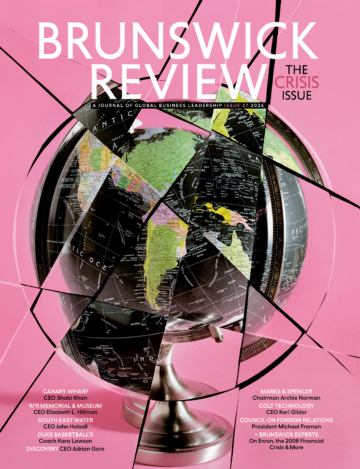
When we started the Brunswick Review, it was designed to share our experience and points of view with our clients and friends. Corporate crisis, in all its myriad and increasingly complex forms, is something we probably have more experience of than any other firm in the world—and we certainly have some clear points of view on it. So, this edition brings together some of our views, and we hear from others who carry the battle scars of going through the most challenging periods in their careers. I would like to thank everyone who has contributed to making this such a rich edition.
In this hyper-connected world, where stakeholders can become activated and animated incredibly quickly, potential triggers for a serious crisis seem ubiquitous. But there is one common denominator among the survivors, and that is the mindset of the people leading the organization.
Rather than summarize, I thought I might add a few perspectives from my own experience and from what I can only describe as the privilege of being alongside people at the most challenging moments, when they carry an immense responsibility for their people and organizations, and often their own careers are at stake.
I have no doubt in my mind that companies are like people and are seen as such. They have characters, they have prejudices, they are built around their own DNA. They are capable of amazing performance, inventing and delivering incredible outcomes that rely on large numbers of different, related parts like our own organs. We rely on most of these parts but do not pay attention to them or understand their importance until something fails, through weakness or infection.
Like people, our organizations have periods when all is good, when they flourish and get stronger. Then, sometimes seemingly out of nowhere, we get hit. The pressure on us and our people becomes almost overwhelming and the threats become existential.
Embrace Leadership
Our starting point is that a belief in crisis management is dangerous. If you could manage the situation, it would not be a crisis—it would be a serious problem. It might still be extremely serious, but, by definition, a crisis is something that you cannot control, so a control mindset is dangerous.
A leadership mindset, on the other hand, is crucial. Crisis is actually one of the most extreme tests of leadership. Handled well, you might survive. You might even find a way of using the energy and attention it creates to make progress in other ways. But when you are in it, you cannot hope to manage all the moving parts, stakeholder reactions and agendas that are outside of your control and ultimately make crisis periods so dangerous.
We have always believed that these high-stakes periods of great pressure and consequence are defining moments. They are, however, incredibly difficult. In part, this is because good decision-making under strain is often something you are not trained for, as soldiers are, so you have to learn under fire. When the adrenaline and cortisol are pumping, sleep is short and the words that keep going round in your head are “that is not true and that is not fair,” it is hard to make sense of why the situation is the way it is, let alone make the right calls.
These pressures make the most important part of decision-making extremely hard: truly understanding what the issue means to others, why the regulator is responding so harshly or the journalist is so negative. To understand their behavior, you have to understand their agendas and priorities, and only then can you take actions to address them appropriately.
Often you hear people say you have to act or speak authentically. What we believe that means is you have to express your recognition of what it means to them. Empathy and humility are hard to fake, and they start by being able to see how other people see the problem, talk about the problem and, most importantly, “feel” about it.
Even a Disaster Doesn’t Have To Be a Crisis
Terrible tragedies can take place, but they don’t have to turn into corporate crises. With the right leadership, the first response is a major factor in determining whether the disaster turns into a crisis for the organization.
This is mainly because it demonstrates whether the leadership fully understands what it means to its stakeholders. It is worth remembering that stakeholders are people too and have strong feelings and important agendas.
Every crisis has at its heart a broken promise. The company had promised that its products’ ingredients were safe, that the engineering of its cars, trains or planes was up to scratch, that your data was secure, or that the hygiene in its restaurants and the training of its people were of the right standard.
Usually these are implicit promises, but when they are broken, they sit at the heart of the problem. That has to be recognized and must guide both actions and statements.
Being able to act and respond at speed is essential. Small groups with high levels of trust are key to this. To benefit from external perspectives and advice, it is helpful to have those advisors on board beforehand, so they know the internal landscape too.
We all work on our risk registers and that preparation is essential. But plans rarely work as planned, and a crisis almost always feels like a surprise, even if the issue is actually hiding in plain sight. As divers say, the shark you do not see is the one that bites you.
When we say we do not believe in crisis management, we do believe that you can prepare. In the same way, when going into a boxing ring, you may not know what punch is coming, but you can train for agility, speed of reaction and keeping your balance when hit hard.
That training is crucial to processes and practices. Atul Gawande’s book, The Checklist Manifesto, is a magnificent articulation of why people like ER doctors or pilots prepare and rehearse. Even though they don’t know exactly what shape or form the problem will take, they understand all the moving parts they have around them.
Defense Doesn’t Win
Too often, a corporate response is exactly that: a corporate response. It sounds like it is defending the organization rather than recognizing the impact on those affected. That, in turn, leads to a sense of minimizing the issue or, even worse, covering it up. The reason it is so often seen as worse than the original problem is that it emphasizes the self-interest of the company and its leadership, suggesting they do not have the right priorities.
One of the greatest single errors in the early stages of any significant problem or crisis is the belief that, because you are not in possession of all of the information, you could be misleading people by communicating. When a fraud is discovered, you may not know how much money has gone. When a product is contaminated, you may not know how many people are affected. But that should never stop you from being open in your communication and expressing your concern about the problem.
Often, cautious lawyers will tell you that you are putting yourself or your company at risk because you cannot answer all the questions, so better not go out and talk about it. Or they may suggest putting out a short corporate statement, as if the brevity of the statement will shorten the coverage or attention.
We have seen this advice prove more destructive to leaders’ reputations and their companies than almost any other piece of advice given to the person on the spot. The best lawyers will, of course, explain your legal liability, but also recognize that you will most likely be tried in the court of public opinion well before you ever reach a court of law.
We believe it is like being the pilot on a plane hit by bad turbulence. As a passenger, it is hard not to be fearful, to worry about whether wings could crack or what the stress on an airframe is. The worse it gets, pilots know not to be silent or to come out and start talking about the technical risks and how the engineers have built the plane to withstand them. That will not help any of the passengers or crew.
What I want, as I tighten my seatbelt, is a calm update from the pilot. He explains that hot drinks may be suspended but we will get there roughly on time, and just hearing that calm, reassuring, chatty pilot makes all that turbulence and worry feel better. He may be scrambling with the controls for all I know, but at least he’s put us in a better place while he gets on with the serious work of getting the plane to its destination.
The Four Questions
When faced with a hue and cry, there seem to be a million questions people want answered. But in essence, there are four in any crisis. They overlap, and how you help sequence them is vital.
The first: What actually happened? How many were hurt? What time and where? How much money was taken? How many people were infected? Everyone wants the facts. Though you cannot always know all the details, you can be clear about what you do know, your intent to find out more and your promise to keep everyone concerned informed.
The second is more complicated: How did it happen? Was there a crack in the steel? Contamination in the factory? Poor controls on the dealing desk? These may lead to reviews, investigations and even hearings. Setting out the facts you do know and committing to getting the full picture as fast as possible are the best ways to help people. Looking like you are hiding behind lawyers, not fully taking responsibility or putting the blame elsewhere can be a major early error.
The third: Who is to blame? The political and media universes are particularly fixated on this, and it keeps the legal profession in work. Something I learned years ago is that, put provocatively, if your house catches fire in a corporate universe, you run out to get a hose or a bucket of water. In a political world, you run out and set fire to the house next door. Everything is oppositional. Everything is useful. Everything is fuel to drive your agenda.
In an increasingly complex world, we seem to personalize leadership more. We want individuals who can cut through the complexity and come across as powerful leaders. But we also want to blame them when things go wrong.
The fourth: What are the wider implications? Will more regulation be needed? Will people be fired? Will counterparts face write-offs? It’s a sad truth, but too often improvements come because of tragedies. As an airline CEO once said to me, airline safety gets better when there have been bodies on the tarmac. Being able to point toward what should happen next may be crucial in maintaining credibility and trust in the leadership.
The final step in rebuilding trust is to show how you are working to make sure the problem does not happen again. Often, you cannot promise certainty, but you can be convincing about your conviction.
Trust as Capital, Culture as a Superpower
We believe that a key to success for all leadership teams in the new world is having the trust and support of their key stakeholders. Building reputational capital and relationship capital takes time and effort, but their value in a crisis shows up every time.
Great teams do not just win on the day—they win in training. That means understanding where opportunities and risks exist, and the importance of teamwork, whether playing offense or defense.
In the end, it is about mindset and culture. It is about being prepared to walk toward problems, not hide or shy away from them, however high the stakes or however frightening the problems may be. It is also about understanding why the different forces and actors around you are behaving the way they are.
If we accept that terrible things are likely to happen in our lives and our businesses, we can build our ability to deal with them and come through them stronger in the longer term, however traumatic they may be. We all have experience of good things coming from the most painful events. We have certainly seen that in corporate crises.
Recognizing that the spotlight on you during your most difficult days can be a platform to show the true values, motives and character of the leadership team and organization can transform your relationships with key stakeholders. So, as the saying goes, never waste a crisis.
I hope you find these articles as illuminating as I have. If there’s anything you would like to challenge or connect on, please do not hesitate to contact me or any of the other Brunswick people. After all, at Brunswick, you don’t just get one of us. You get all of us.
Meet the authors
-

Chairman
London
Sir Alan Parker is Chairman of Brunswick, which he founded in 1987. Alan has worked on a wide range of assignments, acts as senior consultant…
More from this issue
Crisis
Most read from this issue

Smarter Under Stress

Meeting the Moment
You might also like

Success on Your Own Terms
America’s Pandemic Leader