Brunswick research reveals historic levels of executive stress and identifies six patterns that shape how leaders perform under pressure.
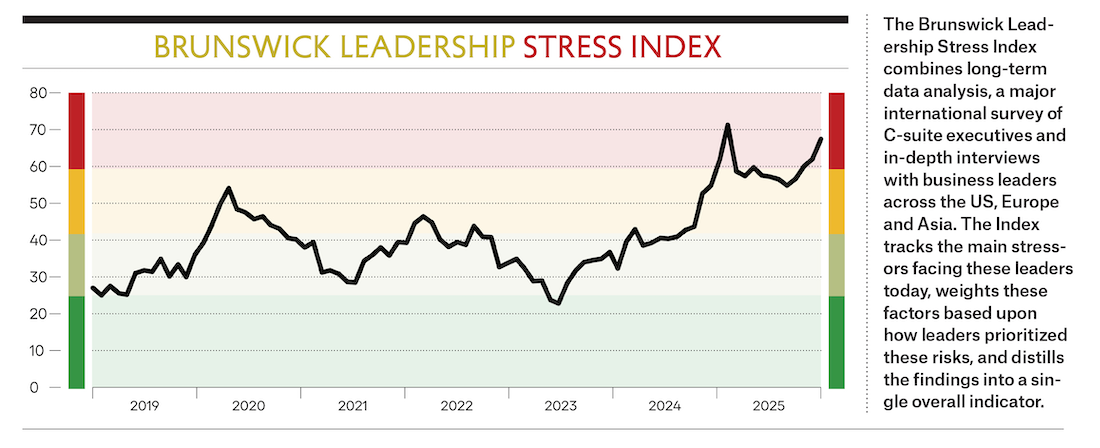
Global business leaders are more stressed today than they were at the peak of the COVID-19 pandemic. That is a central finding of Brunswick’s Leadership Stress Index, which set out to measure the pressures bearing down on the C-suite and then asked 400 senior executives across four countries how they were coping.
The Brunswick Leadership Stress Index uses publicly available data to track the major stresses leaders face—geopolitical instability, market shocks, economic uncertainty, AI disruption and more—blended with Brunswick’s analysis. Each factor is weighted based on how executives themselves prioritize these risks. Alongside the index, the researchers conducted an international survey of C-suite leaders at large corporations in the US, UK, Germany and Japan, supplemented by dozens of in-depth interviews with CEOs and senior advisors. More than half the executives surveyed described themselves as very stressed. Nearly two-thirds said that stress had risen over the past year, and a majority anticipated it would keep growing. Perhaps most telling, there is a wide gap between the threats leaders see coming and their confidence in being prepared for them—whether that’s a major market shock, a surge in shareholder activism, or the societal risks swirling around climate, inequality and identity.
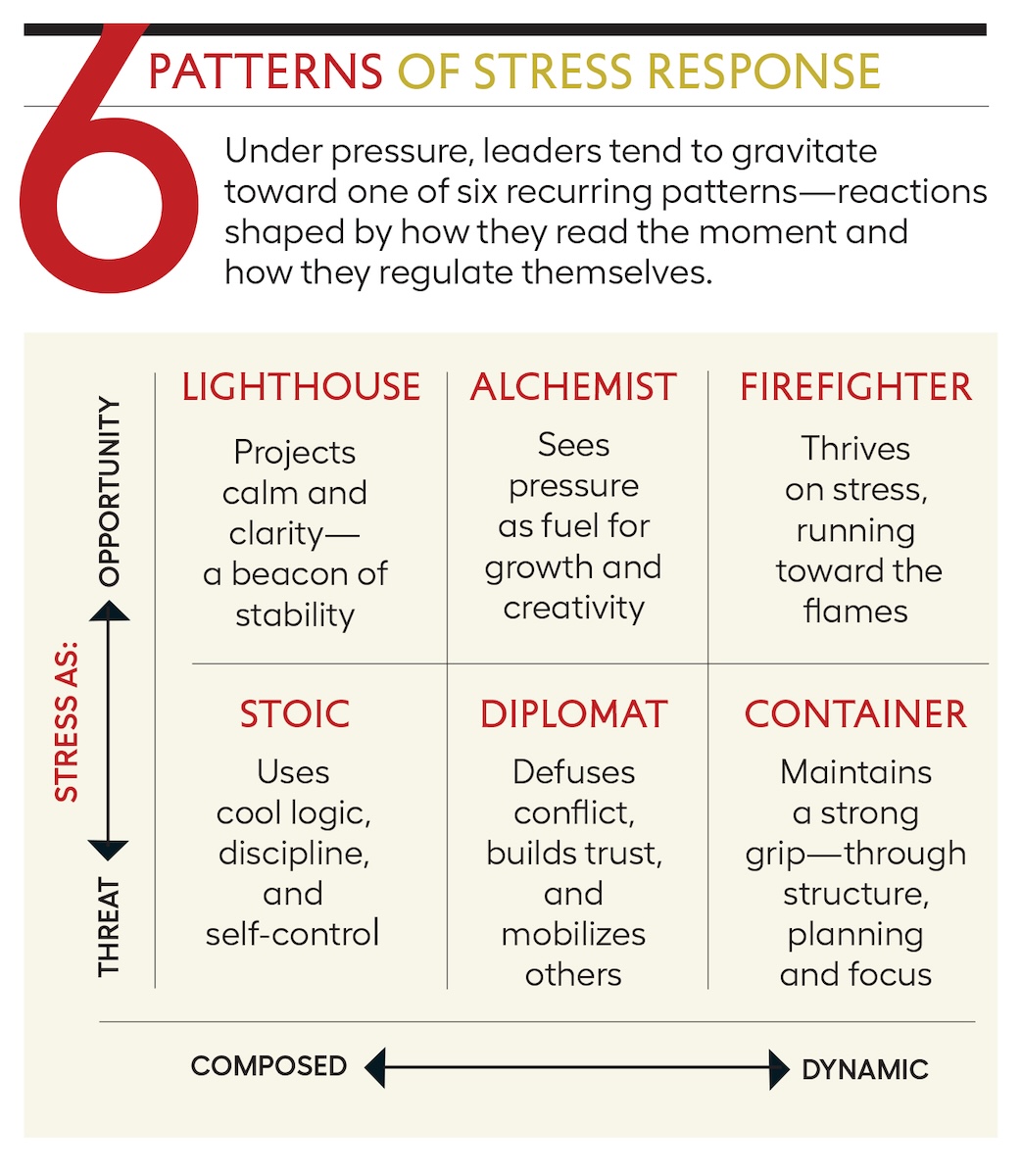
Yet the research suggests that the volume of pressure is only part of the story. What may matter more is how leaders react to it. Under sustained stress, executives tend to fall back on deeply ingrained patterns—instinctive responses that shape what they notice, what they miss and how they make high-stakes decisions. Those default reactions carry real strengths but also predictable blind spots. In a Harvard Business Review article published in the summer of 2026, Jon Miller, a partner at Brunswick Group and a practicing integrative therapist, and Drew Keller, the founding director of the Institute for Business in Global Society at Harvard Business School, identified six distinct archetypes of stress response and argued that the highest-performing leaders develop what they call “stress flexibility,” the ability to recognize their default pattern and deliberately shift it to match the demands of the moment. They named this broader discipline Stress Intelligence.
We spoke with Miller and Keller about the Stress Index and Stress Intelligence, diving into what the data shows, why self-awareness under pressure has become a leadership imperative and what the best leaders actually do differently when the heat is on.
Why did you write the HBR piece?
DREW KELLER: Making good decisions in high-stakes situations is a big part of what leaders get paid for. But we’re living through a period of heightened turbulence, and leaders are simply not equipped for the speed, scale and relentlessness of the consequential decisions they now face daily. We’re not neurologically wired for sustained stress at this intensity— our nervous systems weren’t designed for it. When we speak to senior leaders, the picture is consistent: The pressure is intense and it’s coming from all directions simultaneously—from different kinds of investors, from activist shareholders, from employees. Many CEOs even see their own boards as a major source of pressure.
JON MILLER: That’s why we launched the Brunswick Leadership Stress Index, which tracks the major sources of crisis facing leaders, and what we found is that recent levels of leadership stress are higher than they were even during the pandemic. In our international survey of C-suite leaders, more than half described themselves as very stressed— not just quite stressed, but very stressed. Think about the impact that’s having. And most of them expect it to get worse. So we need to get smarter about how we understand stress, because it doesn’t seem like we’re going to get less stressed anytime soon. That’s where Stress Intelligence comes in.
What exactly is Stress Intelligence, and why does it matter in a crisis?
DREW: Most of us sense that a certain amount of stress can enhance performance, and that’s true. We get a kick from the natural high that comes when our nervous systems are in arousal—it feels like something important is going on, and that’s exciting. It feels like you’re firing on all cylinders. But leaders today are under too much stress for too long, and the science shows that this really does distort decision-making at precisely the moments when it matters most. Leaders under excessive stress have impaired cognitive function, lower attention spans, reduced working memory and a diminished ability to regulate their emotions. As a result, decision quality deteriorates. And right now the world really needs leaders making better decisions.
JON: Stress Intelligence isn’t about finding clever ways to avoid stress—that never works. Stress is part of the job, it’s part of life, and we know the pressures facing leaders are only intensifying. Trying to avoid stress just means you end up getting stressed about being stressed. Instead, we think the answer is to become smarter about stress: how we understand our own stress better, how we work with it. That’s what we call Stress Intelligence. It’s about reducing the mismatch between a nervous system that was built for short, sharp episodes of stress and the current environment of relentless pressure. Remember, stress is how we’re wired for performance—so Stress Intelligence isn’t about becoming less stressed. It’s about becoming more capable while you are stressed.
“When we speak to senior leaders, the picture is consistent: the pressure is intense and it’s coming from all directions simultaneously.”
So leaders need to manage their stress better?
DREW: This isn’t about managing stress better; we’re saying a lot more than that. The goal isn’t more mindfulness or yoga, although those are probably good ideas. The goal is to learn how to work with stress to perform better under pressure. We think this is now a critical leadership capability.
JON: Think of it this way: If you’re in the military, or you’re a trauma surgeon, or you work in aviation, stress isn’t treated as an unfortunate by-product of the job. It’s treated as part of the job itself—a central part of the training. But in business, you’re just expected to know how to deal with extreme pressure. Most CEOs receive almost no training for how to handle stress, even though they make decisions that significantly impact people’s lives and the world around them. Meanwhile the science is clear that too much stress can lead to a downward spiral of poor decisions, bad outcomes and heightened anxiety.
What do we need to do differently to prepare for crises?
JON: It starts with the leaders themselves. Today we surround leaders with data and dashboards and AI agents and world-class experts. All of that is crucial—it’s largely about situational awareness, about bringing insight and experience to help understand what’s going on. But as any good advisor at Brunswick will tell you, it’s also really important to think about the person in the hot seat. How are they doing? What do they need? We think there are two powerful questions that can make a real difference in high-stakes moments. First: Do you know how stress impacts your decision-making? And second: Do you have a strategy for making better decisions under pressure? Those questions can unlock powerful new ways of preparing for crisis—and for leadership.
DREW: There are a couple of other areas I’d highlight. One is teams. We’ve been gathering a lot of anecdotal evidence that the cohesion of executive teams is becoming increasingly frayed in crisis situations, and that’s having an obvious impact on their ability to function when it matters most. We think Stress Intelligence can help here too—understanding how pressure is affecting the group dynamics, and what you can do about it. The other major area is systems. Currently the stress of high-stakes moments sits disproportionately on the shoulders of the final decision makers, particularly CEOs. How can we shift that cognitive load onto intelligent systems? How can AI play a role? How can we create more supportive and resilient cultures? These questions are only becoming more pressing.
How are CEOs meant to use this research?
DREW: Over the years, we’ve observed that different leaders respond very differently to pressure. The starting point is to understand your own default stress-response pattern. Do you react with composure, or do you leap into dynamic action? At an instinctive level, do you approach a crisis as a threat, or do you sense some opportunity in it too? This is really at the heart of our HBR article. We identified six leadership stress-response types, shaped by how you regulate yourself and how you read the moment. Once you understand your own style, you can start working with it—you can understand your strengths under pressure, and you can identify your blind spots. We’ve created a Stress Intelligence test to help people do exactly that.
What has the response been like?
JON: We’ve clearly struck a chord. We’re seeing thousands of leaders taking our test, from all kinds of organizations, all over the world. We’ve had people from the US Space Force getting in touch. We’ve had networks of federal district judges and school principals reaching out—people who have to make tough decisions under pressure. And of course there’s been a great deal of interest from leaders in the business world, which is very encouraging.
We are living through a time of major transitions, and decisions made by leaders today will shape the trajectory of many issues for decades to come. Our hope is that Stress Intelligence can enable a few wiser decisions.
Jon Miller is a Brunswick Partner and practicing integrative therapist. Drew Keller is the founding director of the Institute for Business in Global Society at Harvard Business School.
More from this issue
Crisis
Most read from this issue
Critical Moment: Crisis
Labor’s Expanding Role in M&A
You might also like
Real or Fake?
A Generational Deal