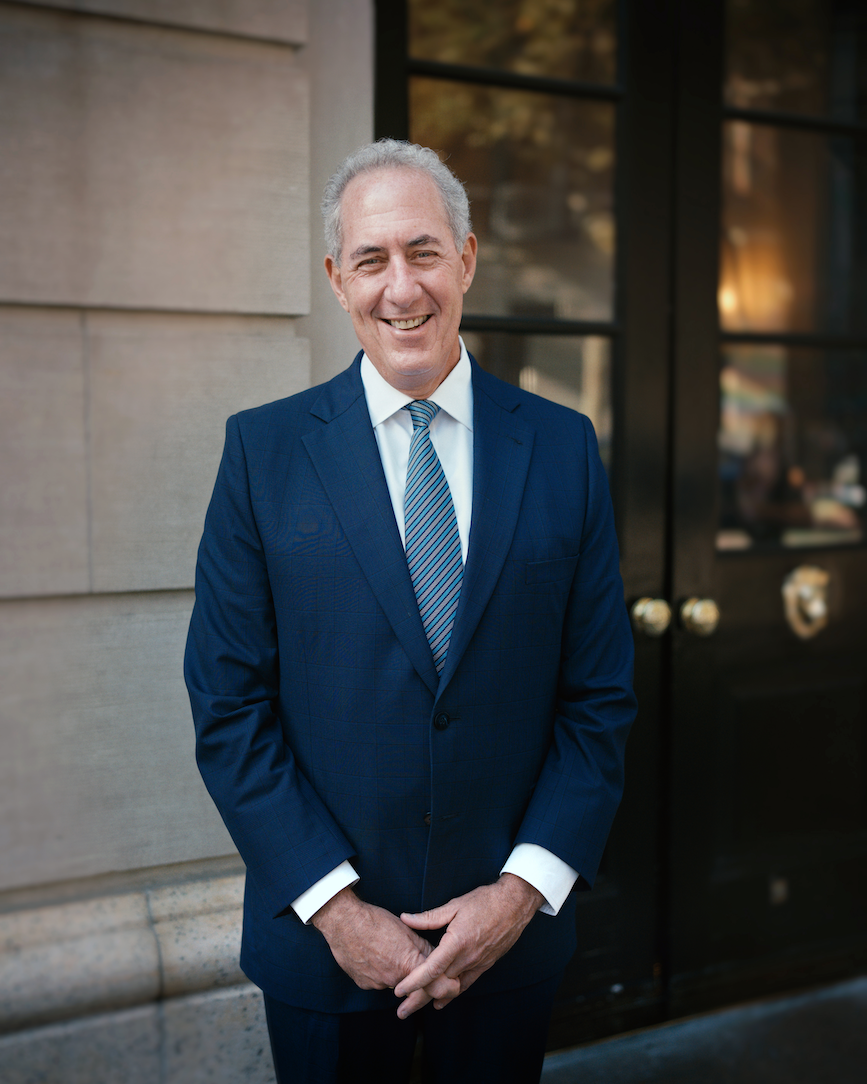
Council on Foreign Relations President Mike Froman on leading across government, business and the nonprofit world, the mentors who shaped him, the lessons of political failure—and preparing a century-old institution for a historic inflection point.
Michael Froman has spent much of his career moving between worlds that increasingly overlap. He has served as US Trade Representative in President Barack Obama’s Cabinet, where he was also Assistant to the President and Deputy National Security Advisor for International Economic Affairs. He held senior roles in the private sector, including at Mastercard and Citigroup. He holds a doctorate in international relations from Oxford University and a law degree from Harvard Law School, where he was an editor of the Harvard Law Review.
Since 2023, he has served as President of the Council on Foreign Relations, a leading independent and nonpartisan think tank advising on US foreign policy. His breadth of experience has given Froman a leadership perspective that travels across institutions even when their missions, incentives and cultures differ dramatically. He is now drawing on all of that experience at a moment he considers every bit as consequential as earlier turning points in the Council’s century-long history.
Froman spoke with the Brunswick Review about building consensus, mentoring and what it means to lead an institution designed to help the United States understand its role in the world.
You’re leading CFR at a period of enormous geopolitical uncertainty. How do you think about leadership in a moment like this?
One of the advantages of the Council is that it has history. It’s about 105 years old. It was founded in 1921, after the First World War and after the defeat of the League of Nations in the US Senate, at a moment when protectionism and isolationism were major concerns.
Then you move into the 1940s, when ideas around the postwar international architecture were being developed. In the late 1950s, a young Harvard academic named Henry Kissinger came here to run a study group that became Nuclear Weapons and Foreign Policy. In the 1990s, the Council was deeply engaged in the emergence of geoeconomics, the nexus between national security and economics.
I view this moment as every bit as consequential as those previous moments in history. We are going through a major disruption in the way things have traditionally been done over the last 80 years. Fundamental questions are being raised about how the United States manages alliances, adversaries and the global economy.
That is a challenge, but it is also what the Council was made for: to take up those questions and think broadly about where we go from here. It’s an opportunity to put our experts, our members and our national network to work on those issues.
What message do you find yourself delivering most often to leaders trying to navigate that uncertainty?
Our mission is to inform US engagement with the world, and something I emphasize is that there are many ways to engage with the world. Over the last decade, we’ve been going through a grand experiment, exploring alternative ways of engaging.
We need to look at the lessons of those last 10 years and the lessons of the previous 80 and figure out where to go from here. It is unlikely that the pendulum simply swings all the way back.
We’ve been at moments of instability and uncertainty before and had to chart our way through them. That can be reassuring. But this time is different in important respects, and our approach has to evolve.
Part of that means getting out around the country and talking to people about their views of the global economic system, alliances and adversaries. We shouldn’t simply be informing them. They should be informing us. Their perspective needs to be part of the policymaking process as well.
“We’ve been at moments of instability and uncertainty before and had to chart our way through them. That can be reassuring. But this time is different in important respects, and our approach has to evolve.”
You’ve worked across government, business and now the nonprofit sector. What are the through lines in how you lead?
I’ve been extraordinarily lucky to work across multiple sectors, and for great institutions. One commonality is that you really need to build teams and build consensus among them to get anything significant done.
There are very few organizations that are truly command-and-control from the top. Even in the private sector, where you have various means of incentivizing people, you still need to build consensus across complex organizations and multiple silos to achieve your objectives.
One thing I’ve found somewhat counterintuitive is how transferable the skills you pick up in government can be. In the White House, for example, you are coordinating policy among several different agencies. You have to manage massive amounts of information and boil it down to its essential nub so that a principal—a Cabinet officer, a President or, in another context, a CEO—can make a decision.
You also have to build consensus across complex organizations. People who come out of government often have implicitly developed very important skills that are useful in the private sector, but they aren’t always obvious.
Is there something you wish more people in government understood about the private sector—and vice versa?
There are fewer and fewer issues that can be addressed fully by one sector alone.
National security and defense used to be seen largely as the province of government. Now we’re seeing innovations in the private sector, whether around autonomy or AI, that have very significant implications for national security. Government has to work with the private sector to understand and integrate that technology.
Whether it’s economic growth, trade, national security or development, all these issues have a strong public policy component and a strong private sector component, often with nonprofit institutions like think tanks contributing ideas and thought leadership.
Increasingly, you need all those perspectives to address a significant problem or challenge.
How do you think about creating the next generation of leaders?
Mentorship is critical. At the Council, we’ve tried to institutionalize it, not only by focusing on mentoring our staff, but also, because we’re a membership organization, by having life members mentor our term members.
In my own mentoring, I try to help people recognize the characteristics and skills they’ve developed that they may not fully appreciate.
When people leave government for the private sector, for example, they tend to think their domain knowledge—be it on trade or China, et cetera—is what matters. That expertise is important, but the softer skills, like building consensus, working across complex organizations, managing vast amounts of information, are typically even more valuable.
Conversely, in the private sector you sometimes promote people because they’ve demonstrated a particular skill, like being a great salesperson or trader, but they may never have had to develop the broader skills required to work across a complex organization, see around corners, connect the dots. Helping people understand and integrate those different worlds is important.
I have been incredibly fortunate to have a series of mentors throughout my academic and professional life, folks like Dick Ullman, Abe Chayes, Les Gelb, Bob Rubin and others. So, I know how important mentoring can be and am committed to paying it forward, so to speak.
“In any complex organization, getting the substantive answer correct is only one part of leadership. You also need to build the coalition that allows you to act on it.”
At CFR, you lead an institution filled with subject-matter experts. How do you decide when to lean in with your own expertise and when to step back?
One thing I love about this job is that I’m learning every day.
I’m surrounded by people who know much more than I do about all sorts of issues, and I benefit enormously from their expertise.
An organization like the Council is strongest when it puts forward all its assets. We’re a think tank, a publisher, an educational organization and a membership organization. My view is that the more we can do to promote our experts and their expertise, the stronger the institution becomes.
If we have dozens of fellows appearing in the media, writing on opinion pages and contributing to the public debate, that creates impact. One of my goals has been to make sure the rest of the organization sees supporting our thought leaders and helping them have that impact as part of its mission.
Looking back, are there mistakes that changed the way you approached leadership?
The one I’m probably most closely associated with is the negotiation of the Trans-Pacific Partnership during the Obama administration.
I continue to believe it was a very good, high-standard agreement that would have leveled the playing field for American works and firms, and positioned us well as leading a coalition of allies and partners across the Asia-Pacific vis-à-vis China. But we clearly did not manage the politics of it as well or as robustly as we managed the policy.
We succeeded in concluding the agreement at a time when it was becoming increasingly unpopular politically.
I learned from that just how important the political side of these efforts is. You need to bring people along politically, even while you are focused on the nitty-gritty of getting the policy or the negotiation right.
Has that changed the way you think about what constitutes a good decision?
Very much so.
You can have a technically excellent answer, but that doesn’t mean you can implement it or sustain it. The process of bringing people along is part of the work, not something separate from it.
That lesson applies well beyond government. In any complex organization, getting the substantive answer correct is only one part of leadership. You also need to build the coalition that allows you to act on it.
If you were to look back on your tenure at CFR five years from now, what would make you feel you had succeeded?
I inherited a great organization that was well run and had a very strong foundation, at a time when there proved to be great upheaval in the broader environment.
I think of my leadership as helping to modernize and develop the organization so that it has the capability to deal with this rapidly changing environment. That includes modernizing our digital footprint, thinking about how we reach different audiences in new ways, and building our capacity to engage the rest of the country—not just Washington and New York, for instance.
Externally, I think of my role as creating the foundation, resources and team that enable the Council to fully meet the moment we’re in.
Substantively, that means helping develop options for future administrations of either party as they think about how the international system should evolve and what role the United States should play in the world.
Meet the authors
-
Partner, Healthcare & Life Sciences Global Lead
New York
Raul leads the firm’s Healthcare practice and advises clients on corporate communications, financial situations, and crisis management.
You might also like

EU Value, Forged in Sweden

A Generational Deal