Inside the quiet, gutting work of preparing the speech no leader wants to give.
Two astronauts sit in their lunar lander, unable to return to earth. Forever stranded on the moon, they will soon perish.
President Nixon shares the terrible news with the world. His words speak to the courage of the astronauts, the tragedy of this moment, the grief felt by millions worldwide.
For a man whose public speaking was characterized as “workmanlike,” this may be Nixon’s greatest speech. His words meet this awful moment: The unthinkable has happened.
Except it didn’t happen.
In the summer of 1969, and with the launch of the Apollo 11 mission a few weeks away, a small group of West Wing staff that included writer William Safire quietly began work on a worst-case scenario. What if the astronauts fail?
Captured in an otherwise bland staff memorandum, the grim plan included a full set of remarks for President Nixon to deliver, penned by Safire.
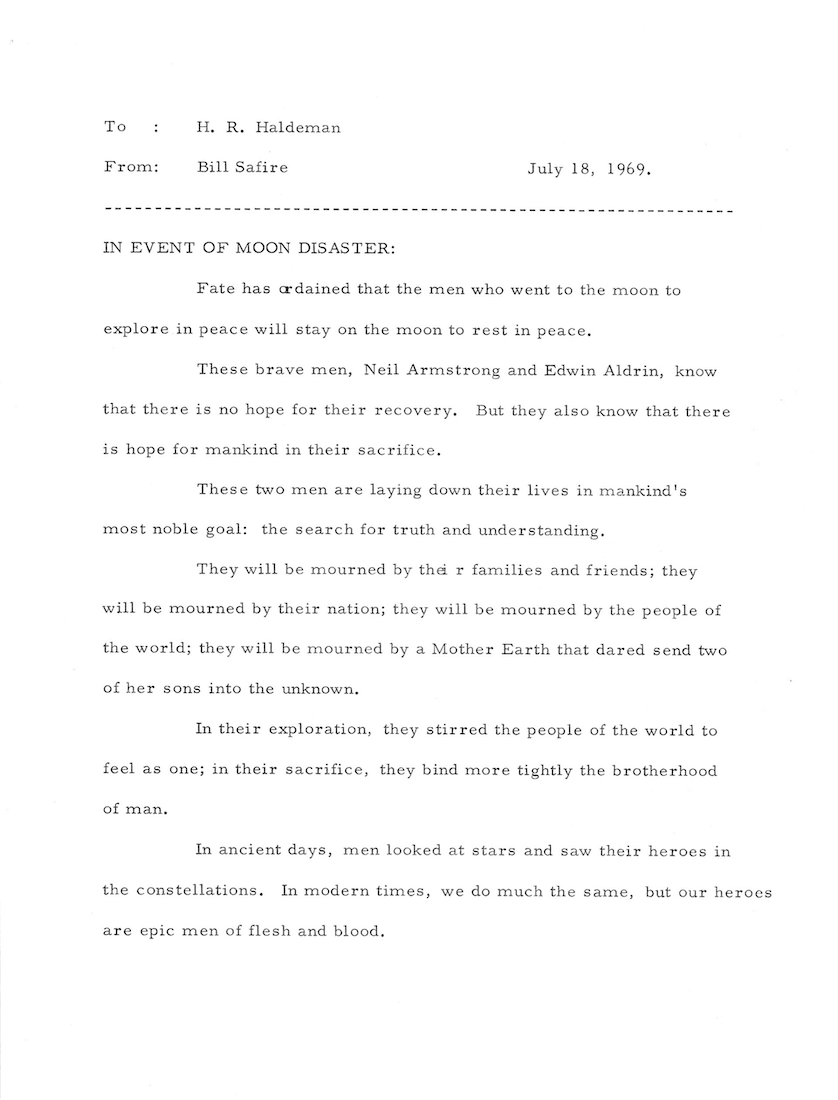
“In their exploration, they stirred the people of the world to feel as one; in their sacrifice, they bind more tightly the brotherhood of man.”
Decades later, with the comfort of knowing that all three Apollo 11 astronauts returned home, the words are no less moving. A fragile, beautiful mix of sorrow, admiration and, ultimately, resolve.
“Others will follow, and surely find their way home. Man’s search will not be denied. But these men were the first, and they will remain foremost in our hearts.”
Beautiful Words (Thankfully) Never Spoken
They are an oratory “what if?”
History’s deleted scenes: remarks drafted but never delivered, as leaders prepared for the outcome they least wanted to contemplate.
Capturing the consequences of failure, these remarks are the ultimate form of crisis preparedness. If the unthinkable happens, what do I say?
But why do these words soar the way they do?
Jeff Nussbaum is a former presidential speechwriter, a partner at Bully Pulpit International, and author of Undelivered, a book analyzing speeches prepared but never given. He sees something deeper at work. Catastrophe, he argues, strips away the things that normally separate us from our leaders.
“It closes a gap: Our leaders, who can seem distant from us at times, are feeling what we are feeling,” Nussbaum told the Review. “We allow them to give voice to our feelings. That yields a sense of connection, which is the prerequisite for inspiration.”
It is not simply that terrible moments call for elevated language. They create conditions in which real language—simple or grand—can actually land.
“True, authentic, meaningful statements hit differently because we are ready to hear them,” Nussbaum said.
Putting that outcome into actual sentences can both prepare a leader to communicate a decision and also change how the decision itself looks.
Catastrophe can leave behind a sense of futility. The leader’s task, said Nussbaum, is to remind people what it was all for.
Safire’s Apollo remarks do exactly that. The astronauts were explorers. Others would follow them. The search would continue. The speech gives meaning to the sacrifice without diminishing the tragedy.
The remarks President Nixon actually delivered were less memorable. A phone call with the astronauts during which the President proclaimed himself the “luckiest man in the world,” followed by an invitation to dinner at the White House, then some casual small talk.
The difference may lie partly in what the two moments asked of language. The successful landing required Nixon to mark an extraordinary achievement. The catastrophe speech posed a vastly different challenge: What did this terrible loss mean?
Another wrinkle to the Apollo speech: There is no evidence Nixon ever saw Safire’s draft. That raises another question about preparing for catastrophe: How close does the leader want to get to the worst-case scenario before it becomes real?
A Scrap of Paper, the Wrong Month, and the Right Words
Twenty-five years—almost to the month—before the Nixon White House prepared for the Apollo 11 mission, another leader confronted the risk of failure.
It was the night of June 5, 1944: D-Day was hours away. Sorties of allied aircraft, filled with paratroopers, were already departing for France. Thousands of soldiers had been loaded on to ships swarming the English coastline, the largest flotilla ever assembled.
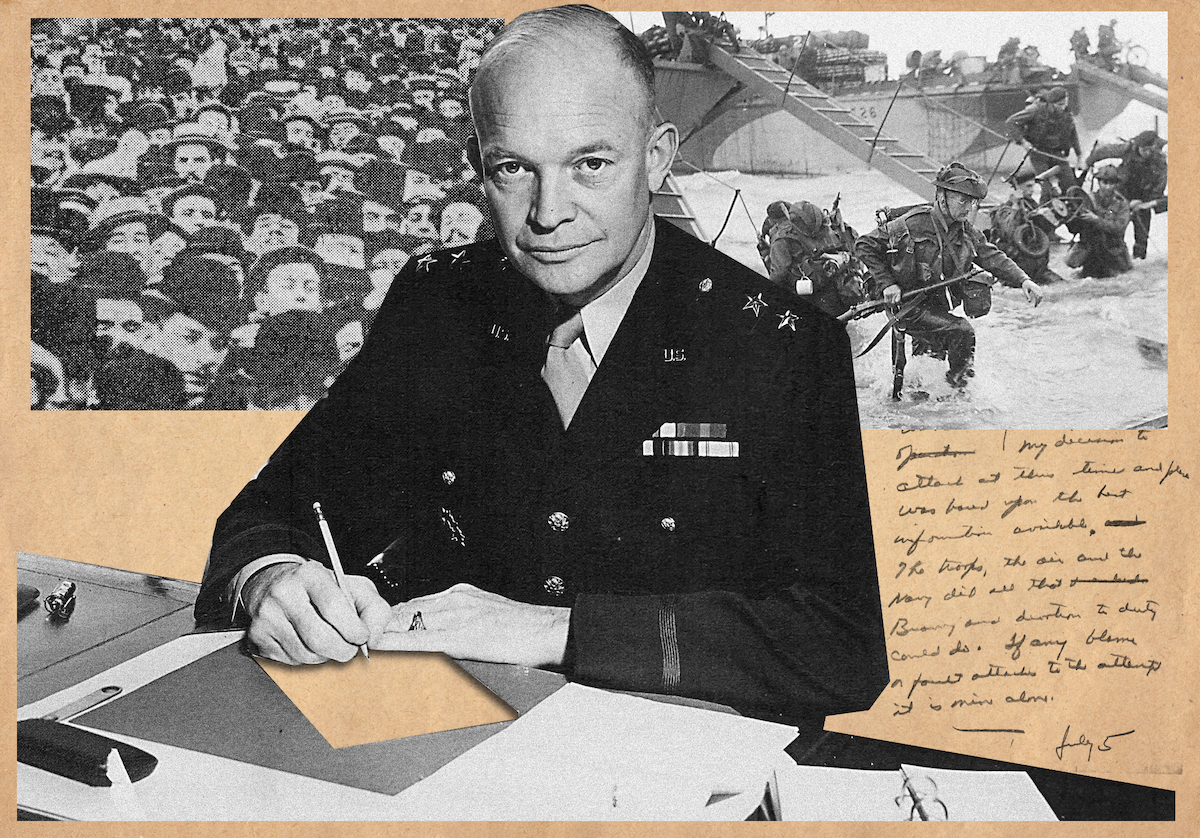
In an English country cottage, Dwight Eisenhower, then Supreme Commander of the Allied Forces, grabbed a piece of paper and scribbled out a few sentences.
A few hours earlier, Eisenhower visited with allied soldiers to shore up their confidence. He believed in the D-Day plan, the 18-plus months of training, the roughly 160,000 troops poised for action.
Yet now, he contemplated a different outcome. What would he say if D-Day did not succeed?
“The troops, the air and the Navy did all that bravery and devotion to duty could do. If any blame or fault attaches to the attempt it is mine alone.”
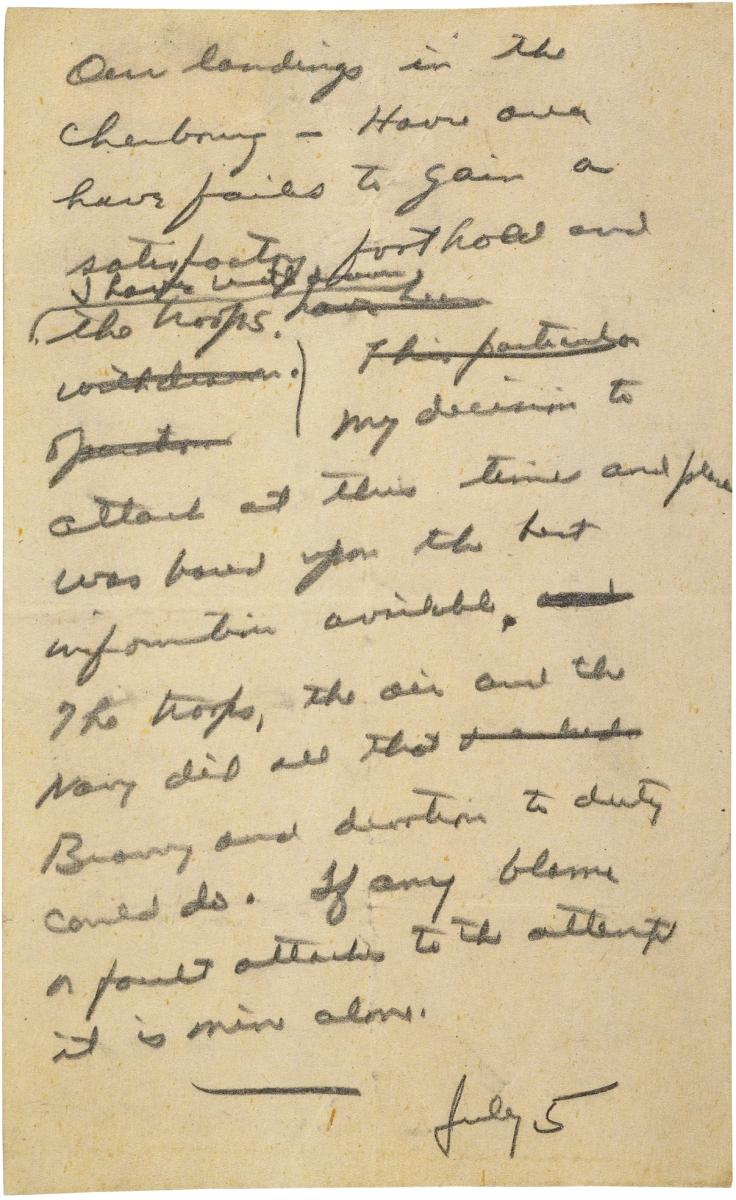
So fatigued was Eisenhower that he dated the draft remarks July instead of June. But even in exhaustion, his editorial instincts were precise. He crossed out a line written in the passive voice—language that would have distributed blame—and replaced it with something unmistakable in its clarity and ownership.
Satisfied with a speech he no doubt hoped would never be heard, he stuffed the handwritten remarks in his wallet and forgot about them for more than a month.
The worst-case scenario was something he had little need to contemplate further.
33 Pages for Success, 33 Pages for Failure
Brunswick Partner George Little was, in early 2011, director of communications for the US Central Intelligence Agency (CIA)—and one of a small group tasked with contingency planning for the mission to find Osama Bin Laden and “bring him to justice.”
Technically a Title 50 covert operation, there was the question of whether Little and his team could even legally prepare statements about a deniable mission. The solution: Draft a “contingency public affairs plan.”
What ultimately emerged was a 66-page communications plan: 33 pages for success, 33 pages for failure. The worst-case scenario got equal space, Little recalls, though in fact, it may have gotten more attention. “The CIA is genetically disposed to do two things: take risks and assess risk. The culture favors considering all outcomes,” he said. “There was no false hope.
“In the failure scenario, the President’s remarks had to be transparent, take responsibility for the decision to move forward with the raid, and educate people as to why we made the decision.”
Before the speechwriters began drafting, Little handed them a thick booklet: the memorial service program for his cousin, who had been on the 104th floor of the World Trade Center with Cantor Fitzgerald and died on September 11. “I told them, ‘This is one guy. My friend. Take it for what it’s worth, but if it helps, use this as inspiration and channel it.’”
With the operation less than 24 hours away, Little found himself briefing senior White House staff on both the success and failure plans.
“We spent the time needed on the worst-case scenario plan and not a minute more. Once understood, the plan was of no further value: dwelling on it was counterproductive.”
“Didn’t Need This One, Brother”
Cody Keenan, Director of Speechwriting for President Obama and now a Partner at Fenway Strategies, faced a daunting task in 2015. The Supreme Court was poised to rule on two signature legislative achievements of the Obama Administration: the Affordable Care Act and marriage equality.
“The math was tough: four different potential outcomes in each of the two rulings,” Keenan recalled. “Without advance planning, down to the exact remarks for even the worst news, we would be left scrambling.”
To help him write, Keenan asked the White House’s correspondence office for letters from people affected by the policy; real voices clarified his thinking in ways a pollster’s memo never could, said Keenan. For the hardest material, he would write at night, often with a carefully chosen playlist and one glass of whiskey. “There is something about the night. It is just bigger. It helps you think.”
And yet for all that preparation, he knew the President would never look at the defeat speeches. “President Obama would only look at the speeches he felt he would actually deliver. That was just glass he would not break.”
In the end, the Supreme Court upheld the Affordable Care Act on a Thursday. Marriage equality was affirmed Friday morning. That afternoon, Obama flew to Charleston to eulogize Reverend Clementa Pinckney, who had been murdered in a church shooting, where he would sing “Amazing Grace.” Keenan had written something for each occasion.
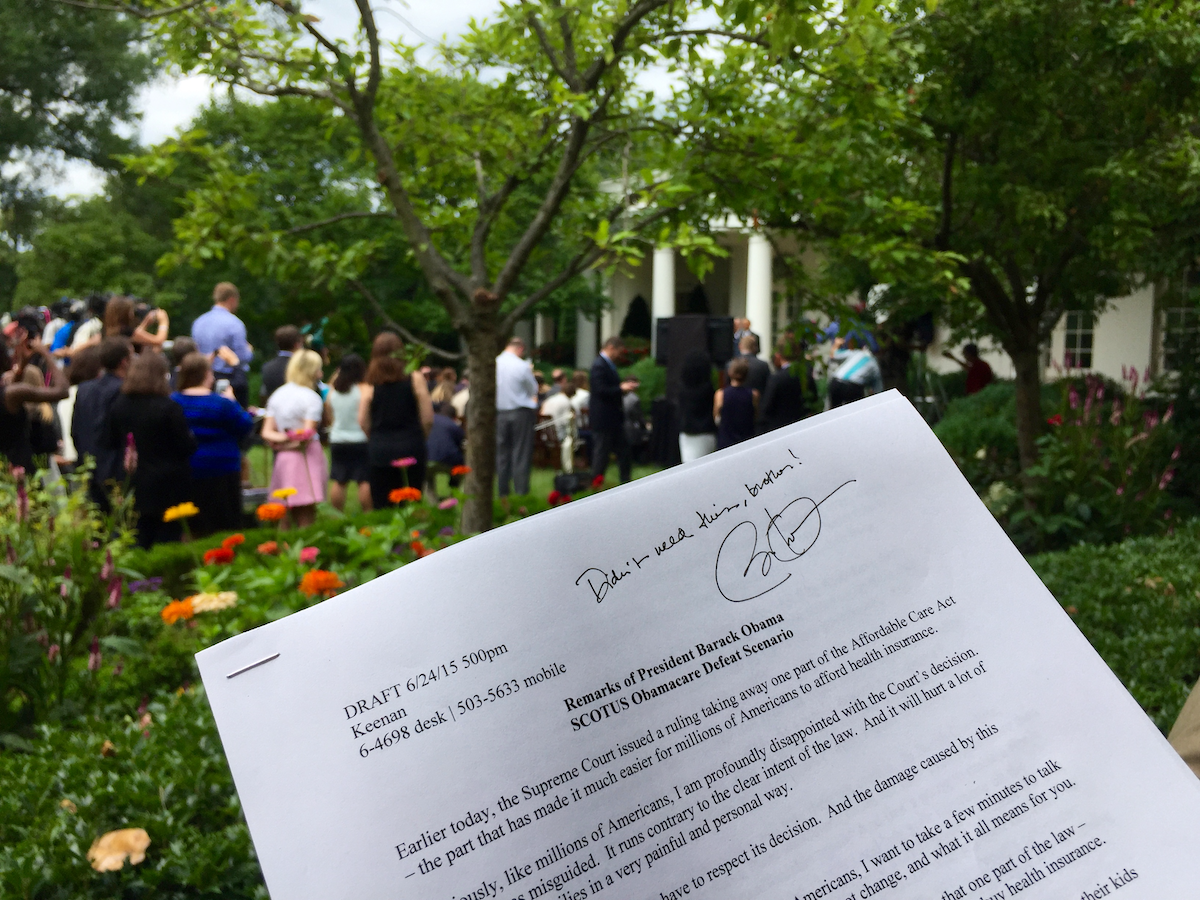
Today, there is only one speech at the Obama Presidential Center with a speechwriter’s name still on it: the Affordable Care Act “defeat” speech that Keenan penned.
Scrawled across the top of the first page, in the President’s handwriting, there is a simple note to the author. “Didn’t need this one, brother!”
Big Moment, Small Speech
For every undelivered speech along the lines of Eisenhower’s D-Day remarks or Nixon’s Apollo 11 speech, there are many more statements, delivered in the face of bad news, that underwhelm.
Cautious, heavily vetted: They leave audiences restless, wanting.
“Leaders and often their advisors find themselves stuck managing causation and culpability, at the expense of consolation,” author Nussbaum cautioned. “Leaders who meet the moment—no matter how devastating that moment is—are those who deliver the most human of remarks.”
For his part, Obama White House speechwriter Keenan sees risk in smooth, finely tuned language.
“If you sand down every word, you are rendering the speech devoid of emotion, feeling or moral clarity, when that’s exactly what audiences are hungry for,” warned Keenan.
The reluctance can start well before any words are sanded down. Nussbaum said, in his experience, many leaders want the reassurance that someone has considered the bad outcome; fewer want to spend much time there themselves.
Yet putting that outcome into actual sentences can both prepare a leader to communicate a decision and also change how the decision itself looks.
Nussbaum pointed to the Cuban Missile Crisis, when US Attorney General Robert Kennedy had each group—those favoring an airstrike and those favoring a blockade—present their preferred course of action. At the top of each memo was a draft speech for the president announcing their respective decision. People around President John F. Kennedy later said the president could not see himself giving the airstrike speech.
“If you see a decision laid out that you then have to announce, and you look at it and say, ‘That is not me,’ that is effectively a way of saying, ‘I am not comfortable with that decision,’” Nussbaum said.
Inspiration in the Darkest Moments
While history is punctuated by the occasional, captivating speech never heard, there are moments when the worst-case scenario remarks, prepared out of sight, are called up for use.
The 35 days between November 7 and December 12, 2000, were an up-and-down fight for both the Gore and Bush presidential campaigns.
Convinced of their arguments and urged on by fervent supporters, the two campaigns battled over Florida vote counts to determine the winner of the 2000 election.
Yet as the Gore campaign fought for every single vote, a small team had quietly worked on a “what if?” speech for the then-Vice President, should the count not go their way. Those speechwriting efforts were not in vain.
On Tuesday, December 12, the Supreme Court issued its ruling, drawing the recount effort to a close and, effectively, handing the election to George W. Bush. The following evening—Wednesday, December 13—Gore delivered the speech he never wanted to give. A speech he had not entertained until after the Supreme Court’s ruling.
In his remarks that evening, he quoted what Stephen Douglas told Abraham Lincoln, who had just defeated him in the 1860 election.
“Partisan feeling must yield to patriotism. I am with you, Mr. President, and God bless you.”
It was, in the view of many, Gore’s finest speech.
Meet the authors
-
Partner
Dallas
Bill specializes in crisis communications, reputation-building and executive counsel.
You might also like
Better Together

All the Reit Moves