Maria Conceição’s journey has taken her to seven continents and the summits of Everest, toward the goal of bringing education to some of the world’s poorest children.
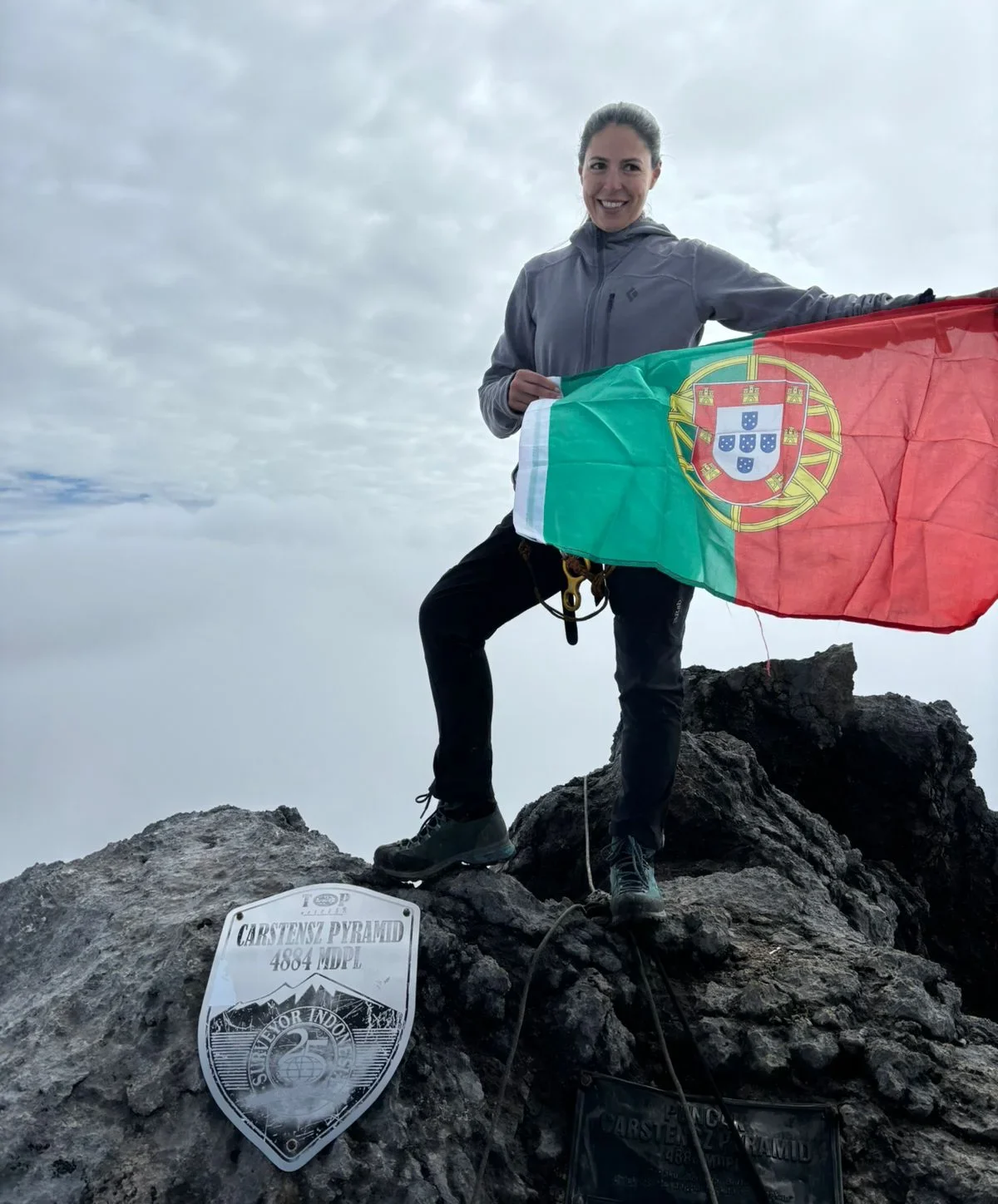
In the photo above, Maria Conceição holds a flag of Portugal at the summit of Carstensz Pyramid, in New Guinea, the highest island peak in the world.
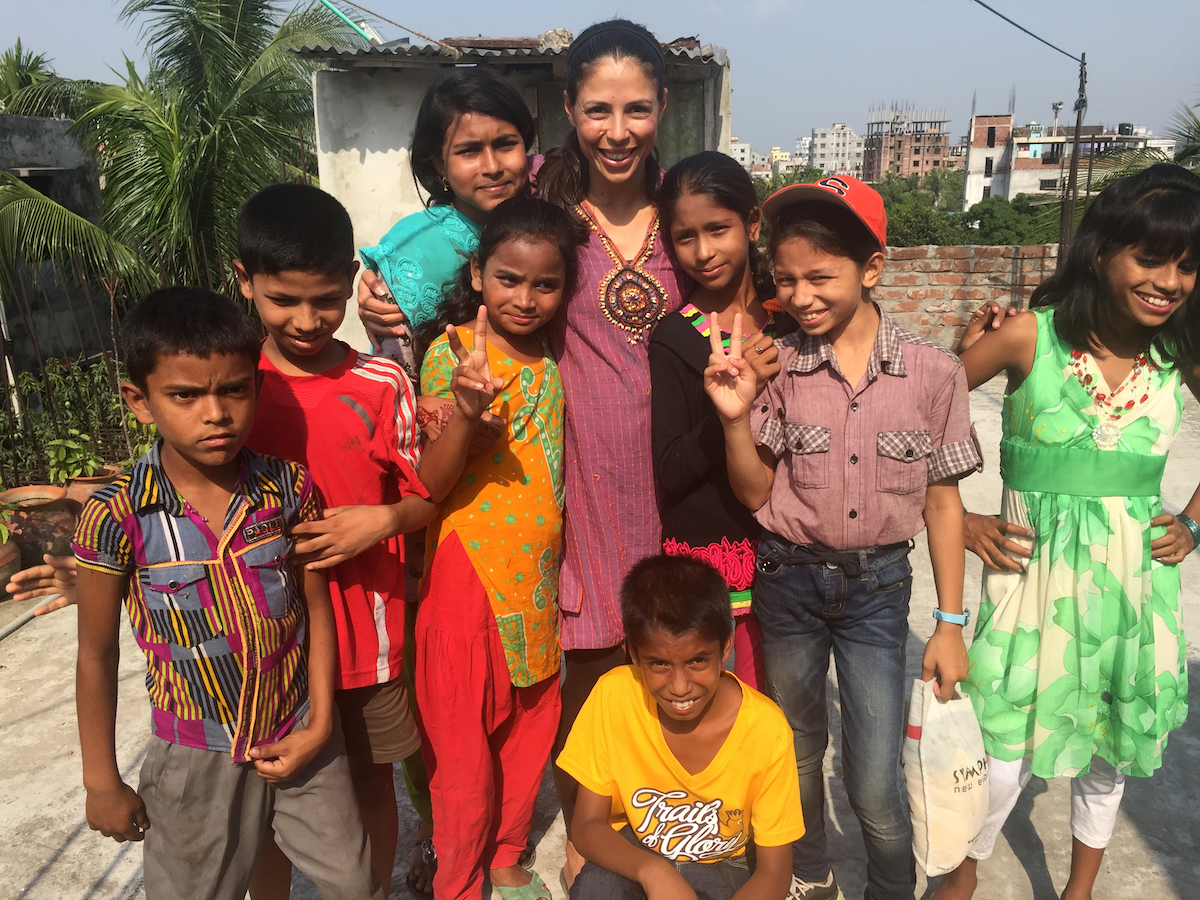
On a break from her job as a young flight attendant for Emirates Airlines, Maria Conceição took a trip through the neighborhoods of Dhaka, Bangladesh. What she found there changed her life.
“I came across a slum area with families newly arrived from far away villages, living in makeshift housing made from garbage,” she told us in an interview recently. “I didn’t know how much difference I could make. I just knew I had to take action. I couldn’t walk away.”
She decided to try to create opportunity and hope where there was none. Without any background in fundraising or education, she decided to start by building a school.
“I found sponsors in Dubai, volunteers, partners and whatever else was needed to build my vision,” she says. The vision quickly grew to include some 600 students and over 100 families.
Conceição today leads the Maria Cristina Foundation, a small nonprofit that works to educate and build opportunity for children and communities in Bangladesh. Founded in 2005 while she was still an employee of Emirates, the charity operates on a knife-edge financially, with an annual budget of around $130,000. Yet it has had an outsized impact, reaching hundreds of children and families. It has helped to start new schools, attract new volunteers, build new roads and staff health clinics.
World Records
Beginning with flea markets, Conceição has found novel approaches to attract support. Most significantly, she turns to what she knows best: her own determination and stamina. As an extreme athlete, she has run ultramarathons, climbed Mount Everest, K2 and Broad Peak mountains, among others, attempted to swim the English Channel and taken on many other high-profile challenges—all to promote awareness and gain support for her work. She now has 10 entries in the Guinness Book of World Records, including the fastest aggregate time for a woman to complete a marathon on each continent.
“Those challenges provide for me and the charity in many ways,” she says. “They raise awareness, they show people I am serious about the project, and lead to funding. I also hope to inspire people, to show that a girl who came from nothing can aim high.”
One of her first such quests was an expedition to the North Pole. “Did I think that through?” she said in a Dubai TED Talk in 2011. “Of course not. Was I the best person to attempt such a physical challenge? Definitely not. Up to that point, my daily exercise was walking from first class to economy class.”
The money raised was at first disappointing, but after making a speech about her experience at a Dubai school, five of her students were given scholarships. Noting that success, she added professional keynote speaker to her résumé and continued to seek new high-profile physical challenges. She has since also authored several articles and books, the proceeds from which go to the foundation.
As public awareness has grown, the foundation has attracted several large Dubai organizations, including Sheikh Mohammed Bin Rashid Al Maktoum’s foundation Dubai Cares; Middle East engineering business KG International; Petrochem, the largest chemicals provider in the Middle East; Mashreq, a leading financial institution in the region; global digital payments enterprise Checkout.com; and Dubai-based healthy food and living platform Kcal.
“She tends to focus on impact per person,” says Saul Keens, Conceição’s life partner and a trustee for the Maria Cristina Foundation. “She really takes the students the extra mile, more like a family would. She’s also very innovative. She looks for what works and builds on that. If it doesn’t work, she moves on to something else.”
Keens was directly involved in one of Conceição’s more ambitious physical gambits, running the 777 Marathon Challenge with her in 2014—seven marathons in seven days on seven continents—where Conceição finished with the fastest time for a woman across the total event.
“When you meet Maria, you get trapped into things you didn’t expect,” Keens says. For the Antarctica leg, they had to sleep in a tent, never able to truly get warm, he recalls. “It was pretty harsh. I’m glad I did it; it’s a story I can tell many people. But I wouldn’t rush to do it again.”
Childhood
As a child, Maria Conceição watched her adopted mother, Cristina, work as a house cleaner in her native Portugal. The Angolan-born widow already had six children when she took in Maria, who was then just 2 years old. Given up by her birth mother and raised in a large, relatively poor family, Maria’s horizons seemed starkly limited.
Cristina died when Maria was only 9. She left school at 12 and shuttled between the homes of her older sisters until she was 18, earning her keep cleaning and caring for their children.
But her adopted mother’s compassion and strong work ethic stayed with her and she was driven to excel at anything she tried. Eventually that determination landed her in the cabin crew of Emirates Airlines, a job that took her around the world and where she worked hard to distinguish herself further.
“It was never really about being the best cleaner or the best cabin crew,” she tells us in our recent conversation. “It was about doing everything I could to be the best version of myself.”
As she built a successful life for herself, Cristina was again a model for how she could help others. “Who feeds six, feeds seven,” Conceição says simply. “It’s a reminder that we can always do more.”
“It was never really about being the best cleaner or the best cabin crew. It was about doing everything I could to be the best version of myself.”
Impact
Through the growing publicity around her and her work, Conceição’s students have won scholarships, internships and employment opportunities in Dubai. Global financial firm Grant Thornton, Emirates Airlines and Checkout.com have all hired students from Conceição’s program. The foundation has also helped staff a health clinic and improved roads, and water and wastewater systems for communities.
Salma Akter is one of the Dhaka children who received education expenses and job placement. Salma is now a master’s degree student at the Polytechnic Institute of Bragança in Portugal.
“She has given me opportunities that have truly transformed my life,” Salma told us. “My greatest wish is to continue Maria’s legacy. I want to ensure more young people can receive the education they deserve and build a brighter future for themselves.”
Biplob Chandra Ray was also supported by the foundation and is currently a scholarship student at Heriot-Watt University, Dubai. This year, his fourth, he will move to the university’s main campus in Edinburgh, Scotland. The pressure of poverty in his neighborhood meant Chandra Ray would have had to forgo education to help support his family through odd jobs, he says. “She gave my family access to education when it seemed impossible for children like me,” he says. “And in January 2023, she brought me to Dubai, opening a new chapter in my life.”
Chandra Ray served as a Commercial Operations Intern at Checkout.com and gained other early professional experience in Dubai as an intern at both Chanel and Grant Thornton.
“We have a number of her children working with us,” Hisham Farouk, CEO of Grant Thornton UAE, says. “They are amazing young professionals, very eager to learn, very respectful, with a high level of empathy and compassion. The value systems that they uphold are synonymous with our culture—integrity, compassion, work ethic, teamwork—all these fundamentals.”
Conceição’s work also creates success for others in less tangible ways, Farouk says.
“She has an amazing message that sometimes gets overlooked here given all the charity work she does,” he says. “‘You’re able to do and achieve whatever you want if you really put your mind to it.’”
Keens says his significant other’s ideas can sometimes seem completely out of reach of her resources. But Conceição’s ferocity to succeed, fueled by the challenges she overcame as a young girl, is unwavering.
“I and others have said to her, ‘You’ve bitten off too much this time. Maybe you can try something a little more achievable,’” Keens says. “But, if she has an idea and she believes in it, she won’t stop. And she’s proved me wrong! She’s proved a lot of people wrong, many times. Simply because she aims high and she doesn’t give up. That’s the thing that gets her results.”
In the interview below, Maria Conceição talks to us further about the lessons from her experiences and her hopes for the future.
Once you made a promise to yourself, and to the community and the children of Dhaka, how did you move from emotion to action?
I started one step at a time. I just focused on what has to be done next. When I realized the children needed a school, I thought OK, what’s the first step? They needed a building, so I went out and found one. I didn’t know anything about building a school, but step by step, eventually we had a school with 600 children.
From early on, I developed a very clear vision of these kids graduating from top schools and universities. Every step I took after that was about building toward that vision.
What has been the hardest challenge you’ve encountered and what did you learn from that?
I wasn’t experienced in humanitarian work and I constantly used to hear things like, how can you, a cabin crew, change their lives? What do you know about education? I was even told that I was cruel to make the kids dream so much.
I had to be able to show people the results. I invited people to visit the project to see how amazing the school and the kids were, and how much progress they made. Those people would then share their stories with others. I had to show them success and also let them share in the success. That’s probably what I learned the most.
Can you tell us about a setback, when things didn’t go as planned?
I have faced many setbacks over the years: the global recession, COVID, injuries, surgeries, financial pressure, and trying to keep humanitarian work going through periods of regional instability. But nothing has ever affected me as deeply as losing my climbing partner, my guide Murad, in a rockfall accident on Broad Peak in August 2024.
After that, I withdrew from many public opportunities, including podcasts, interviews and events I would normally have said yes to, but I kept working quietly behind the scenes for the children.
Murad was not just part of an expedition. He was someone I trusted with my life on the mountain. Losing him opened my eyes even more to how many high-altitude workers take enormous risks to support their families, often with very few opportunities available to their children.
Over time, that grief became a responsibility. I kept thinking about Murad’s wife, his children, and how many families in those remote mountain communities in Pakistan live with the same risks and the same lack of choices.
In some ways, helping Murad’s children and other children from those villages access education became my way of continuing the rescue I could not complete on the mountain. This year, in Murad’s memory, we helped three young people from Hushe become the first in their village to go to university in Malaysia.
Mountain climbing and training are expensive propositions. How did you handle that?
The training itself is not usually about cost; it’s more about structure. When I’ve worked with coaches it has usually been because they provided free support, or discounted, effectively becoming sponsors.
For the challenges, I never self-funded. For Guinness World Record triathlons, for example, the majority of costs were covered by corporate sponsors aligned with the values behind the challenges, or individuals supporting the humanitarian cause. Finding sponsorship is hard work, but it’s possible. For sponsors, the visibility and engagement can translate into many times that amount in direct benefit for the humanitarian work, while also allowing sponsors to meaningfully demonstrate their corporate values through a credible, real-world challenge.
For K2, I joined a corporate project which had their own cause, a sustainability project, a cleanup campaign on K2, and they covered the cost of my climb. In return I had to organize a cleaning team and manage cleaning for four weeks in the mountains. The highest cleaning campaign ever!
How do you train for an event?
Training time varies widely. Some challenges were done with limited preparation due to urgent fundraising needs, which arguably made them harder. For K2, I trained in structured phases for about nine months. Mountain climbs and long treks in the UAE several times a week, gym sessions three times weekly, plus swimming or cycling.
Everest was different, it was more urgent. I had to do two years’ training in one year, to get to where I needed to be physically. I trained for six hours a day for a year. Still no cost, just structure.
Interestingly, a demanding training routine actually improves efficiency in the rest of life. During heavy training periods, I often accomplish more in both my business and humanitarian work, not less.
“From early on, I developed a very clear vision of these kids graduating from top schools and universities.”
Do you have any advice for corporate partners engaging with a charity?
There are two main things. First, have a clear strategy to maximize the partnership. I see too many cases where corporations don’t make the most of engaging with a project, they just expect some magic to happen. They should get staff involved. That can be one of the biggest benefits of working with a charity. People love doing something meaningful and being part of an organization that cares.
Second, corporations need to be very transparent about what they expect from a partnership. Some don’t expect anything in return, which is perfectly fine, but we need to be aligned, making sure both sides understand and can deliver on expectations.
Are there key trends you believe will define the next decade of your work?
There is a lot of talk about the digitization of education. It has some potential to expand reach, especially to rural areas, but I have reservations. These children need connection, inspiration and mentorship. These things will become even more crucial in the years ahead.
Skills-based, hands-on learning to make students more employable will become more important. We’ve seen how effective this is from our internship programs. When children are engaged in a practical, supervised environment, they thrive. But if you put a student in front of a screen, they switch off within 10 minutes. In remote or disadvantaged communities, with parents who may be uneducated, digital models will fail without local support.
There is no one-size-fits-all. Every community needs a model designed around its own situation.
What does the future look like for you? Where do you see yourself heading from here?
For me personally and for the organization, I want to continue to be a catalyst for change, but hopefully on a bigger scale, help more forgotten communities, influence more people and build strong self-sustaining partnerships with businesses and leaders.
For the communities we serve, success means that children and families who once faced limited options now have access to quality education, and more than anything, the confidence to shape their own communities’ futures to thrive.
What scares you the most about the road ahead?
What scares me most is that, despite all our progress, inequality seems to be widening. The gap between wealth and poverty continues to grow, and millions of people are still suffering. At the same time, I fear the true spirit of charity, the kind that comes from empathy and human connection, is fading. Giving used to be deeply personal, motivated by a desire to help others. Too often now, it’s about return on investment or strategic alignment, rather than doing what’s genuinely best for the communities in need.
That’s the challenge that keeps me awake, and also what keeps me moving forward. To me, the next summit isn’t just about reaching new heights; it’s about reminding the world that compassion and collective action still have the power to change lives.
Meet the authors
-
Partner, Dubai Office Head
Dubai
Jeehan advises boards and senior management teams of private and public, regional and international companies on their communications with internal and external stakeholders.
You might also like

A Country Split Three Ways
A Washing Machine, and a Promise Kept