
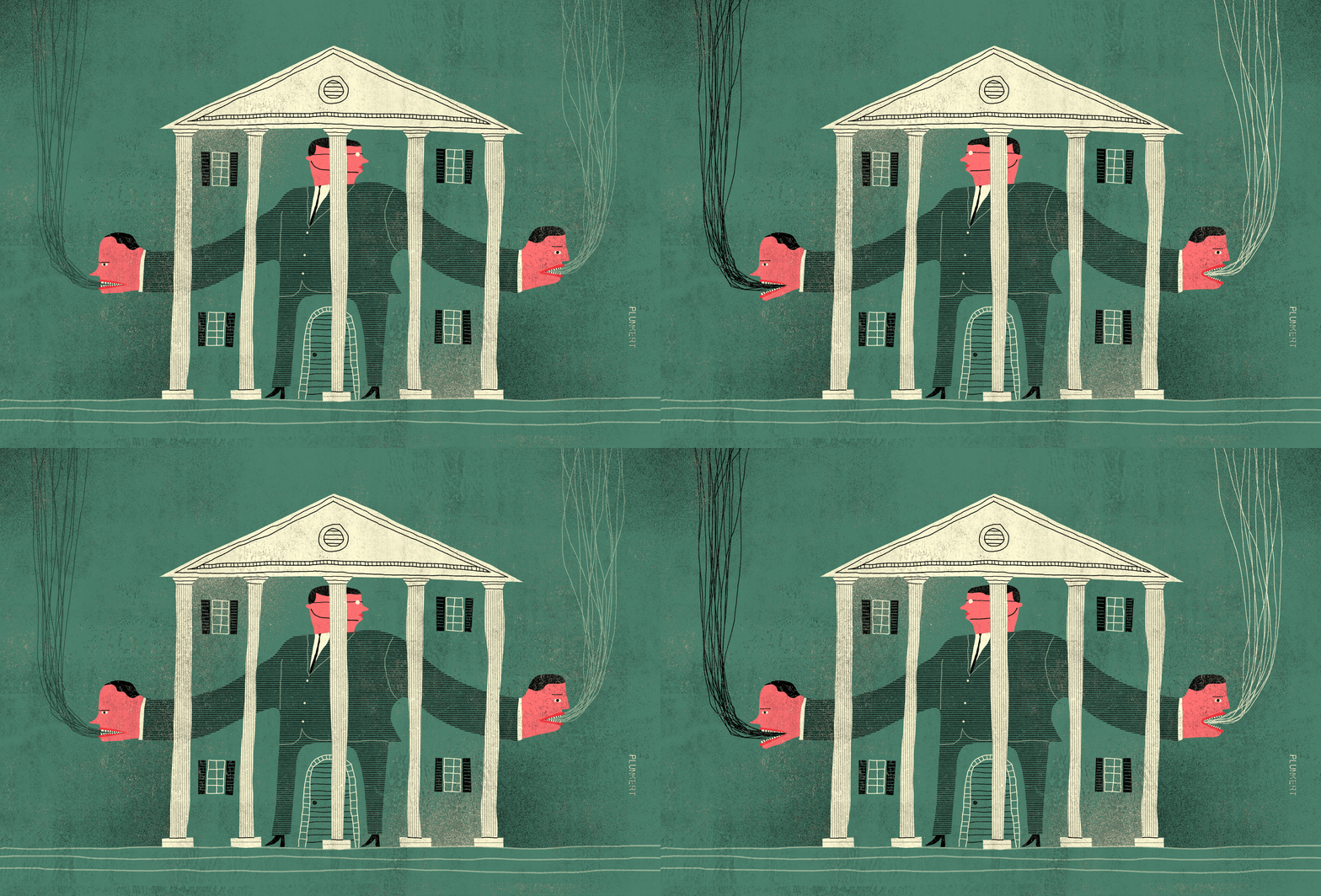
When pressure hits, leaders often ask: “What should we say?” New research on America’s most trusted institutions suggests that’s not the right starting point.
“Just because somebody doesn’t like what you’re doing doesn’t mean you change it,” one cultural leader told Brunswick. “But it does mean you say: I hadn’t looked at it that way. Let me look. And if you think that’s right, you fix it. And if you don’t, you don’t.”
That kind of navigation—principled but not rigid, responsive but not reactive—is what leaders across America’s cultural institutions are trying to sustain amid years of mounting pressure. They are being asked to defend programming decisions, explain donor relationships, and respond to political scrutiny, often while operating under real financial strain—and to do all of it for audiences, donors, boards, staff and artists who each hold different views of what responsible leadership looks like.
New research from Brunswick Insight, combining interviews with cultural leaders and a census-representative survey of 1,000 US adults, examines how these organizations are protecting credibility in this charged environment, and what the public actually expects from them. The findings speak directly to cultural institutions, but may resonate as sharply in the corporate sector, where similar dynamics play out with far less goodwill in reserve.
A Strong Starting Point
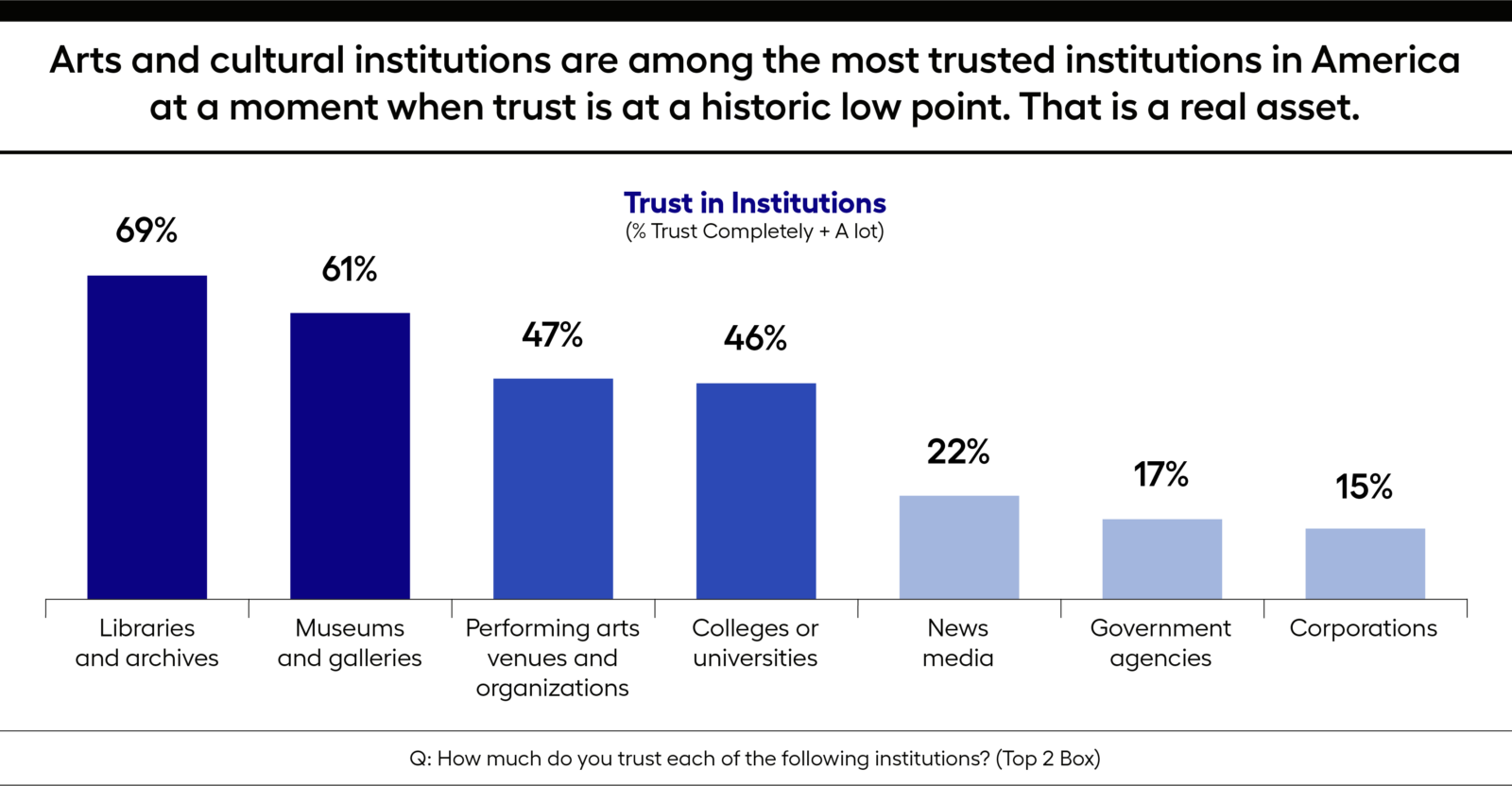
Arts and cultural institutions hold something most organizations have lost: public trust. Sixty-one percent of US adults express high trust in museums and galleries, placing them among the most trusted institutions in America at a moment when trust broadly is at a historic low. Libraries and archives rank even higher at 69%. Corporations were the least trusted institution at 15%.
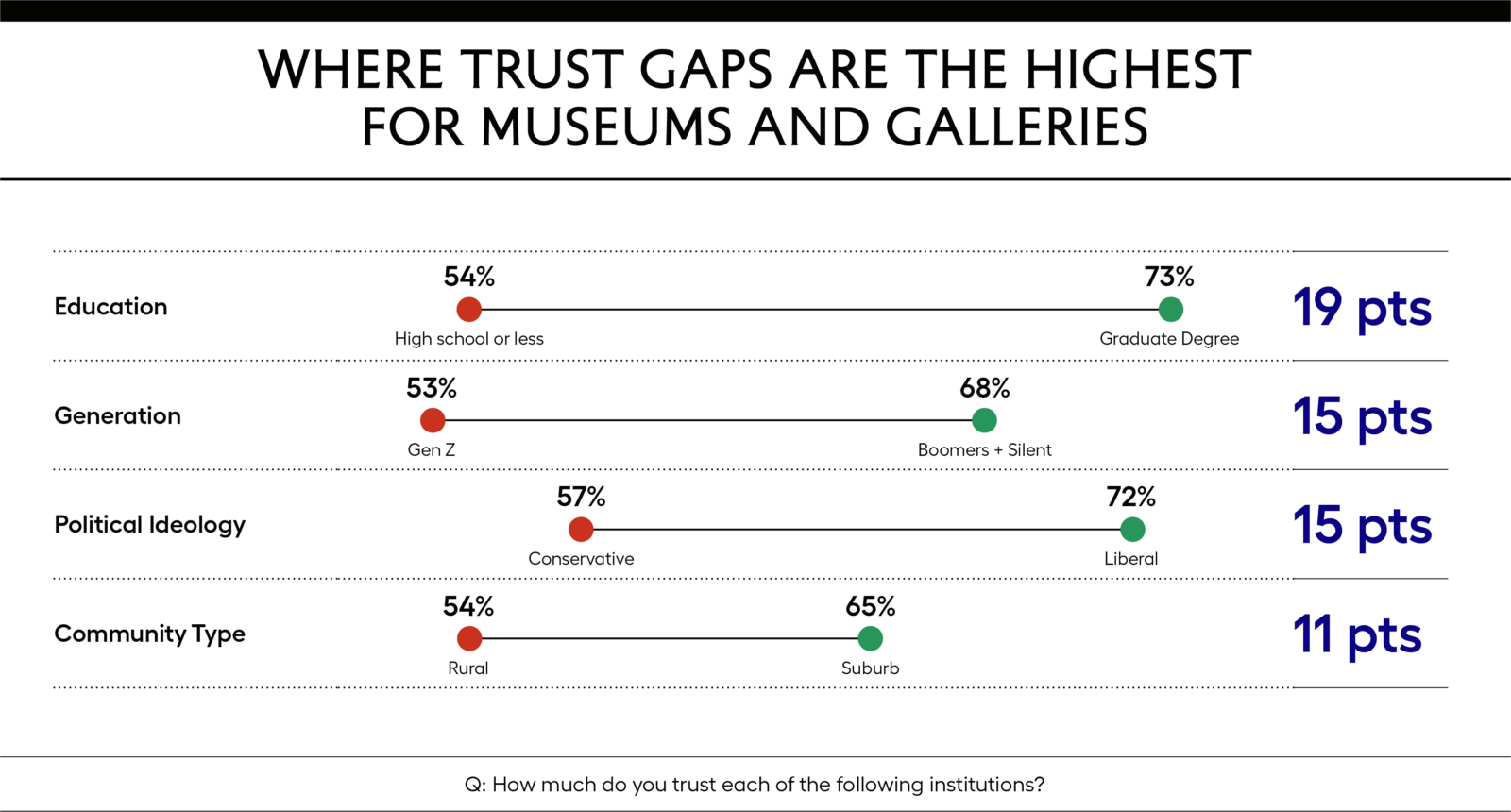
But the trust in these cultural institutions is neither uniform nor unlimited. When looking at how trusted museums are, for example, the study found significant demographic gaps: a 19-point spread between those with a high school education and those with graduate degrees, 15 point spreads by generation and political ideologies, and 11 points between rural and suburban communities.
What the Public Actually Wants
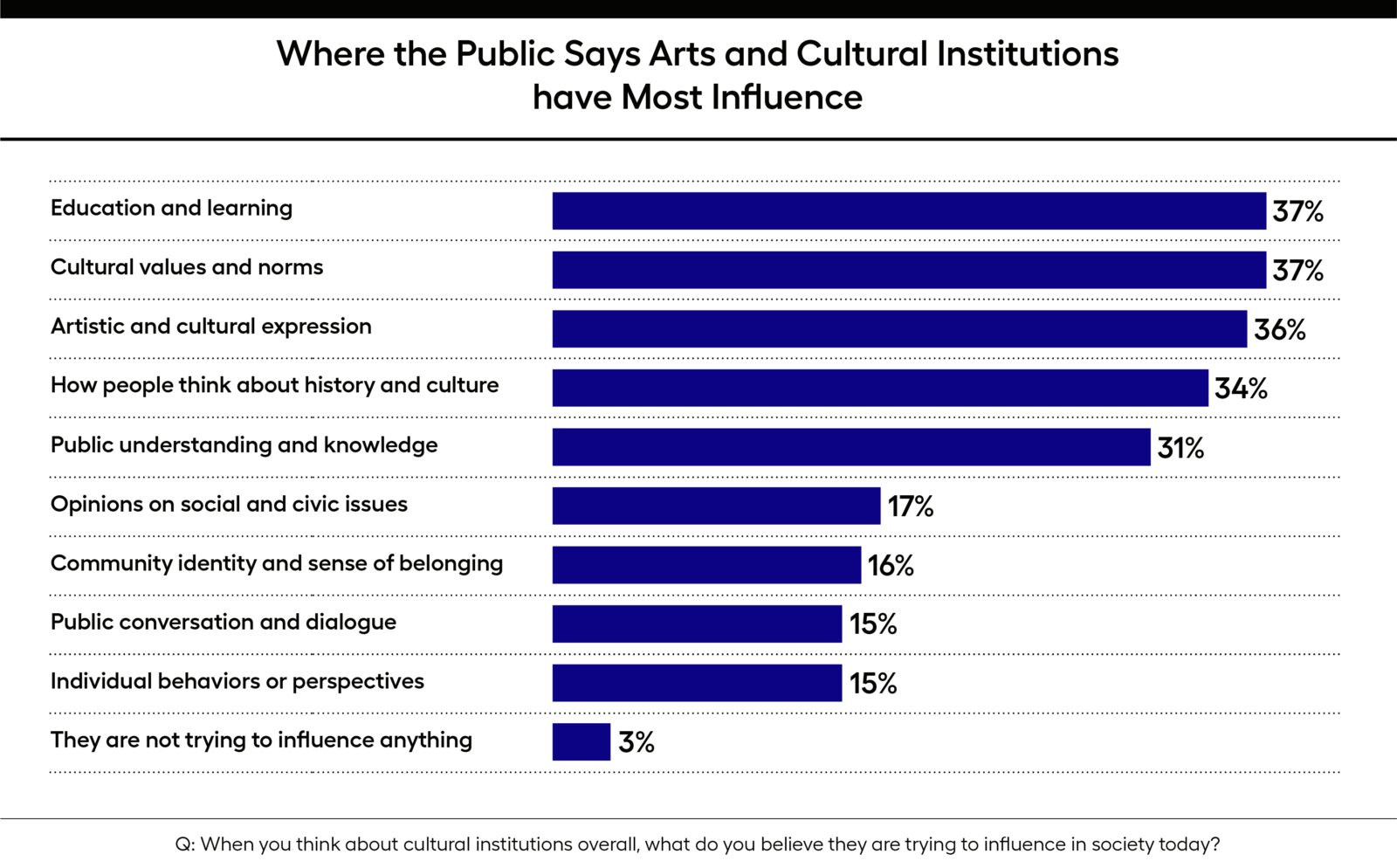
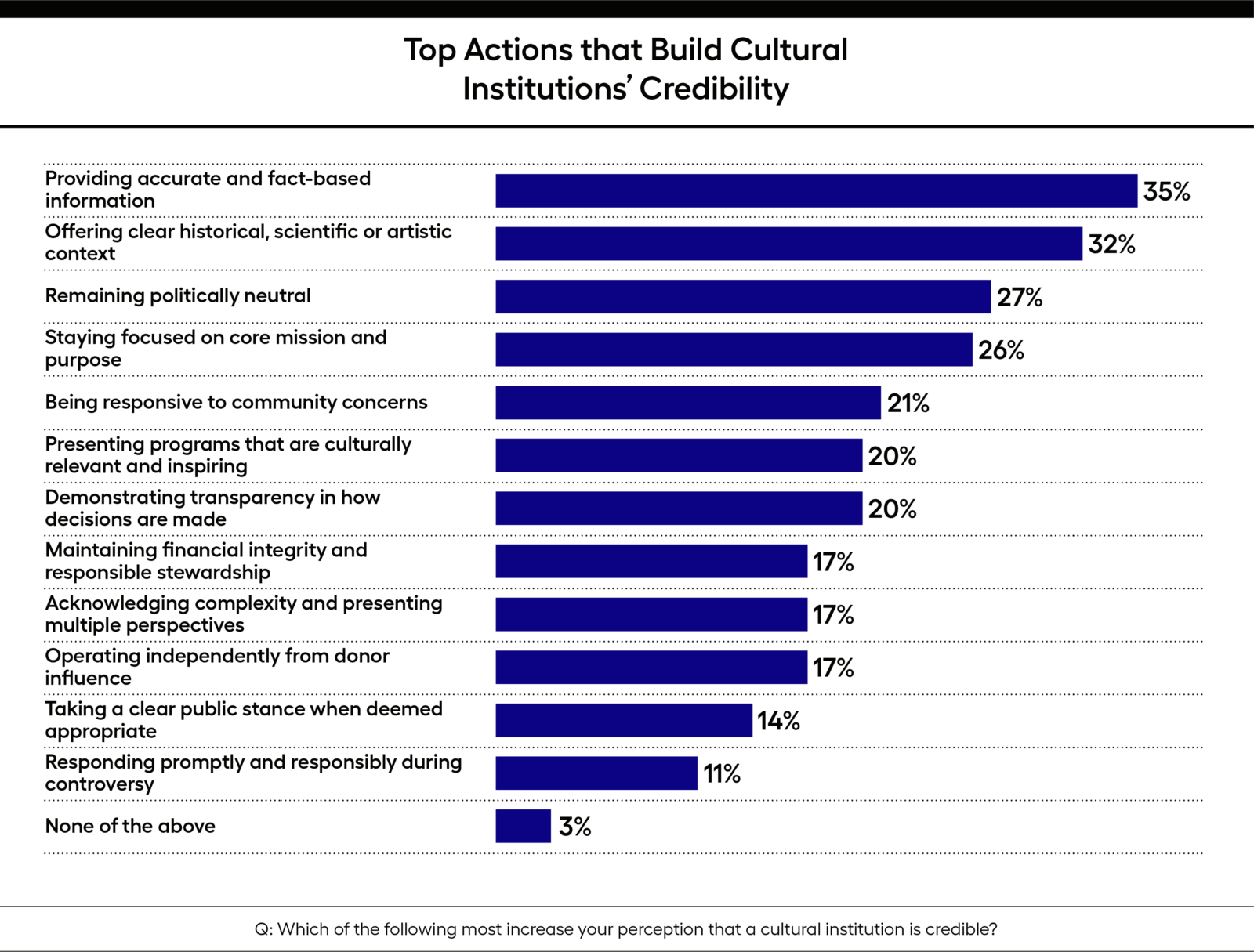
The public has clear expectations for cultural institutions, and they are notably traditional. Preserving history and culture, expanding learning, and broadening artistic access rank at or near the top. Creating public dialogue, driving cultural change, speaking with authority landed near the bottom.
The public is not asking institutions to be activists. But it is not asking them to be silent, either. The data reveals a split: 51% believe engaging on public issues risks damaging credibility, while 49% believe avoiding them risks losing relevance and trust.
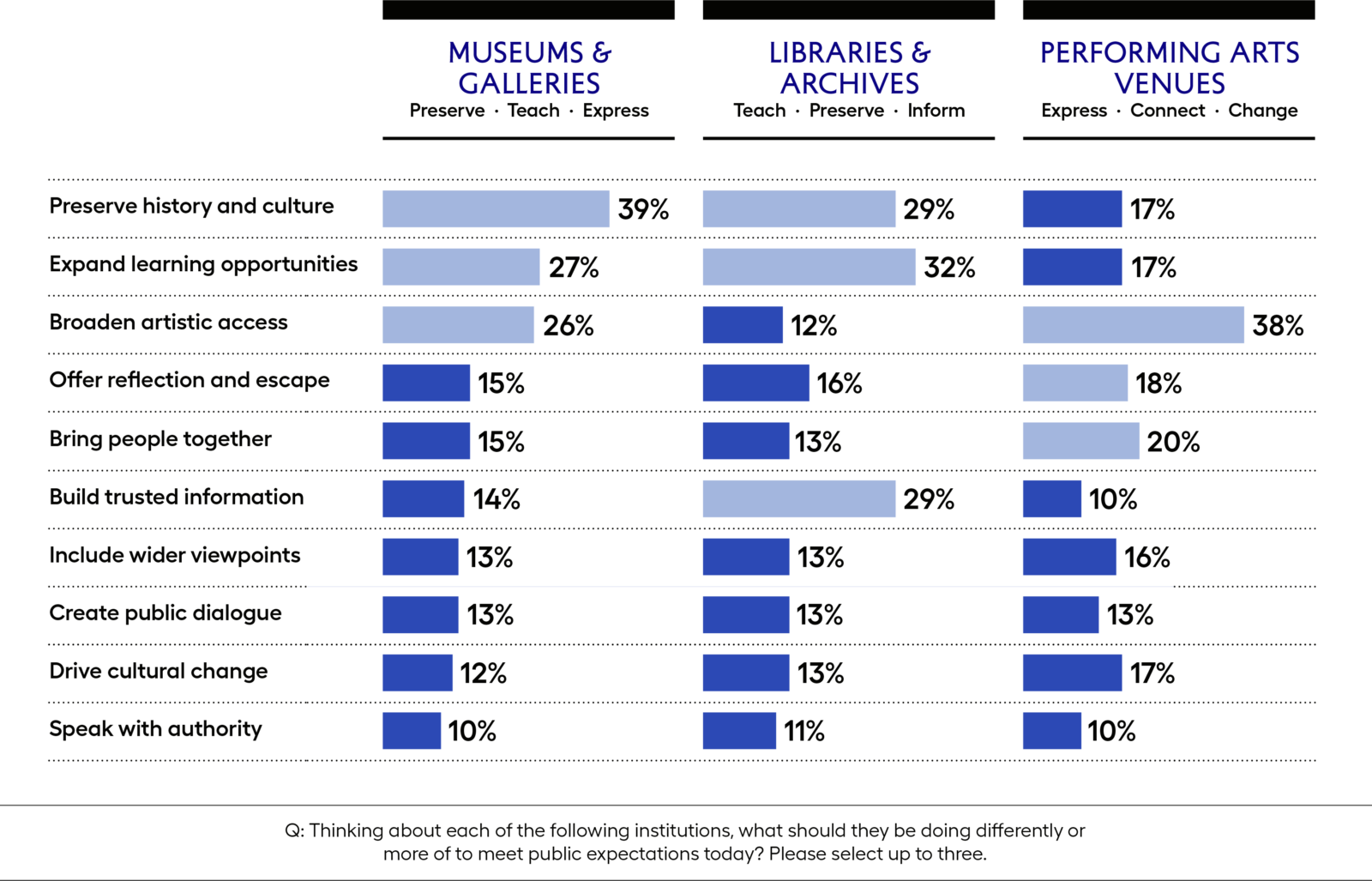
The resolution lies in a distinction the study surfaces: the public separates what an institution programs from what an institution says. Museums are trusted to preserve and interpret history and culture, less so to lead dialogue on social change. Performing arts organizations are trusted to platform artistic expression, less so to serve as credible information sources. Libraries are trusted for access to accurate information, less so as reflections of community identity. Programming has more room to challenge when the connection to mission is clear. The public appears more comfortable with institutions doing hard work through their core functions than with institutions adopting causes outside their established role. This is also where influence lives. Institutions have the most ability to shape thinking and culture in precisely the areas where the public trusts them most.
Not a Case for Silence
A reasonable concern about this research is that it pushes institutions toward self-censorship—that “stay in your lane” becomes “say nothing.” The data is more nuanced.
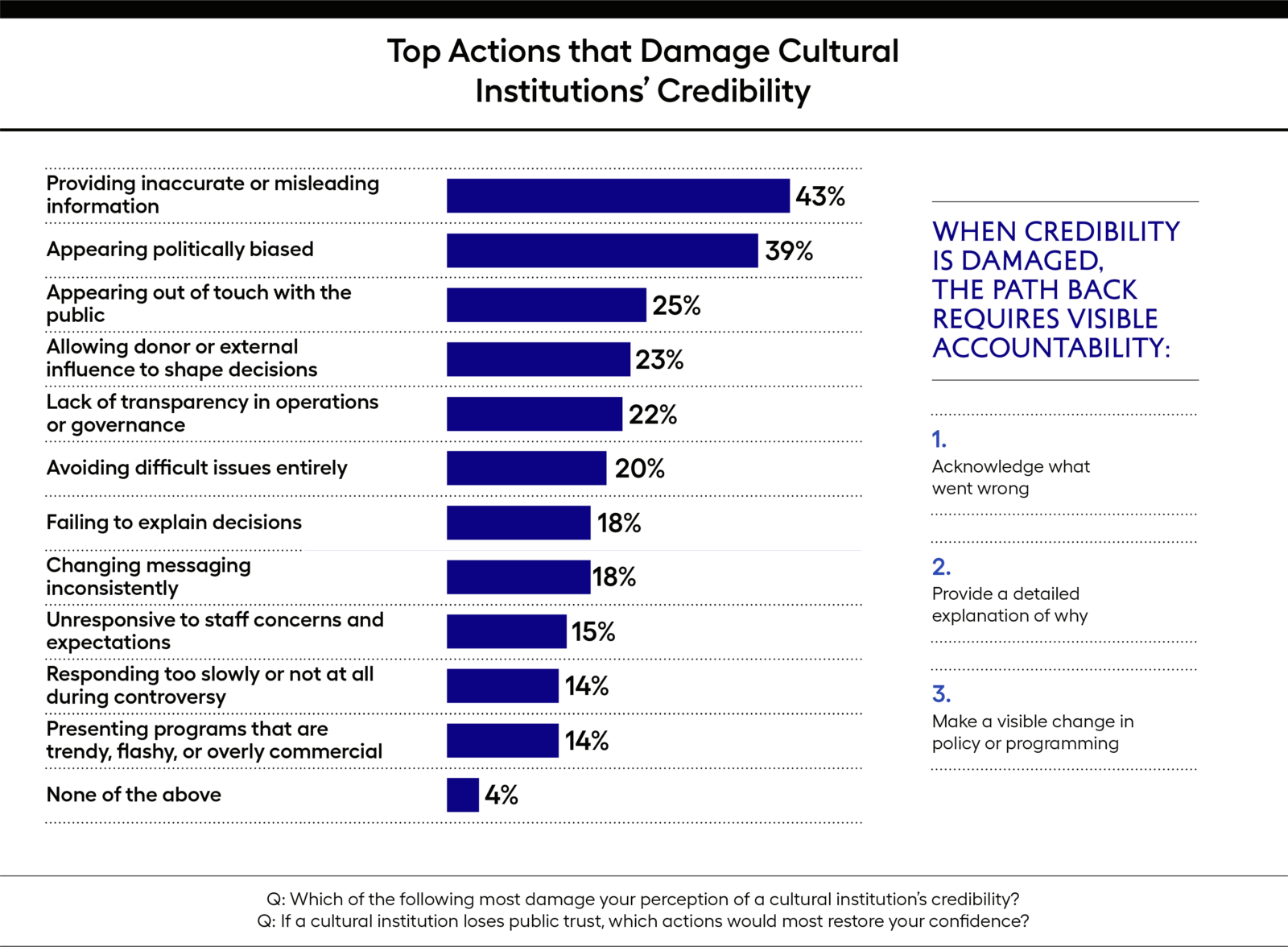
Among the top credibility killers the study identified: providing inaccurate or misleading information (43%) and appearing politically biased (39%). But silence is not safe either. “Not responding covers a multitude of things,” one leader said. “Not issuing a statement, not being open to dialogue, not being available, not communicating. I think that’s the most damaging thing for trust.”
“I think staying true to your values is really the most important thing, whatever those are,” one leader told us. “If you have stated values, stay true to them, defend them. And if you can’t, then maybe those should not be your values.”
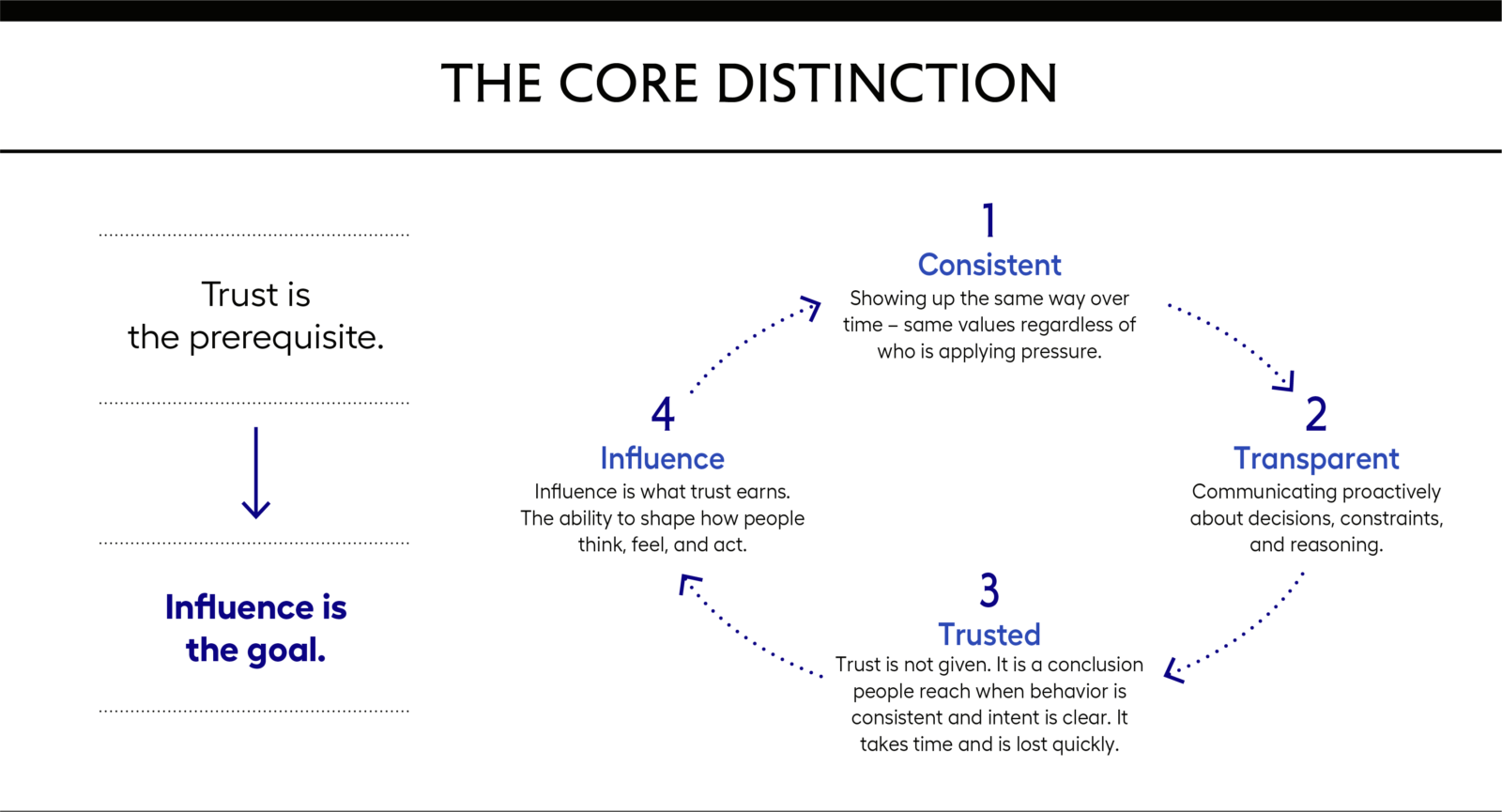
The public’s own answers reinforce this. Sixty-five percent say that being consistent in values and messaging builds trust over time, a view held even more strongly among conservatives (72%) than liberals (52%). Meanwhile, 70% say transparency and openness matter more than carefully controlled messaging, even when openness creates controversy.
“DEAI [diversity, equity, accessibility and inclusion] language may be under attack,” another leader added, “but if we look at our plan, we’ve embedded accessibility and inclusion in so many elements of our day-to-day work that it’s not performative. We’re not just taking a statement down because it’s under attack.”
Acknowledging Pressure
The pressures on cultural institutions are not invisible to the public. Sixty percent believe donors have a legitimate voice in shaping institutional priorities. Fifty-five percent also believe institutions are strongest when decision-making reflects the broader public, not just their funders.
What erodes trust is the pretense that the tensions aren’t there. “You can’t trust an institution if they’re going to take money from people who are undermining your mission,” one arts and culture stakeholder told us. Another leader described the dual temptation more bluntly: “It’s tempting to contort oneself for donors. It’s also tempting to contort oneself for the political power du jour.”
The institutions that hold trust acknowledge these pressures, and let their decisions show how they are being weighed—even in seemingly impossible situations. One leader put it succinctly: “Say what you know. Say what you don’t know, and commit to future updates.”
Lessons for Leaders
If institutions trusted by 61% of the public find this landscape difficult, corporations, trusted by fewer than two in 10, face it with far less goodwill. The principles to navigate it, however, are similar.
Trust is role-specific, and credibility is strongest when actions align with that role. As one cultural leader told us: “They want to see that you are who you say you are, doing the work you say you are doing, for the reasons you say you are doing it.”
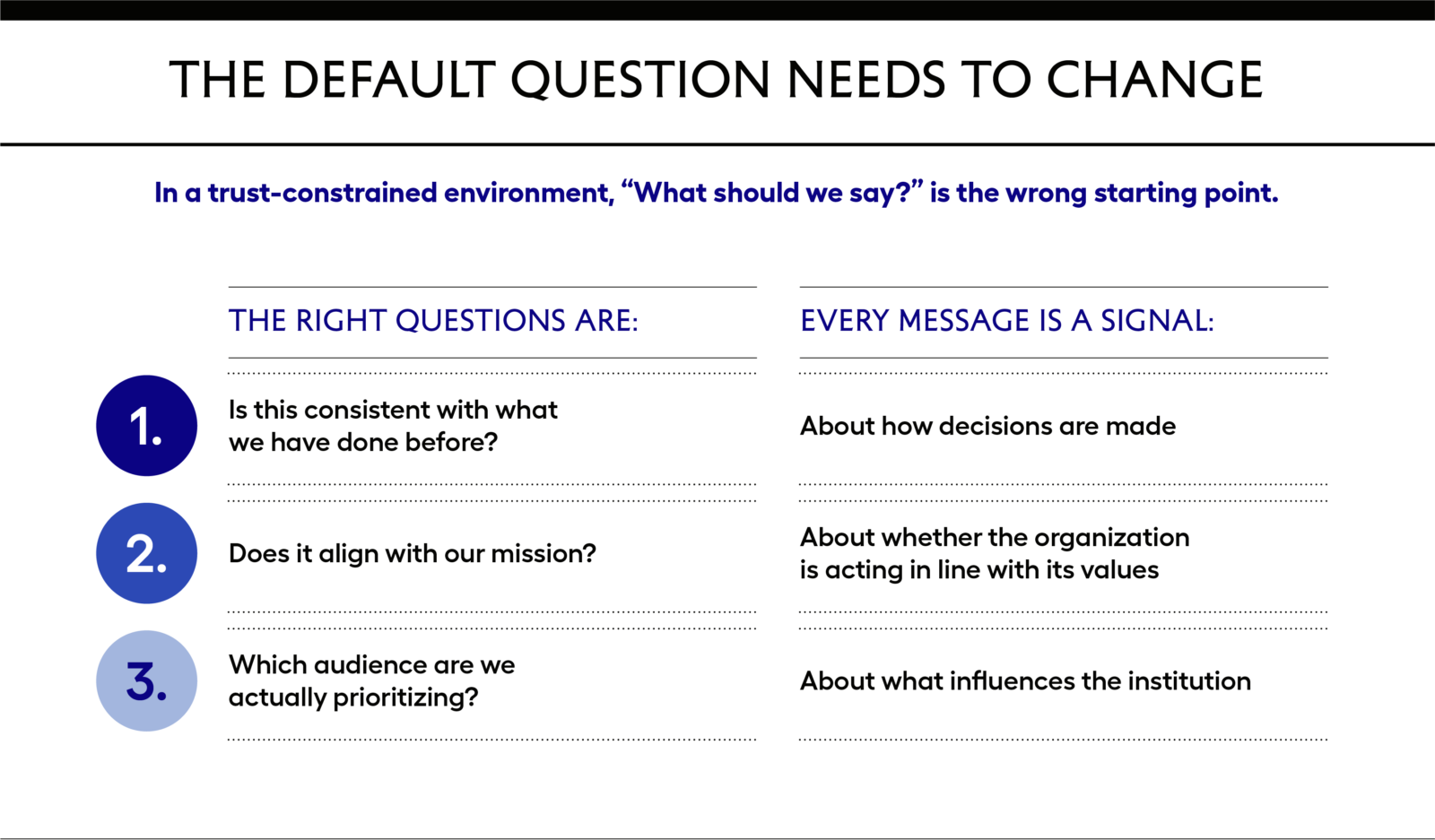
The research is not encouraging organizations to respond more skillfully to what they think people want to hear. That approach produced many of the statements organizations have walked back from. The pull to meet the moment is intense, but the research suggests the most important work takes place much earlier: clarifying, before the pressure arrives, what the institution stands for and how it decides. Leaders who have done that work can defend a programming choice, explain a donor relationship, or respond to political scrutiny without every question becoming a crisis. Durable trust comes from aligning your public position and actual work—before, during, and after the pressure peaks. By then, your actions have spoken far louder than any prepared statement could.
Meet the authors
-

Partner
New York
With Brunswick Arts since 2017, Kim oversees Brunswick Arts in the U.S and has worked with top cultural clients including the Metropolitan Museum of Art,… -
Director
Dallas
Travis leads multi-phased research that guides client strategy in the education, technology, energy, and finance sectors, among others, on projects ranging from crisis communications to… -

Account Director
New York
Maddie is an Account Director with Brunswick Insight, using market research and analytics to help support clients. -

Director
New York
Liza is a seasoned communications expert with nearly 15 years of experience in the cultural sector.
You might also like
William P. Lauder on Leadership and Legacy

Leave the First 100 Days to Napoleon and FDR