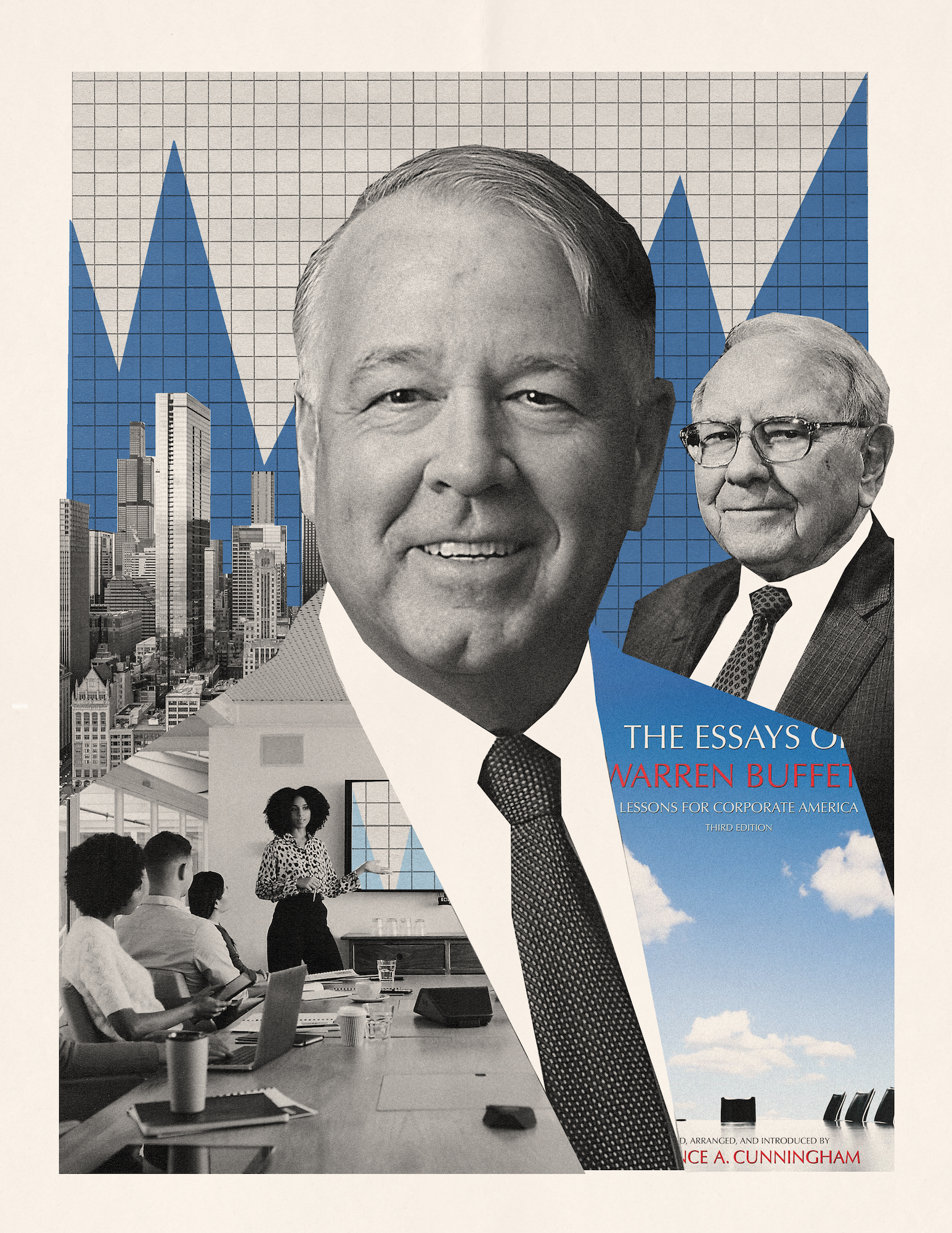
He’s still Chairman of Berkshire Hathaway, but what does it mean that Buffett is no longer CEO? Lawrence Cunningham, author of Berkshire Beyond Buffett, shares insights on the legendary investor and the future of Berkshire.
A high-visibility change in the investment world took place in Omaha on January 1, when Warren Buffett stepped down as CEO of Berkshire Hathaway.
His 60-year run as Berkshire CEO saw its share price rise from less than $20 in the mid-’60s to over $750,000 today. His famously pragmatic outlook and buy-and-hold approach transformed the business from a failed textile manufacturer into a multinational conglomerate with a portfolio of investments exceeding $260 billion. His plainspoken, often humorous letters to shareholders have served as a model of investment strategy for three generations. Every spring, thousands of investors trekked to Nebraska for Berkshire’s annual meeting, a days-long affair during which Buffett presided as a hospitable, smart and funny host.
Will those traditions—especially Berkshire’s history of investment gains—continue under new CEO Greg Abel?
For answers to that and other questions, we turned to Lawrence Cunningham, Buffett’s perhaps most trusted chronicler. A business and law school professor, Cunningham holds seats on multiple boards and is Presiding Director of the Weinberg Center for Corporate Governance.
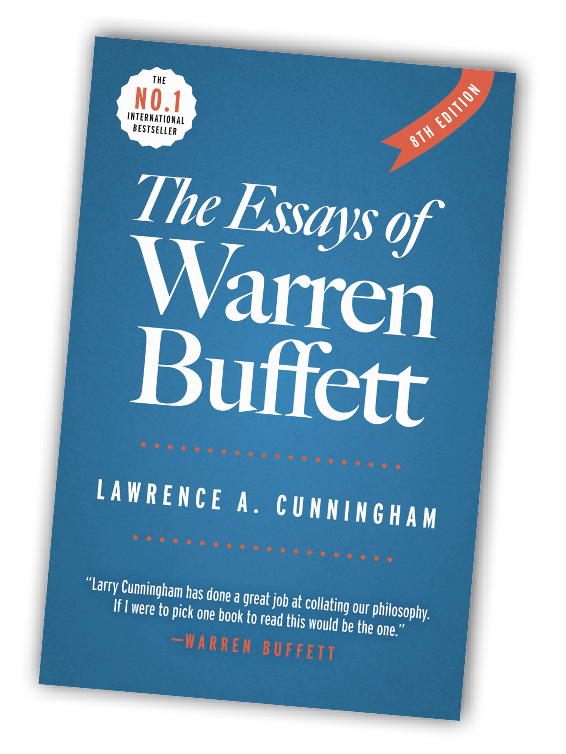
More famously, he is the author of The Essays of Warren Buffett, one of the most popular books in the investment world. Organizing Buffett’s characteristic letters to shareholders by topic, the book has been described as the definitive guide to Buffett’s investment philosophy. First appearing in 1997, it has today sold more than a million copies and has been translated into 12 languages.
In addition to The Essays, Larry Cunningham is the author or editor of over 20 books, including a leading college text on corporations. He has served as a tenured professor at Boston College, George Washington University and Yeshiva University. He received a National Association of Corporate Directors Lifetime Achievement Award in Corporate Governance in 2018 and was included by NACD among “the most influential people in corporate governance and the boardroom.” He is also on the Directors & Boards select list of “Directors to Watch” in 2026.
Can Berkshire Hathaway shareholders place their trust in Greg Abel? After all, he built Berkshire Hathaway Energy into a $133 billion portfolio.
Yes. Think of it this way: Selecting Greg was Warren Buffett’s most important decision in his entire professional career. So, 75 years of allocating capital, hiring people, firing people, managing that big organization and all the CEOs of the subsidiaries, of the companies where he was on the board. Of all that career, this is the most important thing he’s ever done. So, if you trust Warren, by implication, you trust his judgment in Greg. I have some other reasons I think he was a great choice as well. But that’d be my number one.
“Larry Cunningham has done a great job at collating our philosophy. If I were to pick one book to read this would be the one.”
Warren Buffett
You’ve written that Abel might prove to be less tolerant of underperformance. Is that a reason for investors to feel confident?
I think so. Warren is famously hands off. He and his partner Charlie Munger used to joke that they delegate just shy of the point of abdication. Warren doesn’t change managers just because their businesses are underperforming. He’s said that often. Some of the companies are spectacular. But there are a lot of mediocre performers. Could they do better?
Warren’s primary brilliance is investing and allocating capital, not really supervising managers, or even managing businesses. That wasn’t his superpower. In contrast, that is Greg’s superpower. He has very good capital allocation instincts, very good investment philosophy, applies the Berkshire principles. But his superpower is managerial skill, leading people, persuading people, being a manager.
I’ve talked to him about this. He’s going to keep the Berkshire principles of autonomy and decentralization. He was very clear to me about that. But he might feel you have to earn that right to managerial independence. I don’t think he is going to be as hands off. But the company’s also in a different stage now. Buffet built the company from scratch. We’re in a maintenance and operation stage now.
Greg knows he’s not Warren Buffett. I don’t think you’re going to see him having that six-hour Q&A at the end of a meeting, trying to field questions, eating peanut brittle and joking about Coke giving you longevity. I don’t think he’s going to try to do any of that. He will try to write a shareholder letter that he would want to get, if he was the investor. But I don’t think he’s going to try to have Buffett’s Midwestern, aw-shucks witticisms and aphorisms, and quotations of famous authors and filmmakers. He has to be himself. He’ll do it his own way.
How did you succeed so spectacularly in gaining Buffett’s trust?
I would say I gained it through a chain of trust. The chair of my university was one of Warren’s best friends, and the dean at my school was very good friends with Warren’s chief legal advisor. They helped get my proposal in front of him, which was to put together a collated collection of his letters to be the centerpiece of an academic symposium, ideally with him in attendance.
It was a leap, because I knew he had turned down other people who had proposed a book of some sort around his letters. The difference was that I had two people that Warren trusted vouching for me. Warren thinks trust is one of the most important parts of any relationship, business or professional, or otherwise, and he did vet me.
He not only said yes, he brought his whole entourage to our big conference in New York—his wife, his son, Berkshire’s Ajit Jain and Bob Denham, and their wives. The conference was two days, a Sunday and Monday, in late October of ’96, and it was very successful.
What resulted from that was 150 pages of his letters, conversations from the conference, some panelists talking or writing about him, and from that gathering it seemed clear that I should publish it as a book. As it turned out, the conference had gotten a little press, people all over Wall Street were talking about it, and some of the big publishing houses started calling me, offering big advances for a book. So I called Warren and asked for his advice and he said I could do whatever I wanted. But his advice was: Don’t sign a book contract with any publisher. Just publish this yourself. His argument was that once you sign a contract you surrender editorial control, and you get only a fraction of the proceeds. So I took his advice. It was a lot of work but it was worth it. Then it was Warren’s idea to come out with a new edition every few years.
More than an investor, more than a CEO, Buffett is widely respected as a kind of modern-day Ben Franklin, a voice of wisdom and compassion. Is he a role model for younger executives?
Yes. And I know quite a few of them. I’m on the board of two companies where, in both, the CEO is very much a student of Warren’s and sees him as a role model. Not only the CEOs but a lot of the leadership teams and managers.
Beyond those two companies, it’s not uncommon for younger people to see him as a role model. There are also a lot of cynics and critics, and people who think, “oh, that was a different era.” That’s just the generational drift that happens naturally.
But I like your Ben Franklin analogy. One of my favorite things about Franklin is that he was a little older than the rest of those founders. He was a real thinker, a real diplomat, a real organizer. He helped bring the French into the war on our side. He coaxed other people into signing the Declaration. He invented the lightning rod and founded a library and a fire department. He was a polymath, but he didn’t really steal the limelight.
Warren has a lot of those kinds of traits. He obviously has had a huge public personality that he definitely lived in and loved. But he was never a real self-promoter. Very modest about things. It’s harder today, in our much more uncivil society. But Warren had to contend with critics, doubters and naysayers over the years.
He was criticized for missing out on the dot-com era, for instance. He was criticized for opportunism during the financial crisis. And he always played it pretty cool. His ability to stay above the fray earned him, I think, very broad respect.
Can the Berkshire Hathaway model endure?
I think the answer is yes. It will depend very much on the shareholders, in the final word. If Greg is able to promote the performance of the enterprise, across the organization, delivering better-than-market returns—if he can show the value in the model—then the shareholders will nod their heads and agree.
The Berkshire shareholders will be more patient, and this is a big credit to Warren. They’re not here for love or emotion; they’re here for economic returns. But they’ll wait a little longer than average.
Berkshire shows that the conglomerate can still be a wonderful model. And there are other companies that show that too. It wasn’t just the Midas touch of Warren Buffett. There’s something institutional. That’s what my book Berkshire Beyond Buffett is about. It’s about autonomy, decentralization and trust, the business culture of the organization, the commitment to permanence.
Meet the authors
-
Partner
New York
Kevin joined Brunswick in early 2017 as Editor of the Brunswick Review. In 27 years at the Wall Street Journal, he covered politics in London,…
More from this issue
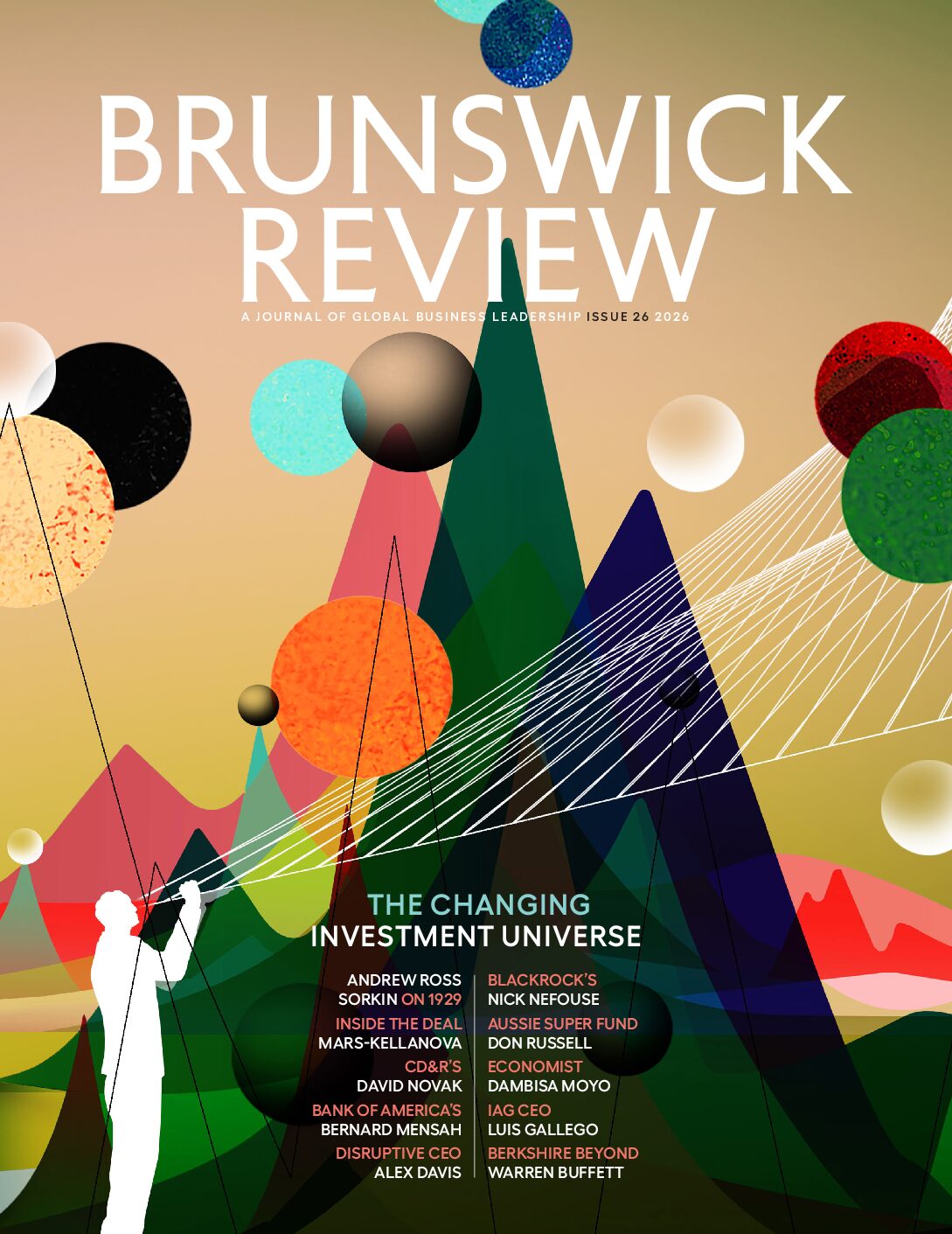
Investment Universe
Most read from this issue
A Generational Deal

Embrace the Complexity
You might also like

COP28: What’s Next

Love Letter from Oscar Munoz