
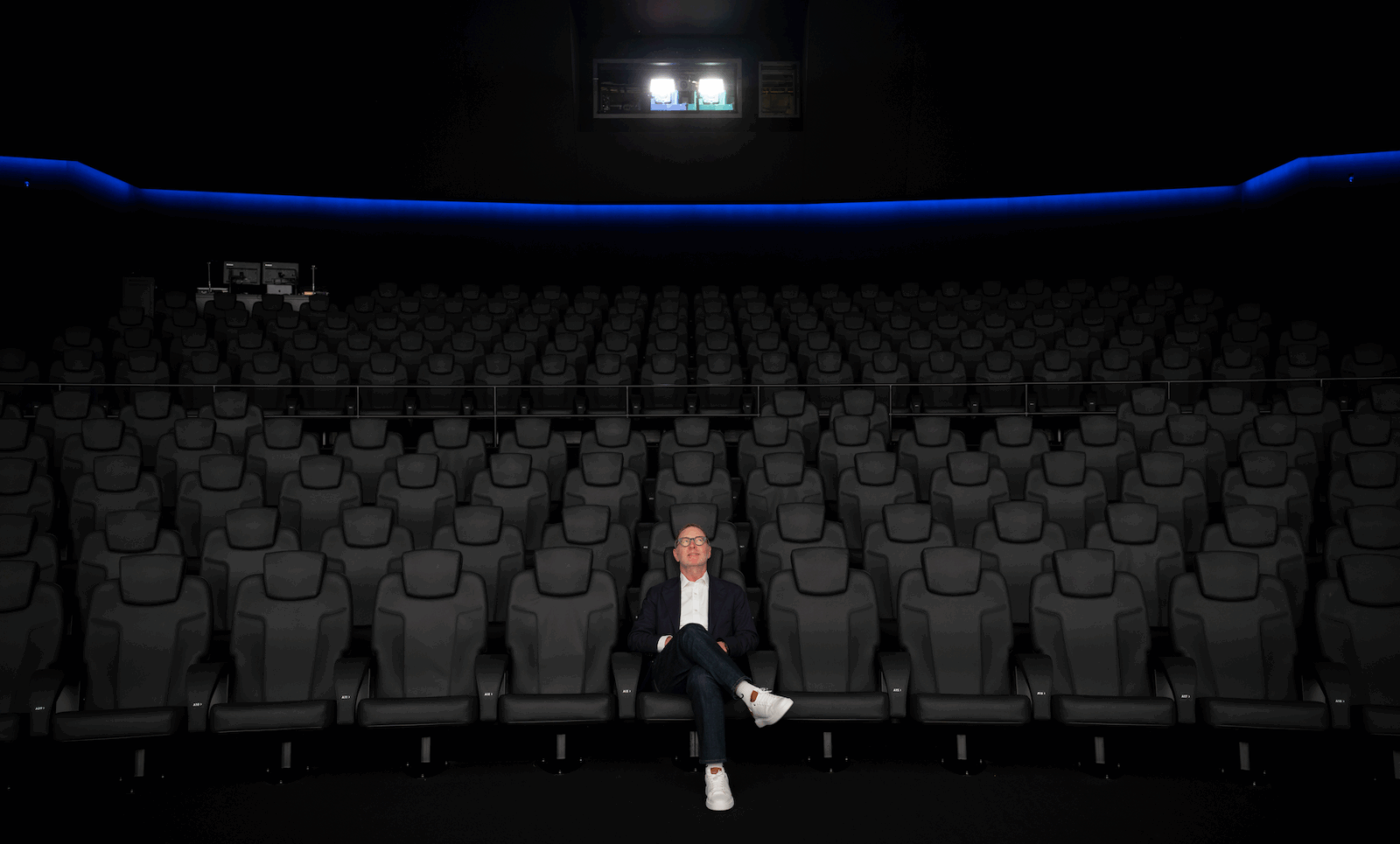
Executive Vice President and General Counsel Andy Sherman reveals the secret behind the 60-year-old company’s consistent pace of world-changing technologies.
For decades, before the opening of many Hollywood films, theater audiences were witness to one of the great branding coups in entertainment history: the Dolby trailer. A short sequence with breathtaking soundtrack and stunning visuals would culminate in the name of the latest Dolby technology enhancing the cinema experience. Debuting in 1971 with A Clockwork Orange, these short reels became a staple of the movie-going ritual.
Those trailers were emblematic of the company’s impact: Dolby shapes how billions experience sounds and images. Yet Dolby may be most remarkable for its behind-the-scenes business model. Rather than building gadgets, it builds the technology inside them, licensing innovations to nearly every corner of the entertainment world. In addition to movie theaters, the strategy puts the company’s products into televisions, smartphones, home audio systems, automobiles, streaming music and many other applications and devices.
That strategy was the brainchild of the company’s founder, Ray Dolby. In 1965, he founded Dolby Laboratories to commercialize the noise-reduction technology that became essential to producers and consumers as a result of his decision to license it to existing audio equipment manufacturers. As the technology landscape changed, the implementation of that strategy became more critical and increasingly complex.
In 2011, the company brought on board Andy Sherman as Executive Vice President, General Counsel and Corporate Secretary. Part of his job was to oversee the company’s legal affairs and worldwide government relations, but he had another important role: to develop new ways to generate value from the company’s ever-growing portfolio of innovations.
The resulting unbranded patent licensing business, which complements the business of the branded licensing of products that made Dolby famous, has grown to play a significant part in the company’s recent success.
Sherman came to Dolby after a career that saw him move from a litigator at a Silicon Valley law firm to Senior Vice President and General Counsel at CBS Interactive. A pivotal moment came early in his career when he accepted a position at a software company. It seemed a natural fit, handling the business’s representation in Latin America. He had been raised in Argentina speaking both English and Spanish. Together with his tech background, he was the perfect candidate. But the reality of the new job wasn’t what he expected.
“My previous position in Silicon Valley had been a very dynamic, high-energy environment,” he told us in a recent interview. “But suddenly I was doing more transactional work. I felt like I had made a mistake. I told my boss that I was thinking about going back to my law firm job and he said, ‘wait, don’t do that. This eventually led to an expansion of my role to include the entire international function.’”
The move gave Sherman new business leadership responsibilities, and a keen insight into the role of legal strategy. “It changed my mindset from being a legal advisor to being somebody who’s positioned to help solve more conceptual and challenging problems at a business level,” he said. That thinking and experience ultimately brought him to Dolby.
I remember in the early ’80s, pressing the Dolby button on a Sony boombox, a large portable cassette recorder. I remember thinking, “OK, who is Dolby? Who is doing that?”
Ray Dolby, our founder, loved music but was dissatisfied with the quality of the sound recording, so he used his degree in physics from Cambridge to figure out how to solve those technical problems. He was a genius technology innovator. Those of us that met him, knew him as an engineer’s engineer. If you did your job as an engineer, people would buy your products. That was his mindset. He thought of marketing as a gimmick.
Ironically, he was a genius marketer. It was important to him that these deeply embedded technologies be visible to consumers as produced by Dolby. The cassette tape cartridge would have the “Dolby” logo, and there was a branded button on the players. The consumer would have to press the Dolby button to immediately hear the sound improve, and recognize that the good sound is Dolby technology. It had the effect of searing the Dolby brand into the memory, like it did for you.
He repeated that again in the cinema industry, recognizing how important it would be for the Dolby brand to be associated with high-quality experiences like stereo. He was part of the negotiation with the studios to create the best cinematic experience, and he traded benefits to ensure that there was a Dolby trailer at the start of each movie that introduced audiences to Dolby sound. Right at the moment where the film was about to start, when people are on the edge of their seats with focus, that’s when you saw the Dolby trailer.

What attracted you to come to Dolby?
One of the things early on that I was curious about was Dolby’s ability to replicate success and innovation across generations of technology, across sectors and across decades. Having one or two successes is unusual. But delivering success after success over such a long period is extraordinary.
History is riddled with companies in virtually every sector that seemed invincible—massive resources, smart leaders, incredible capabilities, robust strategic planning processes that looked way out into the horizon, all of the things people think about when they’re talking about creating long-term success. And yet most of those companies were unable to sustain that innovation.
So the curiosity for me was, what is it about Dolby’s business, and in particular its alignment between intellectual property strategy and business strategy, that has enabled that multi-generational and multi-sector success?
How does Dolby balance those two approaches of continuous innovation on the one hand and focusing on your strengths on the other?
We ask a couple of questions. First, how do we generate value from our innovation? And second, how do we set the stage for future innovation and success? The answers come from a combination of experimentation, which is essential, and staying close to our customers, knowing their concerns.
Much of the experimentation that we do will not have financial success, but we learn a ton from that work. It requires a lot of investment and effort to detect the types of opportunities that can deliver real value.
Then it takes a lot of patience, a lot of investment and wherewithal, to get to a business that builds an ecosystem, and delivers the technologies that activate that ecosystem.
That’s the long-term perspective.
For Dolby Atmos, for instance, we work with the content creation and production communities—everybody from cinematographers to sound mixers, engineers, producers and directors. We work with them to develop next-generation tools and capabilities that allow them to deliver the highest-fidelity, highest-quality entertainment experiences.
We also work with the distribution community, from national broadcasters to IPTV providers to streaming services providers to satellite providers. And remember, each region of the world has its own. Think about the complexity of that work.
Then we work with chipmakers that introduce our technologies into semiconductors that then are available to manufacturers of finished goods, the products that bring audiovisual experiences to every location on Earth. And all of that is constantly changing and it all has to work together.
Dolby’s mission is to unlock the power of sight and sound in pursuit of awe-inspiring experiences. Staying close to each part of the ecosystem helps us find the right balance and stay focused on our mission.
Yet you remain a relatively small company. Is that an advantage, where innovation is concerned?
It’s both an advantage and sometimes a disadvantage. The advantage comes from specialty and focus, really being the best in the world at what we do. The potential disadvantage is that scale can matter in certain environments.
“Right at the moment where the film was about to start, when people are on the edge of their seats with focus, that’s when you saw the Dolby trailer.”
Dolby also helps shape regulation around the world. Can you talk about that?
For a business like ours that has such long time horizons, hundreds of millions of dollars invested to create a next-generation technology, it is important that there’s a framework of intellectual property that allows us basic controls over that and the opportunity to generate value from that so that we can reinvest it in the next generation of technology.
We spend a lot of time helping educate regulators and policymakers, to show them how important incentives are, particularly for smaller innovators that are pure inventors. We have those discussions with regulators in Europe, in the United States and in Asia.
From the days of Edison and the Wright Brothers, often the most disruptive innovations come from smaller companies or from innovation specialists. There are a lot of very big businesses out there innovating. They do great work, no question, and some are great partners of ours. But they don’t have quite the same intellectual property needs as a smaller company, and they don’t innovate in quite the same way as smaller companies do. As a business community, as a society, it is important to protect the innovation that comes from smaller players. Patent protections need to be strong to support that.
How does this type of thinking resonate in China? Dolby is doing well there at a moment when a lot of other companies are pulling back.
We’ve been involved in the Chinese market since the early 1980s and we have been very dedicated to supporting that entertainment ecosystem. We have very close, long-term partnerships in China. Many of our partners are large global companies that are major innovators, and I think that has helped us find common ground. They have become a lot more active as intellectual property advocates across the globe—because they are now major beneficiaries of legal systems that protect innovation. So we’ve seen significant transition. There are discussions about the quality of legal, justice and jurisprudence systems that properly and fairly value intellectual property. We’re increasingly seeing greater alignment between our partners in China on some of these broader global intellectual property policy ideas.
Can you talk about Dolby’s use of patent pools and how that has worked for the business?
Patent pools are the go-to-market strategy for our patent licensing business. They have been in existence since the 1800s, but have recently become more popular as a solution to license patents essential to implementing technical standards. It’s kind of an “exotic plant” area, but important in the tech world.
To understand why patent pools make sense for us at Dolby, we first need to understand something about technology standards. In our space, standards are needed to ensure interoperability—to ensure that audio or video captured anywhere can be streamed over any network, and viewed on any device. To accomplish that goal, we work in standards bodies—alongside many companies, universities and research institutes—to develop the audio and video technologies that form the backbone of that interoperability. The best ideas emerge and are adopted in a standard. The challenge is that this process can lead to 40, 50, 60 or more owners of the intellectual property embodied in the standard.
That’s difficult from a licensing perspective. Nobody wants to negotiate multiple licenses for a single technology. A patent pool solves the problem by putting all the patents together into a one-stop shop and then offering them, in a single transaction, to the implementers, the manufacturers, in a way that’s efficient for them and fair to all the IP owners.
We participate in many different patent pools and contribute to those underlying standards. That’s an extension of the broader Dolby strategy of supporting technology ecosystems.

Does that interfere with the ability to license Dolby-branded technologies?
No. The Dolby-branded and patent licensing businesses are complementary. They offer different products in different ways. One example that I like to use, to help people understand why, is Honda. Honda Motors sells more engines than anyone else in the world—but not because of its branded products. Most of the engines it sells end up in devices that are not Honda-branded. They are components in products manufactured by others—from lawnmowers to leaf blowers to irrigation systems. So Honda has effectively used its engine-building expertise to create an unbranded business that doesn’t compete directly with its branded products.
That’s similar to us. We have branded offerings for customers that need complete audio and video technology solutions. It’s really a full-service business. We also use our expertise to contribute, along with other industry players, to standards that ensure interoperability across the ecosystem.
To reiterate: These are different products for different use cases.
Let’s talk more about Dolby Atmos. Theaters can optimize their sound systems for it, but the technology can also adapt to whatever system the user has, is that right?
Atmos is a level of abstraction above stereo or surround sound channels. With Atmos, you can identify 128 discrete sound objects and place them in your listening environment, given the properties of the playback environment.
If you are optimized with 150 speakers and many subwoofers, you’re going to get the most advanced sensation of sound, the most realistic. In your living room, you’re going to have fewer tools to be able to recreate it. But the technologies calibrate the dimensions and the reflective properties of your room and then use the speaker systems of soundbars, for example, to bounce sound off the reflective surfaces—off the ceiling, off your back wall—to deliver those sound objects to you in your room. It recreates the sensation that you’ve got speakers all the way around you. It’s pretty amazing.
Bradley Cooper used Atmos in the film A Star Is Born (2018). He was the director and the lead actor. He used our testing lab to incorporate Atmos into the film. He’s aligned with us because we gave him the opportunity to represent what it feels like—the experience of fame in this case—in novel and realistic ways.
There’s this one scene in the film where Lady Gaga’s character shows up at a stadium where he’s performing. There are tens of thousands of people. This was filmed in real, live environments. She walks through the back channels of the stadium, and it’s muffled, and as she’s getting closer to the stage, it’s getting clearer and clearer. When she arrives onstage there’s this huge explosion of sound from the band and the audience. You’re hearing the music from her perspective, as the musicians would hear it, from the onstage monitors (where the mix is tailored for each musician), so it changes as she walks across the stage. You’ve got the sound of the audience coming in in waves, reverberating.
These audio technologies are enabling that feeling of emerging from the depths of the tunnels backstage to the stadium stage. You’re feeling like you’re on that stage.
Whether it’s Atmos, or whatever comes next, Dolby will continue to work with the creative community, we’ll continue to innovate, so that audiences can continue to enjoy awe-inspiring sights and sounds as the artists intended them.
Meet the authors
-
Director
New York
Carlton Wilkinson is a Brunswick Director and Managing Editor of the Brunswick Review, based in New York. He is an award-winning journalist, a music educator,… -

Director
San Francisco
Stina advises clients on a range of critical issues with an emphasis on public affairs, multi-stakeholder engagement, and integrated corporate campaigns.
You might also like

Quietly Disruptive

Milken Institute CEO Richard Ditizio