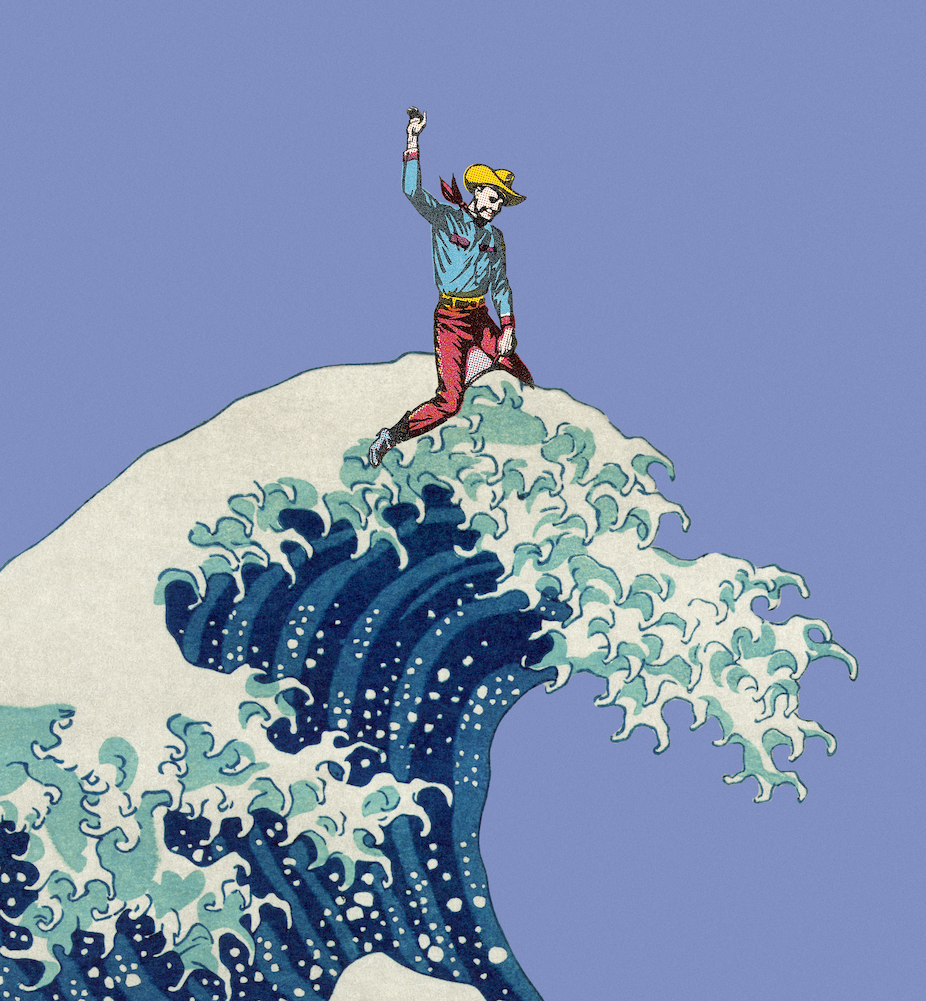
Brunswick looked to a 19th century example to create a new tool for understanding crises as they emerge.
In the early 19th century, the Royal Navy officer Francis Beaufort confronted a problem that will feel familiar to anyone who has ever sat in a modern crisis room. Sailors had plenty of words for wind—breeze, gale, storm, hurricane—but no shared way of judging what those words meant in practice. Beaufort’s answer was not to pretend he could control the weather. It was to create a common language for judging its force.
His scale was practical before it was scientific. It described not abstract numbers but observable effects: what the wind did to the sea, to sails, to the working life of a ship. The Beaufort Scale has endured, long after instruments became more precise, and remains part of the language of professional storm and marine forecasting today. It turned lived experience into a shared system of judgment.
Brunswick’s latest thinking on crisis begins from a similar instinct. No advisor can control a crisis any more than a sailor can control the wind. But after working inside of hundreds of crisis war rooms over the last 40 years, we can begin to recognize the signs: which storms pass, which intensify, which change direction and which threaten the vessel itself.
Every crisis room eventually arrives at the same questions. How bad is this? What kind of crisis are we actually dealing with? Where does it go next? Will we make landfall or hit the rocks? And what can we do now to make the trajectory better?
Those questions are rarely easy to answer. In the early stages of a crisis, facts are incomplete, emotions are high and different advisors see different parts of the threat. Lawyers may focus on liability. Operators on recovery. Communications teams on narrative. Boards on leadership and control. Regulators on process and accountability. Employees and communities on care. Each is right, but none is sufficient. Worse still, many of them will have never seen anything like this before.
The best answer is experience: the memory of the advisor who has seen something similar before. That remains indispensable. But experience distributed across a global firm is difficult to summon quickly. It sits in people, offices, inboxes, old playbooks and the scar tissue of past mandates, almost all of which are highly confidential and therefore difficult to share.
Our Storm Tracker tool is an attempt to make that experience more systematic, to build something usable that is rooted in the real world, not AI vaporware.
The starting point was Brunswick’s Crisis Research Project. We reviewed around 350 major crisis mandates from 20 countries over the past five years, conducted roughly 100 structured interviews with advisors who had led the work, and gathered thousands of data points about crisis type, speed, scrutiny, stakeholders, vulnerabilities, decisions, deliverables and outcomes. A second phase then grouped the findings according to commonly repeated archetypes. All the work was anonymized for confidentiality and legal reasons, but its purpose was practical: to understand how crises actually behave from inside the room.
Several findings stood out instantly.
After working inside of hundreds of crisis war rooms over the last 40 years, we can begin to recognize the signs: which storms pass, which intensify, which change direction and which threaten the vessel itself.
First, crises today move very quickly. Brunswick’s analysis found that more than a third of incidents go public within 72 hours, while the overwhelming majority eventually become known outside the organization in some form. That does not mean every crisis explodes instantly. Some remain slow-burn investigations for months. But the window in which leaders can organize themselves before external scrutiny arrives is shrinking.
Second, not all crisis archetypes behave alike. Cyber incidents have become one of the largest categories of crisis work, but they are not always the most reputationally toxic. A contained data breach may be operationally urgent but reputationally survivable. A product safety issue, industrial accident or sudden death may be less frequent but far more emotionally combustible. In our research, product and industrial cases were disproportionately likely to attract high or sustained levels of scrutiny.
Third, the trigger is rarely the whole story. What determines whether a crisis intensifies is often what it reveals about underlying trust: customer confidence, stakeholder confidence, governance weakness, leadership credibility, culture, political exposure, digital vulnerability. The event lights the fuse. The organization’s pre-existing reputation determines how fast it burns.
Fourth, the hardest decisions recur. How open should we be? When should we disclose? Who must hear first? How do we balance legal caution against reputational necessity? Do we appear calm or defensive? Do we own the issue or contest it? Do we speak globally or market by market? The details change, but the forks in the road are familiar.
Storm Tracker is designed to organize these patterns into a usable tool. Its first version is a 1–5 severity scale, with decimals where useful. At one end is a manageable critical issue: contained, localized, with limited stakeholder exposure. At the other is an institutional or existential crisis: a threat to leadership, license to operate, long-term viability or fundamental stakeholder trust.
But the score is only the beginning. A storm category is useful. A forecast track is more valuable.
A live crisis needs at least three assessments. The first is current severity: What does the situation look like now? The second is likely peak severity: How bad have similar cases become? The third is escalation potential: What could push this further if handled badly, or pull it down if handled well?
That distinction changes the conversation. A client does not simply need to know, “This is a 3.2.” They need to understand whether it is a 3.2 likely to dissipate, a 3.2 with a credible path to 4.5, or a 3.2 that is already quietly becoming something more severe because the organization has not yet understood the real stakeholder at risk.
Weather forecasters use a cone of uncertainty to show that a storm has a probable path, but also possible deviation. A crisis has something similar. There is a current state, an expected track, a tail risk and a stabilization path. The task is not to create false precision but to identify the conditions that move the crisis up or down.
Take an industrial accident involving fatalities. A basic assessment might say: This is a major crisis. That is true, but insufficient. The more useful question is: What kind of major crisis is it becoming?
Is it still in the shock and rescue phase? Has it moved into causation? Is accountability now the dominant frame? Is the company trying to restart operations before the community believes it has earned the right to do so? Are regulators asking technical questions, or are politicians beginning to frame the event as a failure of oversight? Is the company seen as present and humane, or distant and legalistic?
The same rating can conceal very different trajectories. One industrial accident may peak quickly and decline if the cause is isolated, the company acts credibly and families are treated with care. Another may become a long-running accountability saga if evidence emerges of known defects, ignored warnings, regulatory gaps or systemic neglect. A third may become a contagion event if the incident calls into question the parent company’s wider governance or license to operate.
Storm Tracker’s value lies in those distinctions. But to be effective it also needs to be informed by the peculiarities of the specific situation. What level of media or political scrutiny is already at work? How strong is the organization’s existing reputation and what other vulnerabilities does it have?
The point of Storm Tracker is not to predict the future. It is to make the future more discussable.
Our prototype has already been tested against historic cases from the research. In the first scoring run, 100 high-confidence crisis cases were assessed for initial severity, peak severity and escalation potential, based on structured interviews with the advisors who led the work. The distribution was reassuringly imperfect. Most cases clustered in the serious but not catastrophic range. A smaller group reached major reputational crisis. Only a handful sat in the institutional or existential tail. That is what one would expect from a dataset made up of major Brunswick mandates, but it matters that the model did not simply classify everything as extreme.
The archetype differences were also instructive. Industrial accidents, sudden deaths and product safety cases tended to score high because they involve human harm, public emotion, regulatory scrutiny and questions of control. Cyber cases split more sharply: General data-loss matters often scored lower than ransomware or operational-disruption cases, where business continuity, customer confidence and systems resilience were all at stake.
We are now testing an advisor-led prototype that uses AI to structure the assessment, surface comparisons and record the evidence base. A partner provides rough facts; the tool asks targeted questions, proposes a provisional Storm rating, identifies evidence gaps and produces an evidence ledger. The crucial control is that the AI proposes and the partner decides. It is a structured challenge to judgment, not a substitute for it.
That control is essential. No client should be told that “AI has scored your crisis.” The value of Storm Tracker is not automation. It is calibration: Comparing a new situation with Brunswick’s lived experience of hundreds of similar situations and making the reasoning explicit.
The best output will not be a score report. It will be a Storm Readout: current severity, likely track, tail risk, stabilization path, closest comparisons, decision watchlist and recommended response posture.
For example: “This currently ranks as a Category 3.4 cyber-ransomware crisis. Comparable cases suggest it could remain contained if operations are restored quickly, customer impact is limited and regulators are reassured. But it has Category 4.4 potential if customer data exposure, operational paralysis or evidence of prior weakness becomes public. The next decisions that matter are disclosure timing, regulator engagement, customer sequencing and whether leadership appears credible.”
That is a very different conversation from, “This is bad.”
It is also why the tool may be as useful before a crisis breaks as after it has begun. If a company can see that a moderate incident has a high escalation path because of weak stakeholder trust, poor preparedness or unresolved prior issues, it can intervene earlier. It can build relationship capital, rehearse decisions, clarify roles, prepare holding language and identify the stakeholders whose confidence will matter most.
There are risks in this work. A scale can create an illusion of certainty. A decimal can imply more precision than the evidence supports. A dashboard can tempt people to believe the answer is in the tool rather than in the room. Those risks must be designed against. Every score needs a confidence level. Every conclusion needs an evidence base. Every assessment must be open to challenge. High-severity cases need senior review. Missing evidence should lower confidence, not automatically lower severity.
But the alternative is not purity. The alternative is leaving judgment unstructured, precedent undiscovered and lessons trapped in institutional memory.
The point of Storm Tracker is not to predict the future. It is to make the future more discussable. To help a leadership team understand what kind of storm it is facing, what comparable storms have done before, what might intensify it and which decisions now may bend the track.
Beaufort did not control the wind. He gave sailors a shared language for its force. In an age of permanent crisis, that is a useful ambition for advisors too.
You cannot control the storm. But you can learn to read it better.
Meet the authors
-

Partner
Paris
Dan is Global Co-Lead of Brunswick’s Crisis, Litigation and Cybersecurity practice, specialising in helping companies manage their reputation through both proactive transformation programmes and reactive… -

Director, Digital Consultancy
London
George leads our global digital and technology consulting work. -

Executive
London
Lottie Keys is an Executive with the Crisis team in London.
More from this issue
Crisis
Most read from this issue
The 4 Paradoxes of Crisis

The AI Disconnect
You might also like

Embrace the Complexity

The Brunswick Leadership Stress Index