
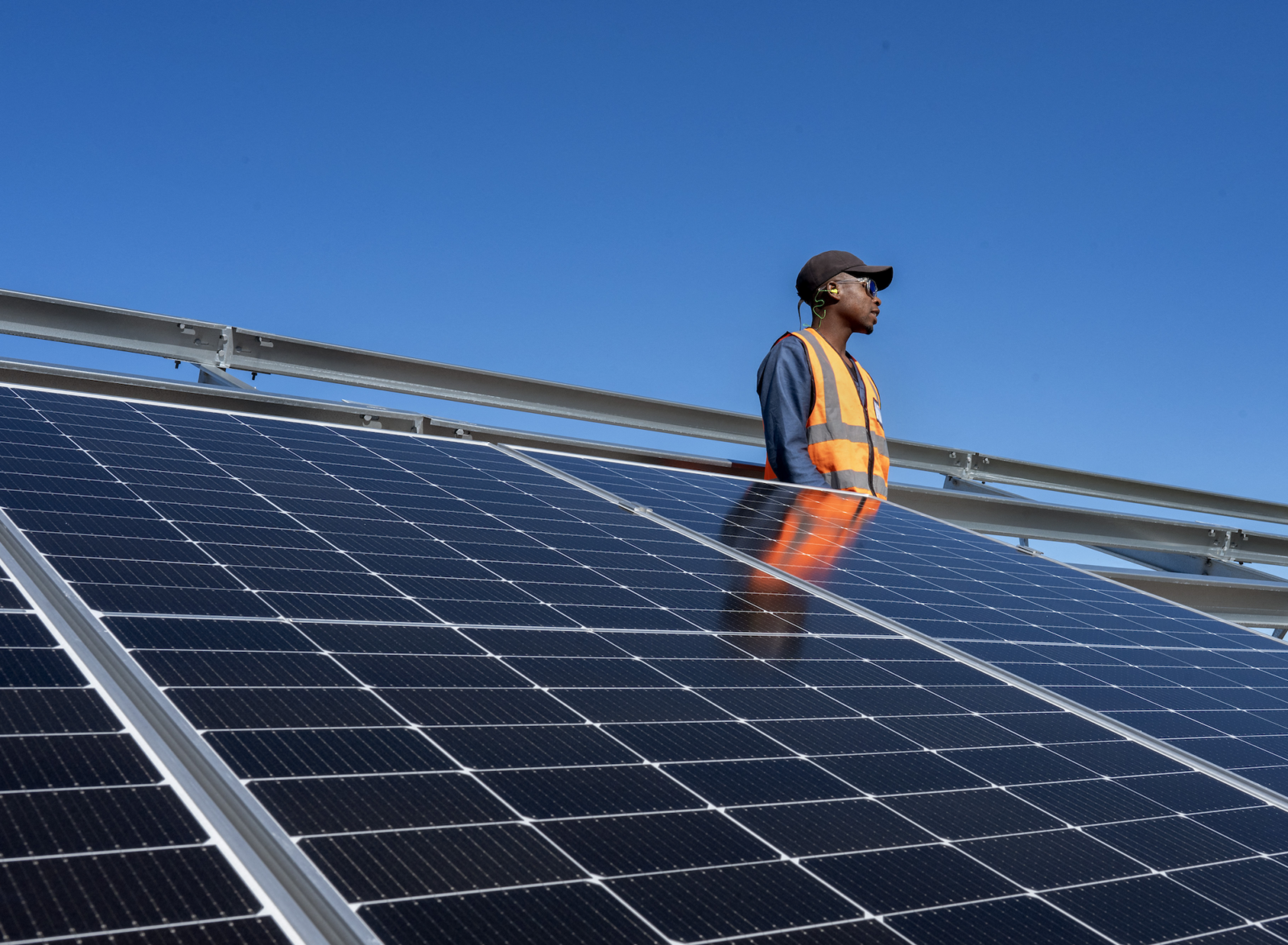
The G7’s investment window is closing, says Itumeleng Mahabane.
Could the European Union’s €750 million ($867 million) investment in South African green energy, announced on the periphery of the G20 summit, signal something larger: that the race for Africa’s energy transition is accelerating, and Western institutions risk being sidelined?
Perhaps the fundamental question is not whether Africa will industrialize through green energy, but rather, which institution will help shape that transition and gain preferential access to a vast infrastructure market?
Africa’s solar capacity, and its ability to produce 50 million tonnes of green hydrogen annually by 2035, can shore up global clean energy supply and decarbonize heavy industry, according to a 2022 study by the European Investment Bank, the International Solar Alliance and the African Union. With 1.2 terawatts of renewable energy potential and 60% of the world’s highest-quality solar radiation, Africa could become a global green manufacturing hub, with IEA estimates projecting 340–650 gigawatts of installed solar panels by 2050.
Green hydrogen costs are dropping and by 2030 are expected to be at €2 ($2.3) per kilogram across several African countries, on par with fossil fuels on an energy-cost basis. For the developed world, this represents a secure, clean manufacturing energy source. For Africa, it is the foundation for a new industrial opportunity, built on a potential resource it possesses in unparalleled abundance.
With 1.2 terawatts of renewable energy potential and 60% of the world’s highest-quality solar radiation, Africa could become a global green manufacturing hub
The IEA projects clean energy investment needs of $130 billion annually. Africa currently receives less than 3% of global clean energy investment, creating a $90 billion annual gap. Between 2022 and 2050, $2.9 trillion in cumulative capital expenditure will be required, with annual energy investment expected to more than double from $70 billion in 2022 to $160 billion by 2050. Also by 2050, 43% of this capital will be dedicated to developing hydrogen and renewable energy infrastructure.
At the generation level, Africa needs massive investment in solar farms, wind installations and hydroelectric capacity. But generation alone is insufficient. The continent requires modern transmission grids, high-voltage interconnections that link countries into continental power networks, reducing energy costs and improving resilience. And critically, Africa needs hydrogen production hubs, industrial-scale facilities where electrolyzers convert renewable electricity into green hydrogen for export and domestic use.
Yet Africa’s investment challenge is shaped less by resource fundamentals than by the global cost of capital. African economies carry $1.8 trillion in debt with $90 billion in annual servicing costs, elevating risk premiums to the point where, as noted by Wamkele Mene, Secretary-General of the African Continental Free Trade Area, borrowing costs are 20 times higher than in Western Europe—a distortion that directly increases project costs and slows investment.
The pathway that builds genuine industrial capacity, creates competitive advantage in global supply chains and delivers measurable economic growth, is also the pathway that keeps global emissions within bounds. Yet as seen at the recent G20 summit in Johannesburg, timelines and commitments for substantive change remain elusive, even as global leaders acknowledge the need to reform the international financial architecture. Without meaningful investment progress from the G7, emerging economies—including many in Africa—may increasingly look to China, the BRICS+ and regional coalitions to pursue alternative financing pathways.
Meet the authors
-

Partner
Johannesburg
During his 20-year tenure at Brunswick, Mahabane provided executive-level advice and counsel on significant corporate actions, strategy, and transformation. He has guided South African and…
More from this issue
Investment Universe
Most read from this issue

Rewiring America’s Retirement

A Women’s Place in History
You might also like

Oz Rising

Clarity on Climate