

Coinbase’s Max Branzburg on crypto winters, AI and “bringing the financial system up to internet speed.”
The conversation around crypto has long focused on Bitcoin price speculation. That impression has not been helped by what The Economist called “the coldest crypto winter yet”: between early October 2025 and March 2026, Bitcoin fell from $124,000 to around $70,000, and the total market value of all cryptocurrencies dropped by more than $2 trillion.
Against that backdrop, the idea that the technology already underpins a large and growing financial infrastructure might sound like industry hype. Yet last year, transaction volumes in stablecoins—digital tokens that maintain a stable value by holding reserves in US dollars or short-term government securities—reached $33 trillion. By the end of the decade, Bloomberg Intelligence forecasts stablecoin payment flows could approach $56 trillion, surpassing the world’s largest payment networks. And hundreds of millions of people around the world are getting core financial services from crypto-powered products beyond investing.
Max Branzburg, Head of Consumer and Business Products at Coinbase and a member of its executive leadership team, has helped drive the evolution of the business, and the industry at large.
Founded in 2012, the US cryptocurrency exchange was set up initially to make it safe and easy to hold Bitcoin. But it has expanded into what the company describes as the “Everything Exchange,” where users can trade equities, commodities and prediction markets alongside millions of cryptocurrencies; spend on a 4% Bitcoin-backed credit card; earn a high yield on savings; borrow, lend and more.
This evolution took place against a regulatory landscape in the US that shaped—and, some contend, constrained—the industry. Under former Securities and Exchange Commission chair Gary Gensler, regulators argued that many digital assets functioned as unregistered securities. The agency brought enforcement actions against crypto firms while warning of widespread misconduct. Industry leaders responded that the absence of clear rules was stifling innovation and pushing activity to more permissive jurisdictions. The clash became a test case for how the US would treat an emerging technology: as an extension of existing financial markets, or as something fundamentally different. The regulatory picture has somewhat clarified: Congress passed stablecoin legislation in 2025 and is closer to resolving the rules around market structure.
Branzburg came to crypto by way of Google, where he co-founded Google Pay India. The experience of building financial services for a population of a billion-plus individuals—most of whom lacked credit cards but carried smartphones—shaped how he thinks about what blockchain technology can do.
“That same mission, giving people access to better financial services, was what drew me to Coinbase,” he says. “Crypto offered the potential to update the financial system on a new, more powerful technology stack.”
Branzburg spoke with Brunswick Partner Ash Spiegelberg about Coinbase’s role in crypto’s next phase, how AI fits into that picture and why he believes “there’s another step-change coming.”
“When you’re building brand new things, the trajectory
isn’t a straight line. The internet started in the ’60s; AI has roots back to the ’50s.”
You’ve been through several crypto winters. Is anything about this one different?
I’ve seen a number of different crypto cycles—from the 2018–19 winter to the post-FTX freeze of 2022–23, and the shifting cycles over the last year or so. In each of those cycles, the analysts and observers have focused on asset prices and the builders have focused on advancing the technology.
Now, more than ever before, the fundamental technology has decoupled from the price of any individual asset or trading volume. Stablecoin usage, for example, is at all-time highs, creating tremendous value for the global economy no matter what is happening with the price of Bitcoin. And Coinbase has evolved through previous winters, becoming the Everything Exchange where our customers can trade any asset on the platform, regardless of the macro conditions.
As the technology continues to improve and regulators around the world improve clarity, I expect we’ll see less cyclical behavior and more consistent acceleration towards updating the financial system.
You posted this in 2022: “The difference between what people think Coinbase is, and what it actually is, is jarring. It’s like we’re watching the same movie, but folks keep leaving the theater and missing key scenes.” Do you still feel that way?
I think people are still catching up to the full movie. Coinbase became popular early on by making crypto easier to trade, starting with Bitcoin. That was important, and Bitcoin is an incredible way to store value and hedge against inflation for people around the world.
But that’s only one piece of what Coinbase does today. Now, you can trade millions of different cryptocurrencies, stocks and ETFs, commodities and prediction markets. You can direct deposit your paycheck directly into your Coinbase account, earn the top-of-market yield on your savings, spend on an American Express-powered credit card that earns 4% Bitcoin back in your account, send money anywhere globally for free and more.
Last year, more than $30 trillion in transaction volume happened in stablecoins across the industry, and Coinbase is helping to facilitate that with USDC, a US dollar-backed stablecoin. Today, you can manage all of your finances on Coinbase with best-in-class rates and services that help your money go further—all in one app.
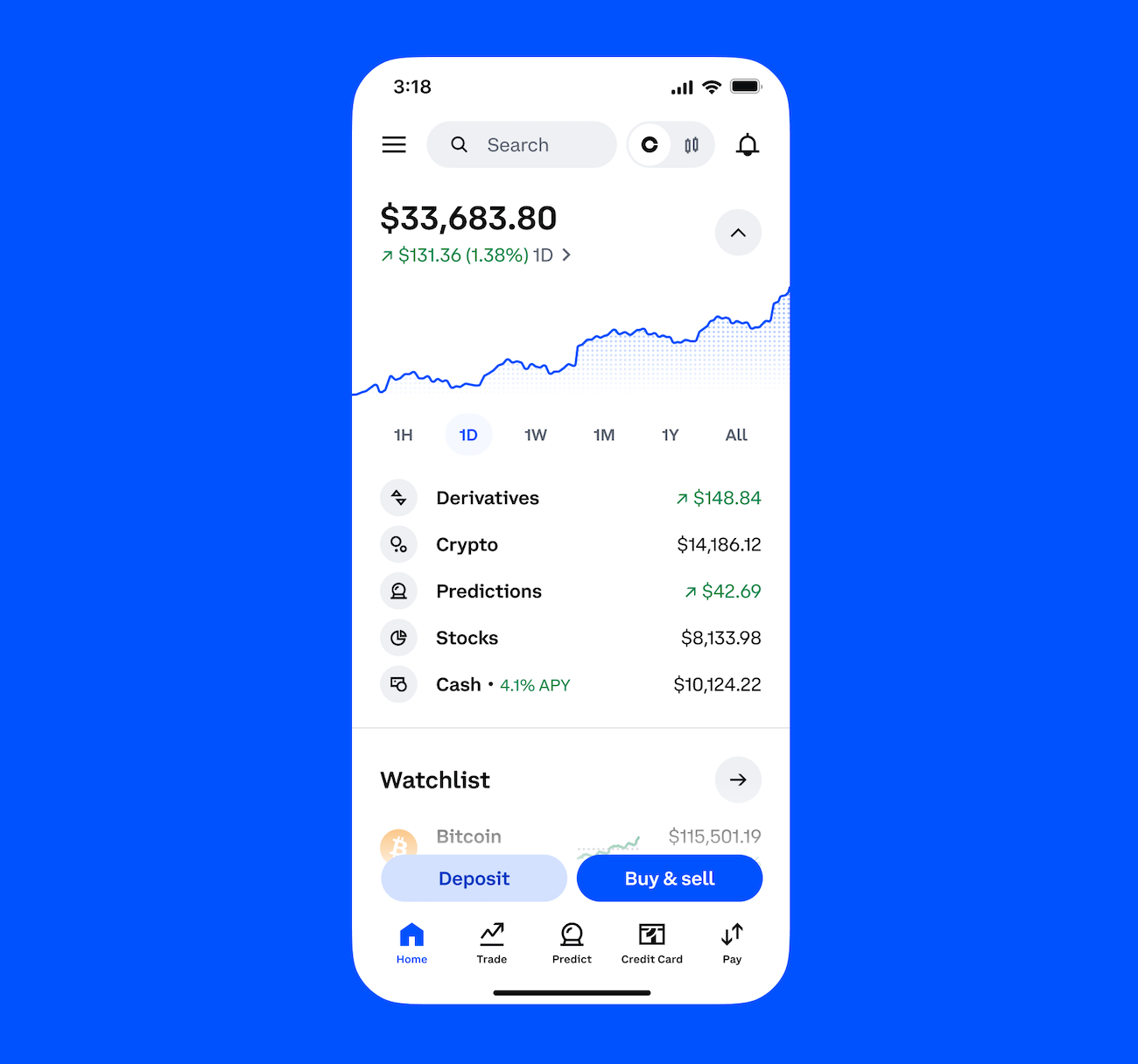
How do you explain that disconnect—trillions in transactions, the exciting applications, and yet people still think of the space largely in terms of a single cryptocurrency?
New technologies take time to be understood. If you asked people in the early days of the internet what it was for, they might have said bringing newspapers online. Rather than being limited to distribution through newsstands around the world physically, you can distribute them digitally to anyone, anywhere. That was pretty groundbreaking. So that answer would have been right in describing what the internet had been used for in the past, but it would have missed what was being built at the same time: social networks, e-commerce, entirely new ways of interacting.
I think something similar is happening now. People see the parts of crypto they already understand, but miss what’s being built alongside them. Much like they didn’t see the vast potential of the internet, they are missing that crypto is enabling an updated financial system that is faster, more rewarding and more global. And those who see that earliest will benefit the most.
You announced that people can trade stocks, futures and prediction markets on Coinbase. For people who aren’t familiar with the app or business, how does that work, and why should everyday investors be excited about that?
Coinbase is becoming the Everything Exchange—a single trusted place where you can trade every asset, borrow, lend, save and spend with the most attractive rates in the industry. With more than a decade of investment in core crypto and tokenization technology, we can now bring all asset classes into crypto to enable more efficient and global markets than have previously been possible. For the $1 trillion in global stocks traded daily, $10 trillion in FX, and more, this technology is unlocking meaningful gains in efficiency and accessibility. The Everything Exchange will be the single unified platform where you can invest and trade in every asset class 24/7, bringing the financial system up to internet speed.
After years of uncertainty, US crypto regulation is starting to take form. How do you think that will affect innovation across the industry and at Coinbase specifically?
We’ve spent years building the “iceberg”—the massive technical and compliance infrastructure below the surface. Now that the regulatory fog is lifting, the world is finally going to see the tip: a financial system that is 24/7, global and significantly cheaper. Clear regulation finally gives us space to bring that more modern system to every investor and every asset class.
You’re probably sick of talking about AI—
[Laughs] I’m not sick of it at all. I think we’re at an incredibly important moment, both for crypto and AI.
So how does AI fit into that picture for Coinbase?
Internally, we operate AI-first in everything we do, from engineering to design to operations. That enables us to improve quality and velocity.
We’re also building products for customers to use AI in novel ways. For example, x402 is a payment protocol that enables AI agents to make payments. As AI agents proliferate and do work on behalf of people, they need to be able to pay for goods and services, and they can now do that with USDC and x402.
We’ve also built an AI-powered Advisor for Coinbase users. Whether you’re not sure what to trade or want help executing some complex trading strategy, the Coinbase Advisor can develop novel strategies that weren’t previously possible. There will be a lot of experimentation in this space, but I wouldn’t be surprised if this becomes a more common interface for trading than traditional order forms and number pads.
“Now, more than ever before, the fundamental technology has decoupled from the price of any individual asset or trading volume.”
Some feel fatigue after hearing about crypto’s promise for years. What do you say to skeptics who feel it’s always just over the horizon?
That’s what innovation looks like. When you’re building brand new things, the trajectory isn’t a straight line. The internet started in the ’60s; AI has roots back to the ’50s. You had people look at both of those technologies and confidently predict they were finished.
What I love about building in crypto is the long-term commitment. We’re building an entirely new economy. It won’t happen overnight, but if we stay focused and keep investing, the results will become clear in people’s everyday lives.
Hundreds of millions of people already use crypto around the world. But there’s another step-change coming. I think we’ll see crypto eat all financial services as people and businesses around the world move their money onto crypto platforms like Coinbase.
That may sound ambitious, but we’re seeing some signs of it already, and I think it’s coming sooner than people expect.
Additional reporting by former Brunswick Partner Ash Spiegelberg.
Meet the authors
-

Director, Senior Editor
Dallas
Edward is a Brunswick Director and Senior Editor of the Brunswick Review, a business publication with readers across 68 countries. He's also written for some…
More from this issue
Investment Universe
Most read from this issue

The Everything Exchange

A Generational Deal
You might also like

Vietnam’s Place in the Global Supply Chain

Surge in the Gulf