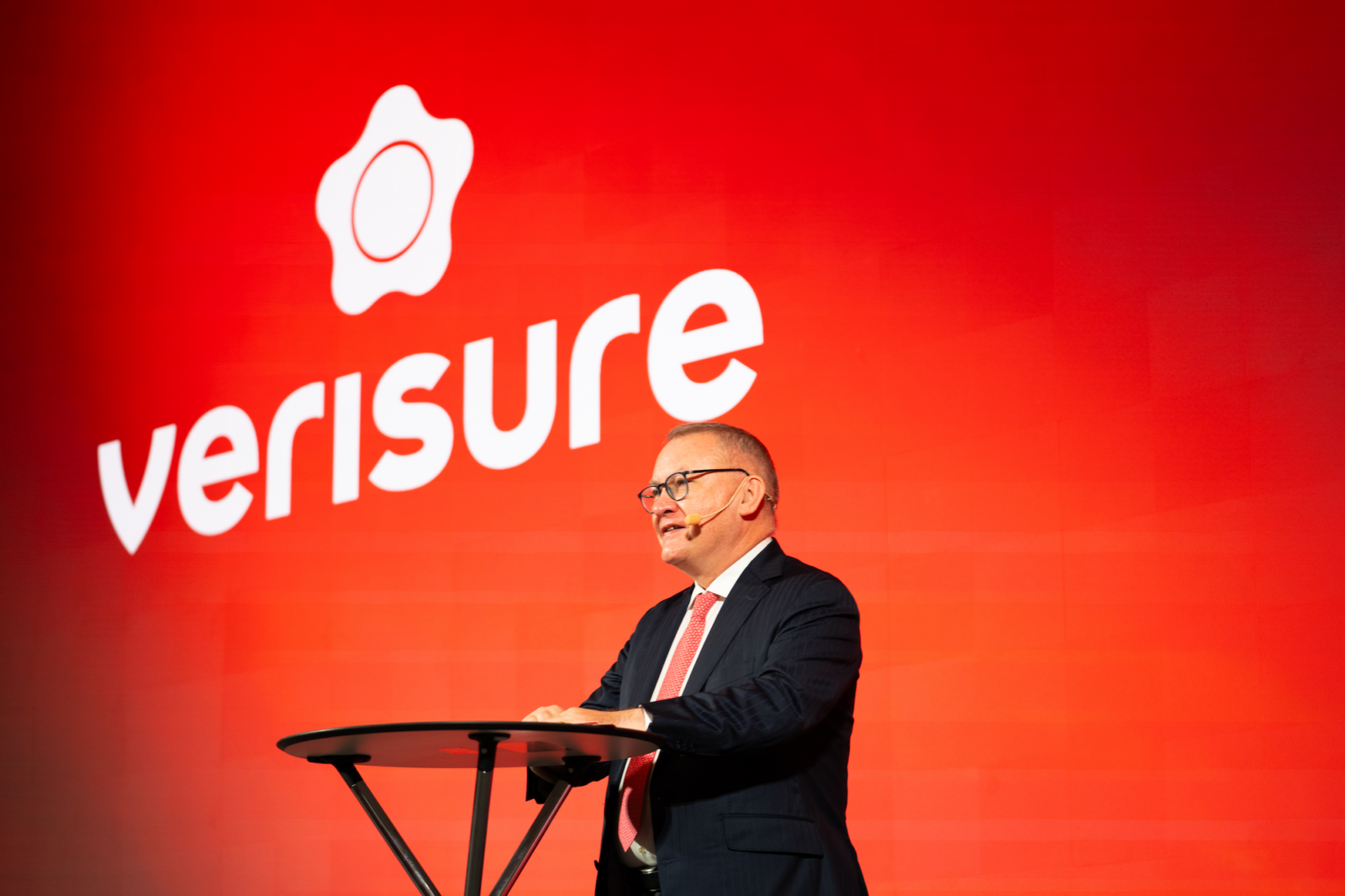
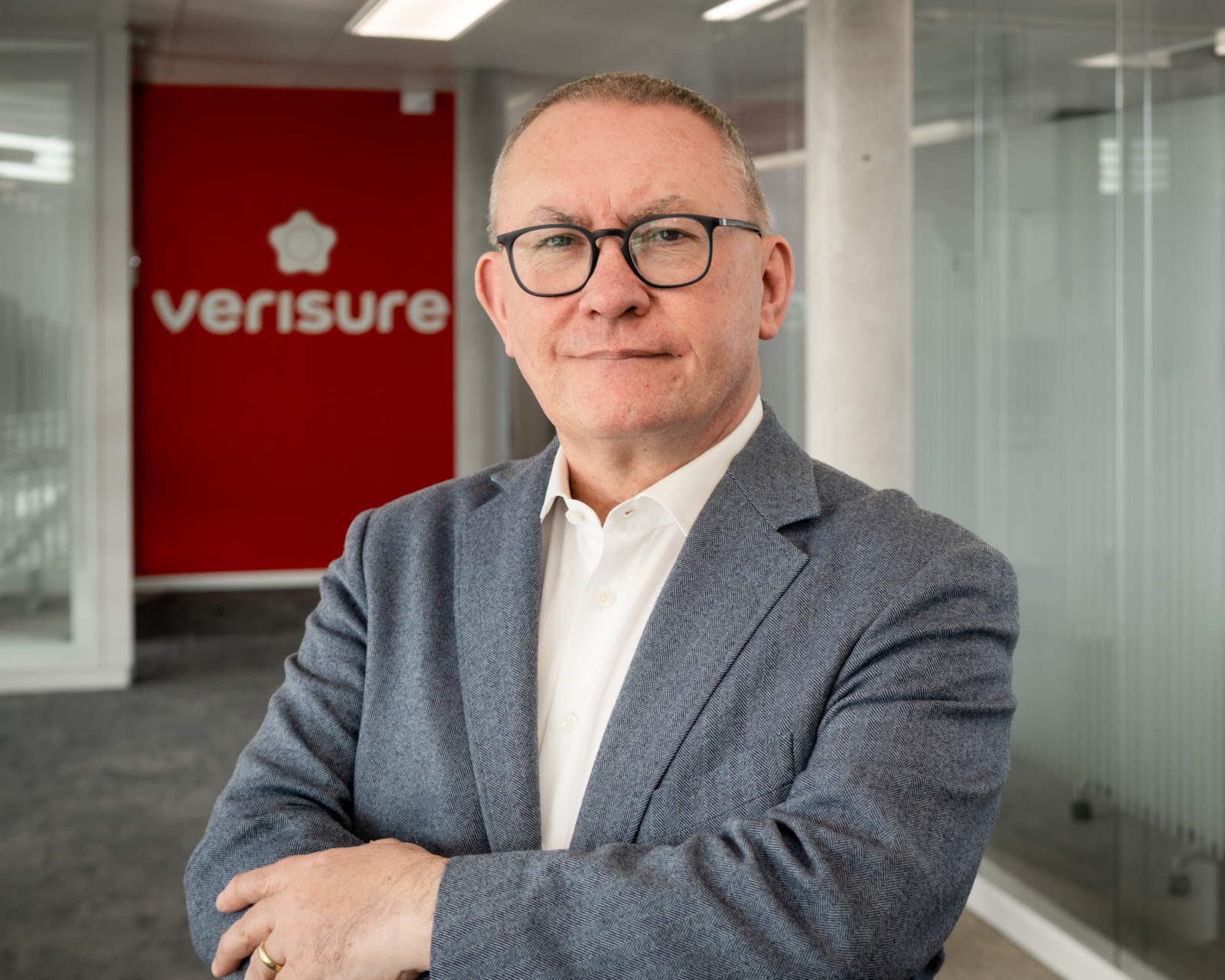
Austin Lally, CEO of Verisure, the leading provider of professionally monitored security services in Europe and Latin America, talks about the company’s success story, its recent IPO and its long-term outlook.
In 2014, Austin Lally joined Verisure as its CEO. He came from Procter & Gamble, where he had most recently served as one of the multinational consumer goods company’s presidents. At that point, he had been with P&G for just shy of 26 years—one tenure, but many jobs, giving him broad experience and taking him to different locations around the world.
“I spent seven special years in Guangzhou contributing to building up the P&G leadership position in China. And then I came back to Europe, to Germany, to Switzerland, and then the US,” he told us in a recent interview. By comparison, Verisure was relatively small, and in an entirely different field. “I would never have imagined at that time that I’d be heading off to lead a monitored home security company.”
A native of Glasgow who calls his early P&G position in England “my first international assignment,” Lally exudes a bright sense of humor and a warm, down-to-earth pragmatism. That sensible outlook was in part what brought him to Verisure. In a conversation with the company’s investors, it emerged that the market for home security in Europe was undeveloped compared to the US.
“Penetration in Europe was fewer than 5% of homes and small businesses, while the US was more than 20%,” Lally says. Yet the consumer habits and practices with consumer goods for the two regions, which he knew from his P&G experience, were very similar.
“So it became an intriguing puzzle,” he says. “Why have these markets developed so differently? If we could understand that deeply, we could unlock really significant growth in Europe. And that’s basically what we’ve been doing in Verisure over the past 11-plus years.”
That insight was the first step in an extraordinary success story that has driven a decade of consistent growth at Verisure, tripling its customer base, expanding into new markets and deploying a range of new technology. The company now operates in 18 countries in Europe and Latin America.
“The first presentation I gave to the board of directors was called the ‘Road to 3 Million,’” he says. “Because 3 million customers seemed like an ambitious target. Later, I had to go back to the board and change it to the ‘Road to 4 Million.’ Now we are more than 6 million. I’ve stopped giving presentations like that anymore.”
Verisure had been taken private in 2008, before Lally joined. In 2025, the company relisted on the Stockholm exchange in the largest initial public offering Europe has seen since Porsche in 2022. But that is only a milestone, Lally insists. The company’s focus, he says, is always firmly on the long term.
Verisure is in 18 countries now. How did expanding into other markets fit in with your vision to grow the market in your base?
First and foremost, it was about building penetration in our existing markets, because even in the markets we’ve been in for decades, the penetration opportunity is still huge.
Take Spain, our largest portfolio and a market that we’ve been in since the early ’90s, the penetration there is still less than half what it is in the US. We’ve complemented that over time by expanding in new countries in Europe and Latin America.
In 2014, we were less than one-third of the size that we are today, in terms of customers, but we were still the European leader in a relatively small, sleepy industry, because we were the leader in some medium-sized economies, like within Scandinavia and Iberia. So the idea was, what if we take this Verisure playbook to Europe’s largest economies? That meant markets like Italy, the UK, dramatically increasing our position in France. Later, it meant entering Germany. And after a very successful entry in Chile, then going to Brazil.
If I take those large European economies—Germany, France, the UK, Italy, Belgium, Holland—they now drive a significant amount of Verisure’s growth.
“This is not a financial calculation for consumers. It’s about emotion. It’s about this feeling of being protected, of being safe.”
What made this the right moment to relist, given the long trajectory of success? And why Stockholm?
It was inevitable that the company one day would be in public markets, just from a size perspective. Our private investors have been really supportive. There’s been a great partnership over the 11 to 12 years that I’ve been with them.
I often tell people it’s sort of natural, spiritual. We sold our first alarm system in Sweden in 1988. Sweden’s not our largest market now, it’s number three, but it’s still important. We have excellent brand recognition, and the investor base in Sweden was very familiar with Verisure. They remember us from when we were listed there between 2006 and 2008. A lot of our Swedish investors had invested with us before and many that I met were customers.
I’m sure if we had chosen a venue other than Stockholm, it would also have been successful, because of the inherent quality of the business. It’s the clarity of the business model. It’s the track record over a long time. And we attracted about 50% international investors, so clearly that made a difference.
Plus I’m from Glasgow, not so far away. I think of myself as a Western Scandinavian.
Do you think the success of the IPO has renewed interest in the IPO market in Europe?
We hope that we made a positive contribution to the markets and added confidence. But I also think that it comes down to the quality of the individual assets. It was always clear to us it wasn’t really about the IPO or the IPO day, because it was going to be a long-term growth story we were trying to communicate. So hopefully that had a positive influence on the markets at the time.
As part of that long-term story, what do you look for day to day?
We’re very focused on how many new alarms we sold and on customer loyalty. We’ve got the lowest attrition in our industry by quite a margin. Currently, about 7.4% of customers cancel annually; that’s quite a low number. That’s because of the quality of the intake in the first place and because of the customer experience that we try and deliver.
Then we look at our pricing per customer every year. Over the past 20 years, the monthly cost to serve the customer for Verisure is basically flat. We’ve eaten years and years of inflation partly by the scale that we’ve built and also because we make cost efficiency our big focus without compromising on the customer experience.
I’ve got to be disciplined also about how I invest in marketing and demand creation. I don’t want to bring in customers who are going to leave quickly, who are only buying because of price, because we look cheap. We spend on average about €1,500 to acquire a customer. It’s not a small investment. That’s why the quality of the customer is very important.
The result is that we have a customer lifetime that’s about 15 years on average and a very good level of unit profitability per customer. So that €1,500 we spend on a new customer, that pays back in just over three-and-a-half years.
An IPO frequently can introduce new pressures on a company’s business model. Do you feel like the investors are on board with that model?
In the run-up to the IPO, we did really extensive investor education. We met hundreds and hundreds of potential investors. And we had a very high conversion from the people that we met, who then came into the book at the IPO.
There were three reasons for this. The first was the business model was fairly simple and well-understood. The second is our track record of more than a decade. You’re not buying into some newly arrived company telling you a story. There are 10 years of data on the trending schedules that you can dig into. And then I think the most important thing was the runway of growth ahead.
If I look at Latin America and Europe, and all the premises that have yet to be protected—residential homes, apartments, small businesses—you get to over 430 million. Well, I only have 6 million customers today. To get to 430 million customers, that’s probably going to take quite a lot of time. But if you asked the question, “Do you think we can get to 10 million, 12 million, 20 million, 30 million?” Look at the track record. We’ve tripled over the past decade. What investors see is that there’s a really attractive runway of opportunity ahead. We just have to go and execute it.
What is your outlook on developing your customer base?
We’re about 80% residential and 20% small business. The story here is we’re trying to make peace of mind—feeling safe and secure, feeling protected—something for everybody, for every family. We’re not focused on high-end villas or rich families. We think that we can be within reach, in our key markets, for families everywhere.
This is not a financial calculation for consumers. It’s about emotion. It’s about this feeling of being protected, of being safe, of thinking that you’ve done the right thing for your family.
The reason we are interested in small businesses is these tend to be owner-operated. Effectively, the same technology solutions work well for those customers. So, we’re able to add small business as a
productivity builder for the company, without having to create two R&D programs, or two different sales approaches.
“Look at the track record. We’ve tripled over the past decade. What investors see is that there’s a really attractive runway of opportunity ahead.”
Is there a particular technology or aspect of R&D that you’re especially excited about?
We have got an intervention device called ZeroVisionTM, which we call the “fog bomb.” That is a safe pyrotechnic that we remotely detonate from the alarm monitoring center. It’s designed to get the intruder out of the property immediately, because we can’t always control how long a police response may take.
The biggest technology challenge in the industry isn’t detecting incidents; it’s that you end up generating thousands of false positives, alarm signals being triggered. You know something’s triggered it, but you don’t know if it’s a spider, if it’s a dog, or if it’s an intruder. Those volumes are too high to dump on the local police departments or to dispatch guards each time.
We target 99.5% elimination of the false positives through verification. We were an early pioneer of bringing imaging into the system. We’re bringing video to help the monitoring center really understand what’s happening in the home; two-way audio to enable the monitoring center to listen in the home. This also enables the monitoring center to talk to the intruder. “This is Verisure. Please identify yourself. You’re being recorded.” And if they don’t identify themselves properly, then we detonate the ZeroVisionTM device.
We guarantee the intruder will leave the property within 30 seconds. As we say in our advertising, “you can’t steal what you can’t see.”
AI now is playing an important role. One of the difficult technology challenges for indoor detectors was: How do you differentiate between a big German dog and a small Scottish burglar? Small Scottish burglar crawling along the floor. Is that Austin? Or is that a dog? Outdoors you have bright sunlight, snow or other atmospheric conditions. AI dramatically improves the job of object identification. So we’ve just brought what we call GuardVisionTM into our system.
We’ve got a rich pipeline of other ideas that are coming in the period ahead.
Has the geopolitical climate given you any surprises or changed the business at all?
We’ve seen very little impact. We’re not immune to the macro. In my business career, I think ’22 and ’23 were probably the toughest external environment that we had to operate in, but we still sold around 800,000 alarms a year. We still grew and we had only a very modest increase in attrition. What we learned from the various exogenous shocks over time is just how resilient the business is.
For years, we’ve been strengthening supply chain resilience so that we’ve got continuity. If you look at our sourcing today, it’s supported by quite robust contingency plans.
One of the things that I’m pleased with, even during the supply chain pressures right after the pandemic, we didn’t lose a single sale because of supply challenges. The work we did on resilience paid off.
“How do you differentiate between a big German dog and a small Scottish burglar? … AI dramatically improves the job of object identification.”
Do you think that the long tenure you had, now at two different organizations, has informed your views on leadership?
Thirty-six years in two jobs. It does say something about loyalty and commitment.
I was really fortunate in the Procter & Gamble company, because although I worked in one organization for that length of time, it was a real privilege to be able to work in different parts of the world and to touch different businesses. I learned a huge amount and had a lot of fun and I never really regarded it as one job. I think that what P&G and Verisure have in common is the importance of thinking long term.
I know that the average tenure of a private equity CEO is three or four years. Everyone told me that before I joined. But I didn’t come in with that timeline in my head. The team that we assembled is amazing. We all shared one idea, which was that we wanted to build a great company.
We wanted to do for security, for residential families, what companies like Orange, Vodafone and others did for telephony, what companies like Dell and Apple and others did for computing. In the early ’90s, portable computing and portable telephony were seen as B2B ideas. And then they got democratized; they became for everybody. We want to make it as normal for families to be protected with electronic security as it is for them to have an iPad or a mobile phone.
It was long-term thinking. We really focused on building our own talent. We built up our own technology organization. It took years to build that platform and it was a strong multiyear investment. You don’t build the number one brand in 18 countries overnight. We just entered Mexico, not because we wanted to make the 2026 numbers look better, but because we’re trying to ensure that the growth profile of the company in 2030 looks as strong as it does today.
One of the things I’m so happy about is the level of commitment and engagement we’ve got in the company. People are coming here to build careers because they’re building a special company. We are very focused on a really strong ownership culture. What we’ve got to ensure is that as a public company that’s getting larger and larger, we don’t dilute that culture. We talk about always innovating, trust and responsibility, winning as a team. Those elements are just as important in public markets as they were when we were a private company.
Meet the authors
-
Associate
Stockholm
Elsa Lundquist is an Associate in the firm's Stockholm office. -
Director
New York
Carlton Wilkinson is a Brunswick Director and Managing Editor of the Brunswick Review, based in New York. He is an award-winning journalist, a music educator,…
You might also like

05:46 GMT March 11 2011 – Disaster struck
Legacy Rooted in Family