
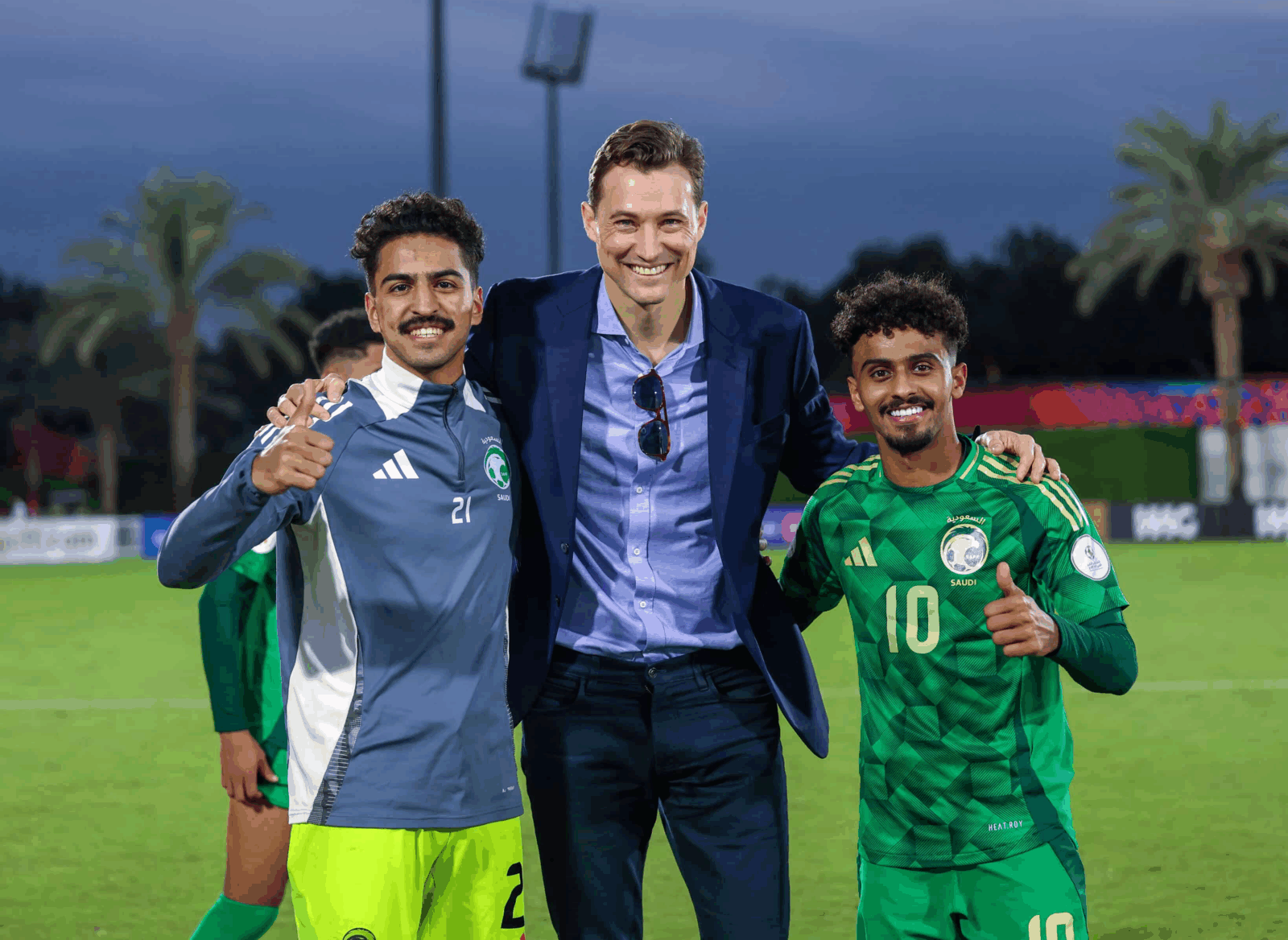
In conversation with Brunswick’s Adam Jibali, investor Ben Harburg discusses his acquisition of Saudi Arabia’s Al Kholood FC, the strategy behind starting from the bottom, and what Saudi football looks like through a private capital lens.
The Saudi Pro League has no shortage of global attention. From landmark player transfers to a growing media footprint, the League is being reshaped in real time, and increasingly, it’s catching the eye of institutional investors.
In the summer of 2025, Harburg Group became the first foreign investor (and also the first private investor) to fully acquire a Saudi football club, buying 100% of Al Kholood FC in a deal facilitated by the Ministry of Sport and the National Center for Privatization. It wasn’t one of the big names. It wasn’t Al Nassr or Al Hilal. Al Kholood, a modest top-flight club from the Al-Qassim province, had no real infrastructure, no brand and no fan base to speak of. That, according to Ben Harburg, was the appeal.
Harburg is an American investor with a background in global tech and venture capital. He is a founding partner at MSA Capital, where he invested early in companies like Uber, Airbnb, Palantir and Nubank. He also now leads Novo Capital, a special situations fund focused on the Middle East, and chairs Harburg Group, his multi-club football investment vehicle.
Harburg has spent the past five years in football. Alongside a stake in Spanish side Cádiz CF, Al Kholood represents Harburg’s most ambitious football project to date, not because of its size, but because of what it represents: a bottom-up experiment in building value through structure, data and long-term discipline.
Recently, Harburg sat down with Brunswick’s Adam Jibali to talk about why he picked this club, what a private capital model in Saudi football looks like and how he plans to compete without relying on stars, subsidies or social media hype.
What made Al Kholood the right entry point into Saudi football?
First, it was the location. Al-Qassim is different. It has a strong regional identity that you don’t really see elsewhere in Saudi Arabia. People say they’re Qassimi before they say they’re Saudi. And that matters. Some of the country’s most influential families come from there. They may live in Riyadh or Jeddah now, but that Qassim identity carries weight across boardrooms and government offices. You hear it everywhere.
That makes it a strategic place to build from. It gives us pockets of support across the Kingdom, and when you’re starting from scratch, that’s valuable. From day one, we branded the club as “Al Kholood Saudi Arabia.” We’re not trying to build a local team. We’re trying to build a national-level challenger club.
There’s also a unique opportunity in how fans support football here. Most people follow one of the big four clubs—Al Hilal, Al Nassr, Al Ittihad or Al Ahli—even if they’re from smaller provinces. Their connection is soft. It’s not city-based. That gives us a chance to win people over. If they were all die-hard fans of their hometown club, it would be harder. But they’re not. We can pull them in with the right story, the right identity.
And from an ownership standpoint, having a smaller club is actually an advantage. There’s no fan pressure to overspend or win now. There’s no legacy baggage. Every step we take becomes a first. First derby, first five-goal game, first time selling out a match. That’s powerful. It means we get to define what this club is, on our terms, without the noise.
You clearly have a strong grasp of the local dynamics and have spent a lot of time on the ground. What’s the value in doing that as an investor? What does proximity allow you to do differently in terms of building trust?
This wasn’t a standard acquisition. It wasn’t a private equity deal where you come in, restructure a few things, cut costs and exit. This was a start-from-zero build. The infrastructure was the weakest in the top three divisions. We effectively inherited a squad of six players. The administrative team quit the day we arrived. It was more of a startup than a football club.
And I’ve studied this space for a while. I’ve been in football ownership for five years now. One of the clearest patterns I’ve seen is the failure of absentee owners, especially foreign ones. They buy a club, never visit, never understand the city or the people. That disconnect is where things fall apart.
Proximity definitely matters, especially in Saudi Arabia. I’ve spent countless hours in the community. Visiting clinics, schools, hospitals. Talking to kids, giving out scarves, inviting people to games. And it works. I see the same faces now at the stadium. That kind of relationship has to be earned. It doesn’t come from behind a desk in another country.
We’re not trying to win people over with trophies or star players. That’s high risk. What if the player leaves? What if you lose a few games? You’ve got nothing left. I wanted to build something that’s impervious to all that. A fan base that really loves the team, not just winning.
From day one, we set expectations: no famous signings. No 35-year-olds looking for a final payday. We’re bringing in 20-year-olds no one’s heard of and turning them into something. We’re not going to outspend the big clubs. But we can outdo them on structure, culture and professionalism; things we can control.
“We’re going up against clubs that will outspend us 8- or 20-to-1, maybe more. But I think we can spend a quarter of what they spend and still outperform them. Not through talent alone, but through structure and discipline. That’s the bet.”
You’ve said that this isn’t a short-term play. What does success look like to you in five or 10 years?
First, let me be clear, if you’re looking to maximize financial returns, football probably isn’t your best asset class. There are easier ways to make money. You could invest in the S&P 500 and sleep better at night. Or put money into one of my tech funds. But if you’re going to do football, you need a kind of religious fervor for it. You have to love it beyond logic.
Our view is that there’s a way to create real value, if you get the fundamentals right. That starts with buying in at a low equity cost. Most investors overpay for the badge and then spend years just trying to keep their head above water. We didn’t do that. We came in at a sensible valuation, with a clear plan to increase the club’s commercial performance and player value.
That being said, we talk about building a sustainable club, staying mid-table, running a profitable player trading strategy. But privately, I believe we can do better than that. I believe we’ll be better run than a lot of the clubs we’re competing against. And in this league, that counts for a lot.
We may not have the biggest budget, but we’ll have the strongest model. And once we’ve cleared out the legacy costs and rebuilt the squad over a few windows, I like our chances.
What is the governance model you’ve put in place that you think puts you at an advantage? And how does it connect to the multi-club strategy you’re building?
We’re not personality-led. We’re infrastructure- and strategy-led. From the start, we made decisions at the Group level, what kind of players we want, what our game model looks like, how we run the football side of the business. Then we put the right people in place to deliver that.
The best thing an owner can do is hire smart people and let them do their jobs. I try not to interfere day-to-day. We’ve got a strong Group CEO and a top-level sporting director. Then we have sporting directors at club level in Cádiz and Al Kholood who stay closely aligned. They engage across both clubs. It’s collaborative, not siloed.
We’re already sharing resources like data science, scouting, analytics, performance planning. Staff have spent time in both places. We’ve moved players between the clubs. And because costs in Spain are lower for comparable talent, we’re already seeing the benefit of operating between two markets.
That said, each club needs to be financially sustainable on its own. But where we can centralize and create efficiencies, whether in recruitment, development or analytics, we will.
There’s been a visible shift in the types of players joining the SPL. This summer, the top 15 arrivals were all under 30. From an international investor perspective, did that make the investment more attractive?
We certainly helped drive that trend, let me put it that way. Every player we brought in over the summer was 25 or under. And I’ve been outspoken about this at the League, Federation and Ministry levels. Saudi Arabia should not be a final destination league. It should be an interim destination. This shouldn’t be where players come to wind down their careers.
At Al Kholood, we’re very clear. We’re not signing anyone whose best football is behind them. I’ve said from day one: No one should retire at this club. I want to bring in players who might not have considered Saudi before, and position us as a stepping-stone to bigger things, whether that’s the national team, or a move to Europe. It’s healthier for the League. It’s smarter financially. And it opens the door to building something sustainable, where we’re developing talent and creating value.
You’ve put a lot of emphasis on data. Some might compare your thinking to the famous “Moneyball” approach. How are you actually using data inside the club?
I don’t want to give too much away about our secret sauce, but I will say that we believe in data over instinct. We believe in data over humans, frankly.
We’ve built a system that synthesizes a huge number of performance metrics, both on-ball and off-ball, and localizes them to our specific league and game model. It helps us evaluate how a player will actually function in our environment, not just how they looked in another one.
We’ve brought in people who are data-first and have done this at the highest levels of global football. It’s a major focus. We’ve invested heavily in it. And it’s working. We’ve signed players who weren’t on anyone else’s radar, certainly not in our league, and they’ve performed exactly as we expected them to.
For a team with one of the lower budgets in the league, it’s a way to punch above our weight. And that’s why we’ve put a huge amount of time and money behind it. We don’t have the biggest budget compared to other teams. But when the modeling works, it gives us an edge. And when you’re trying to punch above your weight, that edge matters.
You’ve said that women’s football in Saudi could one day even outpace the men’s game in the Kingdom. From an investor’s point of view, what would need to be true for that market to scale in a commercially meaningful way?
My comments have been very specific to Saudi. Globally, I think women’s football in some markets is overvalued. You see speculative investors applying venture-style valuations to something that’s not yet delivering venture-style revenue growth, profitability patterns and returns. That sets things up for disappointment because investors have to grow into the valuations they are applying today.
But Saudi is different. The competitive landscape is wide open, on both the club and national team side. With even a modest amount of serious investment, you could outspend and outperform most of the market. That creates a window to leapfrog years of slow organic growth.
It won’t take huge budgets for the women’s national team here to surpass the men’s, just steady investment and proper infrastructure. Already we’re seeing high-caliber global players come to the Saudi women’s league, not far from the top of their game, because people here are willing to invest seriously.
So yes, I’m bullish on the opportunity in women’s football, but only in places where the economics still make sense. Saudi’s one of those places.
In your experience so far, what’s it been like operating in a league which still has a lot of state subsidies and support? And how is that different from your European football experience?
It’s a challenge. In Europe, you have predictability. You know your TV revenue, you know your matchday income, your merch projections. Here, those things don’t exist in the same way. And most clubs still rely on state subsidies.
We’re going up against clubs that will outspend us 8- or 20-to-1, maybe more. But I think we can spend a quarter of what they spend and still outperform them. Not through talent alone, but through structure and discipline. That’s the bet. And my hope is that if we succeed, the League and the government can look at our model and say: We can do this more efficiently. That what we’re doing becomes a cost benchmark others can learn from.
Right now, our league is top three in the world in spending. In my view, we should be top five in performance. I actually think this league is already better than the French League, for example. We just need to sort out the sustainability side.
We’ve got a nine-year runway to the 2034 World Cup in the Kingdom. That’s how long the League has to get to sustainability. Our bet is that over the next decade, we figure that out.
Meet the authors
You might also like

Branded Residences
A Seasoned VC Sees Virtue in Adversity