
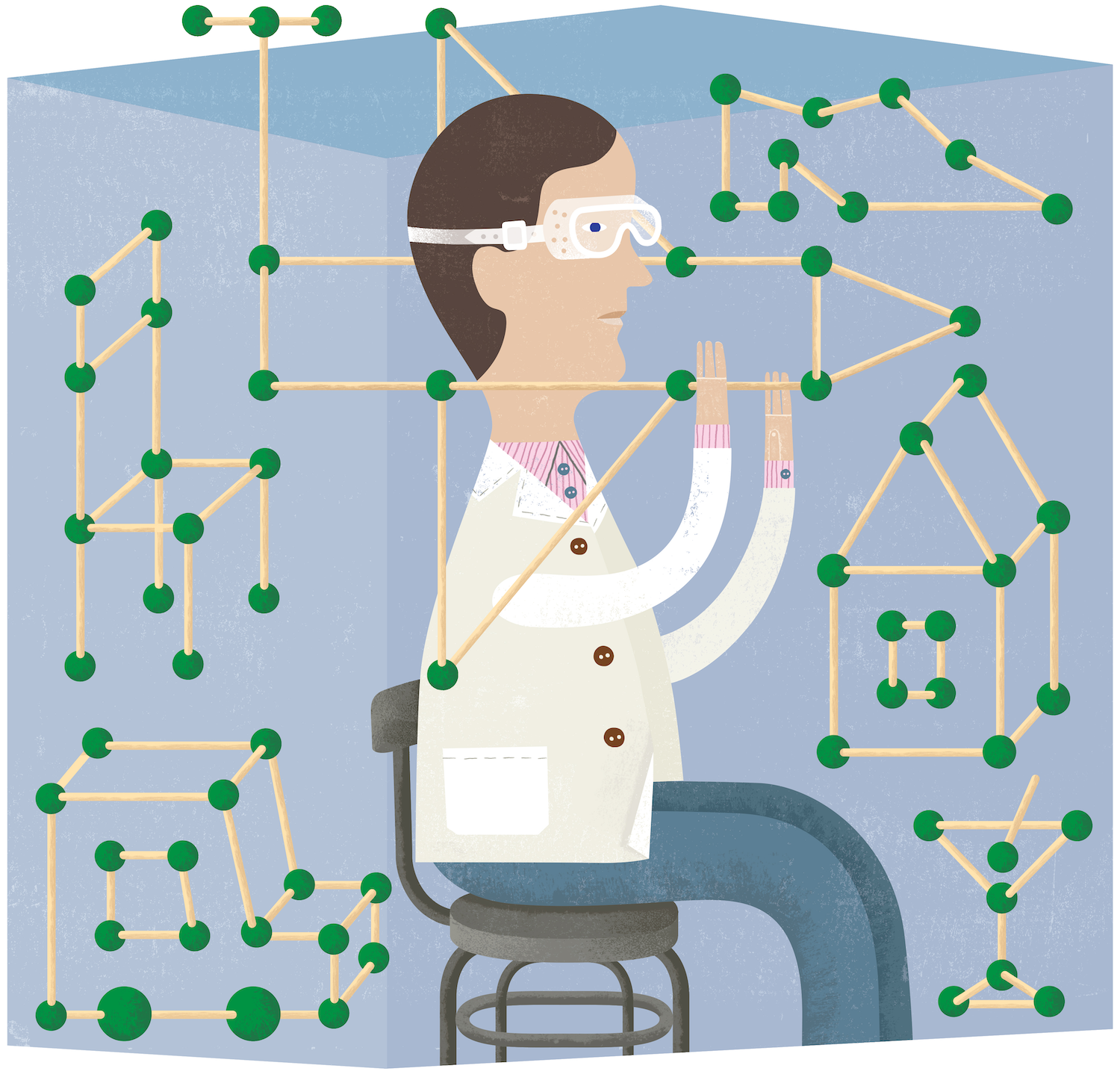
Paul Anastas, the “father of green chemistry,” now with the Moore Foundation, talks with Brunswick’s David Wei about the field’s potential to transform our material world.
Behind the business innovation that we depend on are scientific advances we don’t see, the work of molecules and formulas that design greater efficiency and safety into industries as diverse as energy and fashion. Around the world, scientists are making breakthroughs most of us will never recognize, that ultimately shape the products and services we use every day.
Paul Anastas is the Director of the Gordon and Betty Moore Foundation’s Green Chemistry Initiative. He is credited with helping establish the field of green chemistry in the early 1990s. The term describes the science of redesigning hazardous chemical products to make them safer, more efficient and more cost-effective, without releasing toxic substances that harm people and the environment.
In addition to his work at the EPA as Chief of the Industrial Chemistry Branch and Director of the US Green Chemistry Program, Anastas was Assistant Director for the Environment in the White House Office of Science and Technology Policy from 1999-2004.
How do you define green chemistry and why does it matter today?
Chemistry is not just a course you took in high school, or a single industry. It’s everywhere and everything. If you look around any room you’re sitting in, there’s not a single thing that has been untouched by chemistry. “Green” connotes young, fresh and new—and that’s what green chemistry is. It’s about innovation, invention and discovery, new chemical products, new manufacturing processes that give you higher performance, higher function, while eliminating historic problems that chemicals have had.
There’s no doubt in anybody’s mind that the accomplishments of chemistry over the past 150 years have been truly astounding. But there is also waste and inefficiency. On average, we generate 100 times more waste in a manufacturing process than the product we make. Green chemistry is about building on the successes of the past, while introducing new innovations, and not repeating the problems of the past.
When people hear “green chemistry,” many think of something very technical, maybe carried out by a few big companies, like Dow and BASF. Are they wrong?
Companies like BASF, Dow, P&G and PPG are definitely doing some great green chemistry. But that is absolutely not where it ends. When we look at companies that are engaging in green chemistry as an innovation driver, we find L’Oréal, Pfizer and Patagonia, retailers like Best Buy, Walmart, CVS.
That is the breadth of chemistry. By some estimates, chemistry touches 96% of the economy—and quite honestly, I can’t figure out what that 4% of the economy is that it doesn’t touch. When we innovate at the molecular level, it cascades throughout all aspects of our society and our economy, every product and process, and all aspects of how we generate, store and transport our energy.
Every pharmaceutical company uses green chemistry to increase efficiency. But it can also reduce waste. That’s why BASF, Eastman Chemical and so many others are engaged in it.

Can you tell me about an innovation from green chemistry that evokes wonder or awe for you?
Taking our largest problem, CO2, and turning it into our largest opportunity, that captures my imagination. There are ways now of transforming carbon dioxide into things like jet fuel and shipping fuels.
Just this morning I heard a wonderful talk about people using bio-mimicry to duplicate the performance of the mussel byssus, the adhesive that a mussel produces to latch onto a rock. It takes a lot of strength to pull a mussel off of a rock. It creates an adhesive that is so strong, with no heat and at room temperature. And it does it underwater, just to show off.
We can’t do those things, but we can learn from nature. People are making new adhesives and structural materials to mimic the strength and the manufacturing process of the mussel. That is one that I just heard this morning and was astounded by. These things are happening all the time.
There’s rising concern about the chemicals and toxins in the environment and coming into our bodies—PFAS and endocrine disruptors in microplastics for instance. What does tackling that look like in practice?
That’s a great point. Right now, you, me, and everyone we know has synthetic substances that are bio-accumulating in our bodies. As far as I know, not a single person ever signed a waiver or said that’s OK.
Not so long ago, 99% of the use of arsenic in the United States was as a preservative for pressure-treated lumber, where it was part of a compound called chromated carbon arsenate. Arsenic is highly toxic and the compound was used in everything, including porch swings and playground equipment. The arsenic could leech out to the surface of the wood or into the soil. Green chemistry came up with an alternative in the 2000s that worked better and the commercial use of arsenic plunged by about 99% almost overnight.
We’re absolutely able to design substances so that they degrade harmlessly into the environment, rather than build up in our bodies and the biosphere. The fact that we still have chemicals today that are able to get into our bodies and stay there with, at best, unknown risks—that needs to be recognized as a design flaw and ended. That’s what green chemistry does, and that’s what we all should insist on.
Is it really possible to have an innovation that delivers better performance, better safety and better cost?
From the beginning, it was all about aligning our profitability goals with our environmental and health goals. We have seen countless prizes for the commercialization of technologies since President Clinton first launched the Preliminary Green Chemistry Challenge Award. And that has been duplicated all over the world. So it’s no longer theory, it’s practice. The leaders in industry are the ones who have put this into practice.
“If you think chemistry isn’t touching your business, you’re mistaken. And it is an opportunity, not a threat.”
Do you think enough capital is being allocated to green chemistry?
Leaders in industry are investing in green chemistry, but it is far from systematic. A recent survey of tech leaders done by Morning Consult showed that roughly three quarters viewed green chemistry as a driver for innovation. But that does not always immediately translate into the kind of investment that’s needed, throughout all layers of industry.
The biggest obstacle is lack of awareness. There are still many folks throughout various sectors, different layers of management, who aren’t familiar with the power and potential of green chemistry. Once they learn that you can increase function and performance, that you actually can drive innovation and discovery, that’s when we see the most activity.
How does AI intersect with the future of green chemistry? And conversely, how will green chemistry impact AI?
AI infrastructure has many resource demands where green chemistry will help—new kinds of cooling systems for example. So there are ways that green chemistry technologies can be used to help advance AI.
But perhaps more exciting is how AI can assist green chemistry. It is one of the most powerful tools in our toolbox. It will assist the chemist, the engineer, the inventor, the designer, to come up with new materials and approaches, new structures that can turn into the next generation of medicines, paints, manufacturing processes and electronics.
The interactions of any molecule with the body, for instance, are astoundingly complex. AI helps to understand all of that complexity to make sure any molecules don’t cause a harmful effect. We use the expression “benign by design.”
While it’s an absolutely powerful tool, it will never, in my opinion, replace the judgment, the discernment, the thoughtfulness and the ethical and moral imperatives of any scientist. It always is simply going to be a tool for the designer.
Can green chemistry help with another concern of global business today, which is supply chain pressure—energy, food and materials like rare earth minerals?
Each of the things that you’ve named benefits from green chemistry. Critical minerals and rare earth minerals for instance: One of the very active areas of green chemistry is in using materials that are plentiful, like iron and copper, instead of platinum, palladium and some of the rare or more precious substances.
Green chemistry work is about adding resilience. Developing safe, sustainable, resilient approaches, these are the imperatives that complement the drive to innovation and discovery.
If there is one thing you want readers to take away from this interview, what would it be?
If you think chemistry isn’t touching your business, you’re mistaken. And it is an opportunity, not a threat. Green chemistry offers opportunity to improve top-line growth, driving innovation. And if you and the folks in your company are not aware of it, I would recommend looking into it.
Meet the authors
-

Partner, Sustainable Business
New York
David is a member of Brunswick’s global Climate Hub and Sustainable Business practice. He advises clients across sectors on recalibration of sustainability goals and strategies,…
You might also like

Churchill and the Flu

Midterm Counter