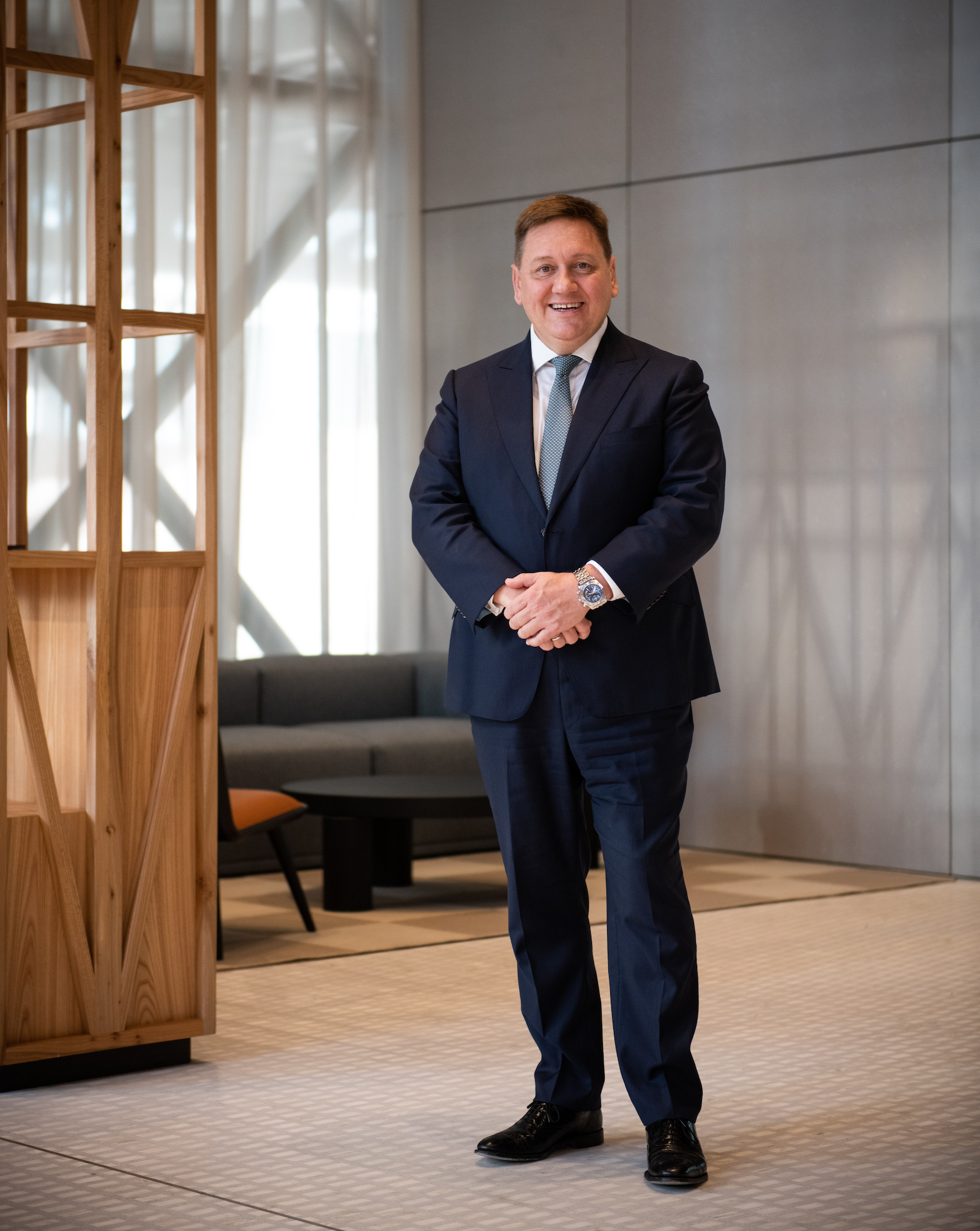
Global CEO Justin D’Agostino shares lessons from the picture-perfect combination of Herbert Smith Freehills and Kramer Levin.
The transatlantic combination of Herbert Smith Freehills and Kramer Levin was a strategic move by one of the world’s leading international law firms to address a long-recognized gap—the US market. It is a move that marks Herbert Smith Freehills Kramer as a global leader. This year will see Ashurst and Perkins Coie, Taylor Wessing and Winston & Strawn, and Hogan Lovells and Cadwalader vote on transatlantic merger proposals.
Reflecting on the combination six months after Herbert Smith Freehills Kramer went live, Global CEO Justin D’Agostino says the deal represents both continuity and transformation. It builds on decades of global growth while marking a new chapter for a firm intent on meeting clients where they operate.
“It had become increasingly clear to me that we had reached an inflection point,” D’Agostino says. “Our clients were global in every sense. Their strategic decisions, capital flows and risk profiles increasingly included the US. Yet we didn’t have the scale there that matched the rest of our platform.”
A strategy shaped by crisis
D’Agostino became CEO at the start of 2020, and the COVID-19 pandemic. Like many leaders, his early months in the role were defined by uncertainty, urgency and an overriding focus on people.
“Those first weeks and months were about survival: keeping people safe, keeping the firm functioning and maintaining trust,” he recalls. “Strategic ambition had to take a back seat for a while.”
But once the immediate crisis receded, the long-term questions returned more clearly than before. Among them was a structural reality that had been years in the making.
“We were effectively the last top-tier international law firm without real scale in the United States,” D’Agostino says. “That wasn’t sustainable.”
Herbert Smith Freehills had built a formidable international business, with deep roots in Europe, Asia-Pacific and the UK. But the absence of a substantial US platform limited its ability both to follow international clients into the American market and to attract US clients seeking truly global counsel.
“That gap was becoming more pronounced every year,” he says. “And once you see it clearly, it becomes very hard to ignore.”
Defining the right partner
The firm’s response was methodical rather than opportunistic. D’Agostino and his leadership team undertook extensive market mapping, working through different scenarios and permutations.
“We were very clear about the shape of the firm we were looking for,” he says. “This wasn’t about buying revenue or chasing headlines.”
The priorities were specific: strength in New York M&A, presence in Washington, DC and Silicon Valley, and optionality for future expansion in Texas. Equally important was avoiding significant overlap that could dilute rather than strengthen the combined offering.
Kramer Levin stood out—not only for its market position, but for its mindset.
“They were bold in the way they were thinking about their own future,” D’Agostino says. “And the timing was right for both firms.”
Just as critical, however, was culture. “Culture can sound like a soft concept, but in a law firm it’s existential,” he says. “Partners are deeply attached to the way their firm operates. The fastest way to derail a merger is to get that wrong.”
From the earliest conversations, D’Agostino sensed a strong alignment. “It was palpable,” he says. “A shared sense of professionalism, collaboration and respect for quality. You know it when you see it.”
Integration with intent
Many combinations promise integration. Herbert Smith Freehills Kramer embedded it.
As part of the deal, the firms agreed a detailed investment and growth plan in advance, covering lateral hiring, capability expansion and priority markets. Crucially, that plan was included in the partner voting materials. “Partners weren’t being asked to vote on an abstract idea,” D’Agostino says. “They could see exactly what would happen next.”
“Culture can sound like a soft concept, but in a law firm it’s existential. Partners are deeply attached to the way their firm operates. The fastest way to derail a merger is to get that wrong.”
The firm also resisted the temptation to let integration unfold organically. Instead, it embarked on an intensive pre-combination program. Practice groups met across borders to develop joint business plans. Client opportunities were identified in advance. Business services teams, from IT and HR to finance and business development, were fully engaged.
“It was almost like a manifesto,” he says. “But it wasn’t top-down. These were plans built by the people who would be responsible for delivering them.”
One decision proved especially consequential: appointing a senior executive partner with sole responsibility for integration and growth.
“Everyone already has a full-time job,” D’Agostino says. “Integration can’t be a side project. Making it someone’s only job was a real investment—but an essential one.”
Winning trust inside the partnership
Between announcement and partner vote lies what D’Agostino describes as the “moment of maximum risk.” Trust, transparency and familiarity mattered.
Here, the firm drew heavily on lessons from the earlier Herbert Smith–Freehills merger. One stood out above all: the importance of a single global profit pool. “That’s what sustains collaboration,” he says. “If people feel like they’re competing internally, the firm fragments.”
Governance was also addressed early. The combined firm would have one CEO and one chair, but with strong Kramer Levin representation on the firm’s executive team and across governance, remuneration and risk committees.
“For this to work, people needed to see themselves in the leadership of the firm,” D’Agostino says. “That wasn’t a concession; it was common sense.”
Protecting the core while building the future
If there is one area where D’Agostino sees room for refinement, it is workload management during integration. “Everyone wants to work on the merger: It’s the most exciting strategic moment in a decade,” he says. “But someone still has to run the core business.”
Despite the demands of integration, the firm continued to grow revenue and profitability throughout the process. That, he says, required discipline and clarity of roles.
“In hindsight, I might have ring-fenced even more people to focus solely on the day-to-day,” he reflects. “Integration adds weight, and leaders need to be conscious of that.”
A changing profession
Looking ahead, D’Agostino believes the deal sits within a broader wave of consolidation across the legal sector.
“The profession is extraordinarily competitive,” he says. “If you want to be a leading global firm, you need scale and you need to be present in the world’s major financial centers.”
But scale alone is not enough. The process of articulating the merger has sharpened his sense of what truly differentiates Herbert Smith Freehills Kramer.
“We are now the only firm that can credibly describe itself as both transatlantic and transpacific,” he says. “We have leading transactional and disputes practices across all major markets. Many firms are one or the other.”
That clarity, about identity, ambition and value, has become a leadership lesson in its own right. “Doing something like this forces you to be very precise about who you are,” D’Agostino says. “Not in marketing language, but in facts.”
For Herbert Smith Freehills Kramer, the combination is not an endpoint. With ambitious plans for further growth in the US, particularly in energy and Texas, the firm sees the deal as a platform rather than a finish line.
“We didn’t do this simply to get bigger,” D’Agostino says. “We did it because our clients need us where they are and where they’re going next.”
“Given geopolitical developments over many years—and over the start of 2026—our clients need their global trusted advisors to be able to navigate a complex landscape, and that includes having strength and expertise in the US.”
Meet the authors
-

Partner
London
Aideen leads Brunswick’s professional services sector and sits within the strategy and planning team. Much of her work involves supporting sector-leading corporates and institutions on… -
Partner, Industrials & Infrastructure Global Lead
New York
Mike helps clients on a wide range of issues where the quality of storytelling is critical, including crisis, litigation, leadership transition and the articulation of… -

Account Director
London
Lucy Floydd is an Account Director in Brunswick’s London office. Her clients span consumer industries, real estate and professional services. Prior to joining Brunswick, she…
More from this issue
Investment Universe
Most read from this issue

The Long Road to Lobito

Misinformation Inoculation
You might also like
Reimagining Food Systems

Embrace the Complexity