
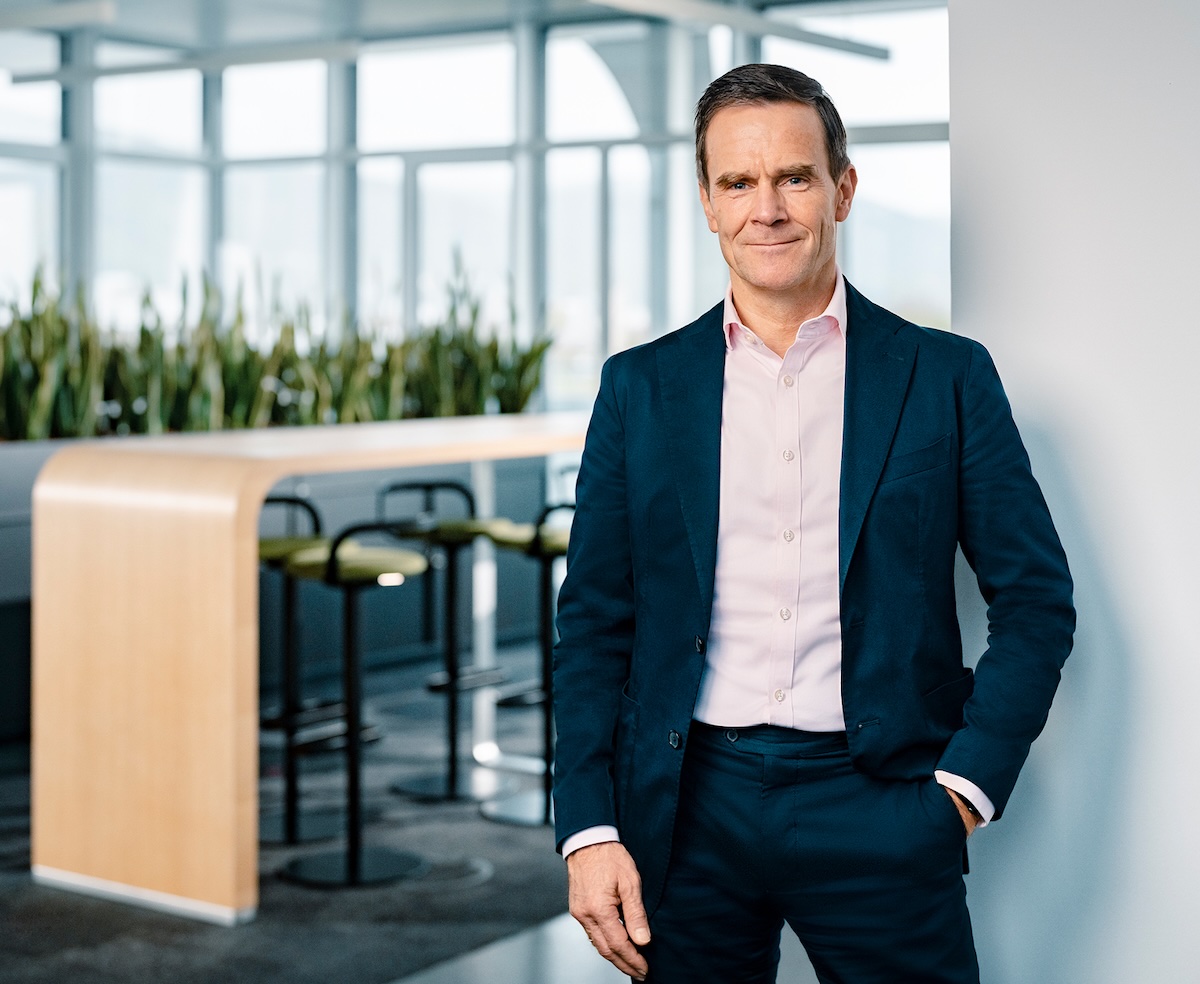
Heidelberg Materials’ Chairman of the Managing Board sees a revolution in the works for what some view as the “old and dusty” cement industry.
Nineteenth century Heidelberg, then and now a picturesque medieval German city, saw the founding of an enterprise that has flourished for over 150 years. In 1873, Johann Philipp Schifferdecker took over a failed local grain mill and quickly turned it into a manufacturing plant for a new breed of construction material called Portland cement. While cement has been in use continually since ancient times, Portland cement was a new invention, stronger and more reliable than historic versions. The mill site provided access to barge and rail transport, and all the raw materials Schifferdecker needed. The company saw immediate success.
Heidelberg Materials has since evolved into a global business, one of the world’s largest manufacturers of cement and concrete, the so-called “heavy materials” of construction. In an old and entrenched industry, the notion of disruption can seem easy to dismiss. But Dominik von Achten, Chairman of the Management Board of Heidelberg Materials, has disruption and innovation very much on his mind.
Cement is the chief component in concrete, “the second-most used material in the world after water,” von Achten says. In the interview below, he talks about his vision to keep the company a “pure play,” focused on heavy materials. But he also believes the sector is on the verge of true revolution, involving both a transition to deccarbonized manufacturing plants and products as well as the digitalization of the industry, through implementation of AI and specially built technology platforms.
He intends to put Heidelberg Materials at the forefront of that wave.
Von Achten, who holds a Ph.D. in Economic Policy, came to Heidelberg Materials’ Managing Board in 2007 after a decade of successful consulting work. The company was in the midst of a major move, the acquisition of Hanson PLC, that opened up truly global prospects for the European enterprise. That transformation required discussions of not only efficiency, but company goals and culture. “For me, joining at that time was a great, fast, deep dive into both the company and the industry,” he says.
In 2020, he became Chairman of the Managing Board, the company’s chief executive officer. In the past five years, he and his team have realized steady increases in revenue and profitability. In 2023, Heidelberg Materials unveiled a near-zero-carbon cement product, the first of its kind, and this year, construction began on a pioneering, fully decarbonized cement production plant.
As CEO, you’ve presided over a period of significant growth just in the last 12 months alone, in a climate that has not really been the most helpful. What convinced you that the market could perceive the potential you envisioned?
There are a couple of things. One, the industry in general is at a turning point, both in terms of its focus and also in terms of structure. There are new topics emerging around decarbonization and digitalization that are fundamentally different from how things have been done in the past.
With that, you also see the strategies of the core players in the industry globally diverging. Companies used to be judged more generally—about your geographical footprint, for instance. Now, a more specialized approach is emerging: What topics are you focusing on, what aspects drive your market, what specific areas of the world are you targeting, what are special growth drivers?
This gave us the opportunity to put our stake in the ground and say, “We are the only true global operator, the only one focused entirely on heavy building materials.” I strongly believe that this pure play is going to continue to prove itself, both in terms of growth potential, but also in terms of profitability potential.
You’re a global player, but the business of concrete and cement is traditionally very local. How did you and the team bring that together in a coherent strategy, given those dynamics?
Our fundamental belief is that while the business has key local success drivers, it’s not all local anymore. In a global company, you have to have different speeds, that’s true. You have different focuses, in terms of local needs and regulations. But it’s easier if you at least have a common foundation in terms of products. Whether you produce cement in the US, or Africa, or Asia, or Europe—in essence, it’s the same production process that you can further optimize, taking best practices from anywhere in the world.
Another global advantage is the decarbonization topic, and a third one is clearly digitalization. Yes, there are very important local rules and delivery points. But being global, these topics are important levers that we can pull to drive growth and profitability.
“In a global company, if you run out of opportunities to either grow or innovate, then you have a problem. But we are just scratching the surface right now in terms of our potential.”
The megatrends you’re seeing—urbanization, investment in infrastructure, decarbonization—we’re seeing some divergence on these globally. How have they been driving the business?
For a European player, on top of what you have just described, there is also the energy transition. You see this also playing out in North America, in Europe and in Asia. For instance, new facilities need to be built to supply energy to all the data centers planned by the hyperscalers. That is a clear demand driver. It’s overshadowed somewhat by a lot of demand decline in housing. The energy transition is moving forward, but its development is going through a kind of slalom.
When it comes to wind energy, the US has moved back a little bit, but it continues to push solar, because there’s a significant business case. In Europe, wind energy is still a big part of the mix. And compared to a gas-powered energy system, a wind-powered system requires about 25 times the amount of concrete to build. So, it’s a massive demand driver for us down the road. Along with that, and with housing and general infrastructure, there is development in the defense sector. None of us want to necessarily build defense systems, but we have to. Geopolitical trends require it. We need to adjust how we can fulfill that demand.
There is already significant concrete demand coming from the infrastructure necessary for
defense and that will ramp up even more drama-tically. Countries in Europe need to spend up to 5% of their GDP on defense. So, you’re talking about total spending in the triple-digit billions over probably just a couple of years.
That includes the building of seaports, airports, roads, supply-chain systems—all defense-related. All of that is very concrete-intense. Just to give you a number, about 10% to 15% of the total defense spend will go into defense-related infrastructure. Of that, a significant amount—maybe as much as half—will be built with concrete.
Have regulations hampered the energy transition in the past? What’s different now?
The whole issue of permitting has been one of the brakes on infrastructure spending, together with the issues of design and funding. I think the funding puzzle, at least for Germany, has been somewhat solved. That is also true for other parts of Europe. Italy, for example, is very heavy on infrastructure spend.
There is work being done to accelerate the permitting process. That relates to the standardization of building projects, such as bridges or roads. You don’t want to have to reinvent the wheel every time. Hopefully the urgency on defense will also ease the permitting for infrastructure.
If there is a pressing need to do something, it can be done. Take the example of the LNG terminals in Germany or the rebuilding of the Genoa Bridge in Italy—done in less than two years. That’s permitting and execution. While here, outside of Heidelberg, you still have bridges where the work has been waiting for 15 years.
The challenge is to learn from those expedited projects and make those examples the standard. Politically, I think the sense of urgency is rising. I hope we don’t have to take another five years to get going. The window of opportunity closes in that case. I would hope that in the next 12 to 18 months, at least in Europe, we’ll see some significant progress.
On a global scale, we’ve been hearing a lot of talk about a pullback on climate-related investments. What is your view of the infrastructure needs and the political will to do that?
Regardless of the language around climate, in almost all parts of the world, there is still significant push on infrastructure.
In Tanzania, for example, there is significant work being done on the rail system’s roads and bridges. In the US, the larger push for infrastructure has not changed. Especially as the US tries to reindustrialize, there will have to be a significant infrastructure commitment.
In Spain, over the last 10 to 15 years, there has been infrastructure being rebuilt. Greece and Italy are now moving. People have realized that the northern parts of continental Europe need to move. Eastern Europe is moving. We already see the benefit. But there is still much potential, particularly in Germany and in the UK.
“Our first, and the world’s first, fully decarbonized cement production plant is being built now in Padeswood in the UK. There, we’ll achieve a reduction of close to 100% of CO2 emissions.
How are you approaching the use of AI?
There are two legs: One is internal and the other is an external platform, for our customers. Internally, we are working on how to apply large language models and create small language models, how to make AI agents fit for replacing some of the manual processes in the company. We are significantly on the move on that front. There are vast opportunities out there, moving very fast, and the question becomes: How do you scale up quickly in order to capture many of those opportunities?
The second leg is building a standalone industry platform that helps the customer base to quickly accelerate AI as a service. We’re looking to create new efficiency internally, but at the same time develop new services externally for the total industry in order to capture growth in that respect.
Together with private equity firm Thoma Bravo, we invested three years ago in the tech company Command Alkon, which creates software for the construction sector—a significant move. We are currently developing an ecosystem around other software and AI investments that we’ve done to provide specific digital services. For example, how to run a concrete plant? What’s the best way of designing your mixes? What is the best practice in terms of quality assurance? What is the easiest way to check your environmental footprint in real time?
So there are significant services that you can provide both to the owner of the concrete plants, but also to their customers in educating and helping the supply chain to be more transparent, all the way from the limestone quarry to the concrete at your home. There are, maybe surprisingly, a lot of quite tech-savvy concrete companies around the world. The early adopters get it, and then from there you will see at some point a mass movement.
I’m convinced that digitalization is vastly underestimated by capital markets because investors imagine that concrete and cement is a super-old and rusty business. There’s so much untapped potential in this whole supply chain. If you make that chain transparent, there are massive opportunities.
Regarding innovation, tell us about the Brevik plant.
The plant allows us to produce a near-zero product from carbon capture—evoZero, the first of its kind. At Brevik, we capture 50% of the total plant emissions. For our remaining carbon emissions, we use a widely accepted mass-balance carbon accreditation system. So, our evoZero product ends up being a near-zero carbon cement, with transparent, blockchain secured and third-party verified carbon tracking. We plan to continue to grow that and accelerate the pace.
Our first, and the world’s first, fully decarbonized cement production plant is being built now in Padeswood in the UK. There, we’ll achieve a reduction of close to 100% of CO2 emissions.
I’ve always said there needs to be a clear business case for decarbonization. We need to be realistic that decarbonization is not a charity topic. We are a publicly listed company. It is an opportunity to make a difference, also in terms of profitability.
The product comes at a different price point because it is a completely new and different product, providing substantial value for our customers. In five, 10, 15 years’ time, will those prices come down? Most likely—like they do for many innovations after some years.
At the moment, evoZero is still a relatively small segment of the market. It really drives value for our customers and makes a massive contribution to their decarbonization strategy. That’s why it demands a different price point.
“Technology is also a challenge, of course. But if we compare where we are to 20 years ago, I think we’ve become a very, very attractive company in an industry that has had two huge challenges: being offline and being very carbon heavy.”
That seems like a very different sales model. How does a company with your global scale, a very volume-driven business, adapt to be able to do that?
That’s an important point. People thought the whole transformation was going to be about technology. But the real transformation starts now. We have the opportunity to make a difference, but now we need to capitalize on it and commercialize it.
Selling a specialty is fundamentally different from selling a commodity. That has implications on local country sales organizations, and also for how we organize globally. So we’ve set up a global key account team that focuses on selling evoZero carbon-captured cement and concrete in order to target pinpointed customers. They engage directly with the building owner, leapfrogging the traditional supply chain.
We are still at the beginning of that, redefining our sales procedures. There is always upside potential. But that itself is fantastic, isn’t it? It’s great to have the opportunity to get up in the morning and say, “Hey, guys. What we did yesterday was nice, but tomorrow, we still have massive opportunities.”
In a global company, if you run out of opportunities to either grow or innovate, then you have an issue. But we are just scratching the surface right now in terms of our potential.
What do you see as the greatest opportunities to continue to innovate, and to continue to deliver at a global scale?
We’re focused very much on this pure-play strategy. We want to be the fastest-growing—growing our revenues, but especially growing our profitability. I think we are perfectly positioned to do just that.
From a content perspective, this will center around the whole decarbonization activity and, down the road, the digitalization applications. For that, you need the right people. There’s a mindset shift that is necessary in order to get there.
That certainly is a building block, one that is becoming more and more important as we scale those things up, as we transform our own sales force or our employees, or bring new ideas from the outside to the team. It represents a pretty significant transformation on the people side.
What do you think has been the greatest hurdle to overcome?
In these large transformations the biggest challenge is always to bring the change to your own people, particularly in companies that have been around for a long time, and to make sure that this transformation really sticks and gets scaled up.
Technology is also a challenge, of course. But if we compare where we are to 20 years ago, I think we’ve become a very, very attractive company in an industry that has had two huge challenges: being offline and being very carbon heavy. If you tackle those two problems, turn them into advantages, then you have massive opportunities to contribute and shape the future.
We can’t do everything at the same time, but that’s why we stay so sharply focused on what we can do best. We know how to innovate, we know how to grow. I think Heidelberg Materials is and will be a fantastic workplace for the generations to come.
Meet the authors
-
Senior Partner
Frankfurt
Paul advises clients across sectors on critical issues including mergers and acquisitions, shareholder activism, IPOs, and investor and stakeholder relations.
You might also like
Punching Above Its Weight
Mark Schneider