
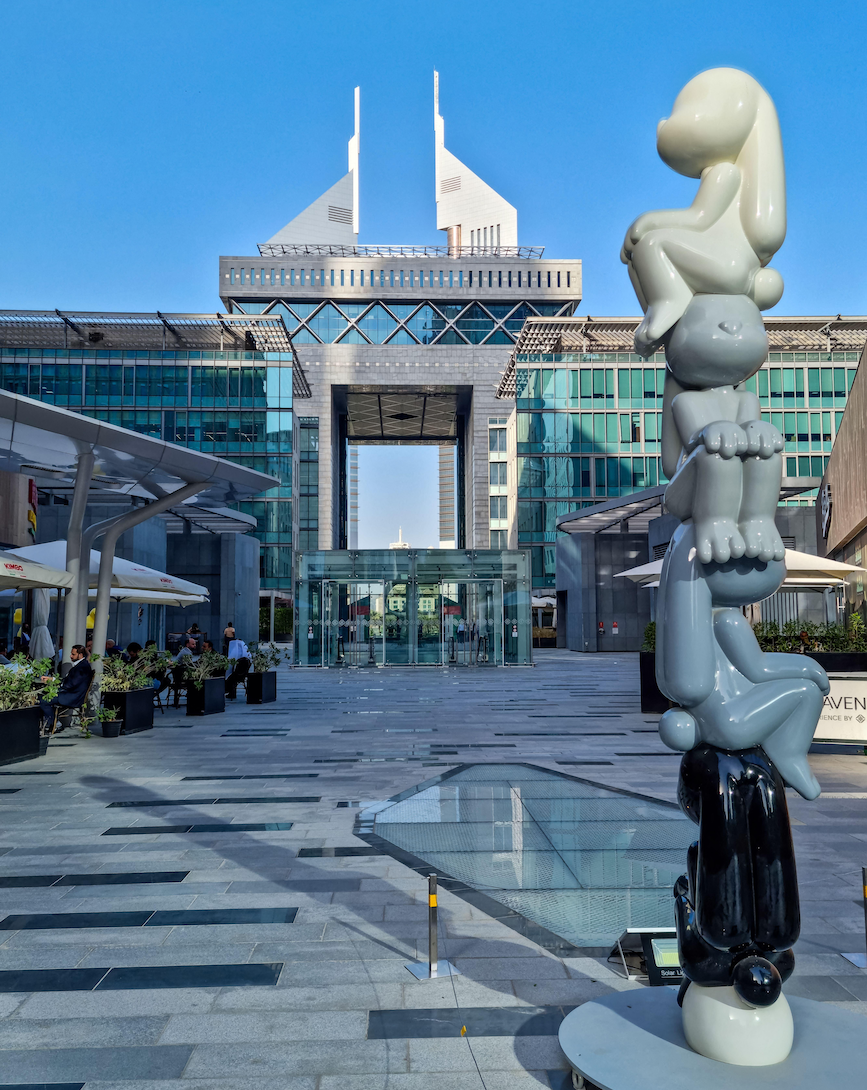
The Emirate emerged from a global recession to become a truly global financial and cultural hub. Marwan Al Abedin was at the center of the decisions that made that possible.
In the image above, Turkish artist Erdil Yaşaroğlu’s “Tower of Rabbits” decorates a plaza in the Dubai International Financial Centre economic zone.
Marwan Al Abedin joined the Dubai Department of Finance as Head of Treasury and Head of the Debt Management Office in 2008, with the task of creating funding routes for infrastructure projects. The global financial crisis began that same year, with the collapse of Bear Stearns and the bankruptcy of Lehman Brothers.
Some problems were revealed almost immediately. Borrowing by government-owned organizations had been occurring as needed, with no centralized oversight. The debt for some of them, notably investment company Dubai World and real estate investor Nakheel, had become so complicated that at first even its true extent couldn’t be determined.
“The initial period was extremely challenging,” Al Abedin told us in a recent interview. “The government was beginning to work more closely with the GREs on these issues, and it took time to develop a comprehensive understanding of their financial positions and the scale and complexity of the situation. Establishing that clarity was an important first step in determining the appropriate way forward.”
The following year, in the teeth of a financial crisis that had already sparked a global recession, Al Abedin became CEO of the newly created bailout facility, the Dubai Financial Support Fund. On November 25, 2009, the government announced that it would seek a standstill on Nakheel’s sukuk obligation of approximately $4 billion. This marked the beginning of a broader restructuring process involving approximately $26 billion of debt across Dubai World, Nakheel and Limitless.
“Major developments always seemed to occur over weekends,” Al Abedin muses. “This came around the US Thanksgiving holiday, creating a long weekend and intensifying the uncertainty.”
Al Abedin and his team worked closely with the Supreme Fiscal Committee, reporting directly to Sheikh Mohammed and the senior leadership. Slowly they put the pieces together to repay the outstanding debts, rather than default, a move that kept the state on good terms with global creditors.
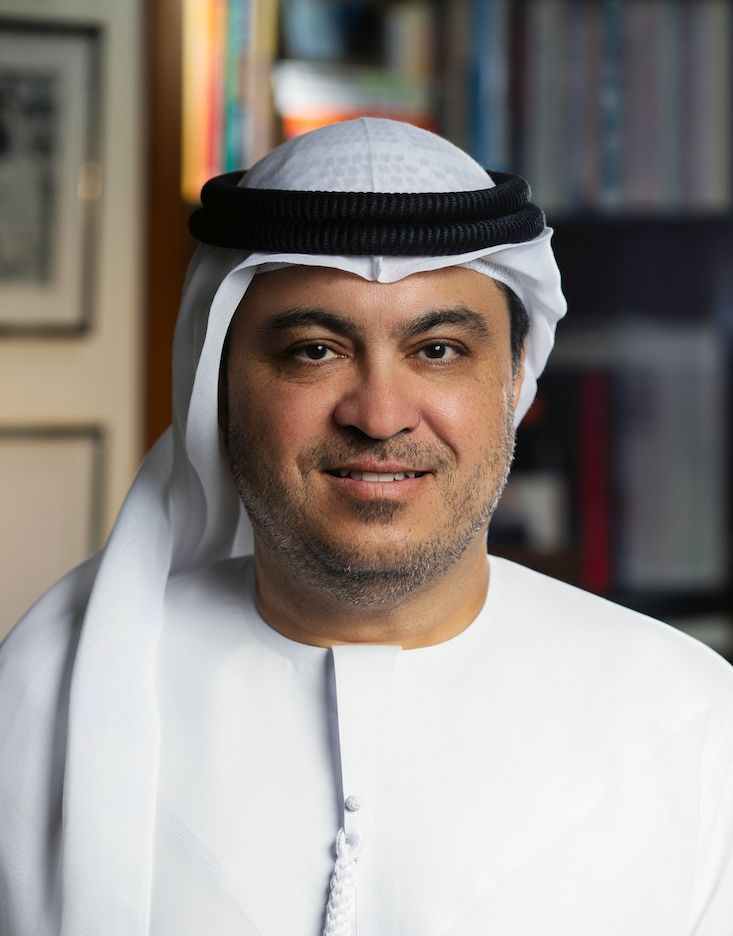
Fast forward to 2026 and Dubai has not only recovered but has surpassed the most optimistic expectations to become a truly global city, a major business and cultural hub. Yet this year, new pressures have emerged with the conflict in neighboring Iran. In the disputed Strait of Hormuz, a critical corridor for goods coming in and out of the Emirate, shipping has been periodically halted and remains fraught. Dubai had prepared for a potential closure of the strait for years and has managed to open new alternatives to keep its economy humming, even as the ongoing troubles reshape aspects of international business. [Read “Supply Chain Strain”]
Al Abedin is currently founder and CEO of Flatrace, a boutique consulting firm for international business in the Gulf region. He is also a board member of Global Partners Property Fund for international investment in the region, and a Strategic Adviser for RIIG, an international AI-assisted digital discovery services firm in healthcare.
We spoke to Al Abedin about the crisis he and the government handled in 2009 and about the outlook for Dubai’s economy and its ongoing development in light of current geopolitical pressures.
What was the mood like in 2009?
There was a lot of uncertainty, of course. There were intense pressures from regulators and central banks. I attended meetings where people were cordial while Their Highnesses and senior officials were in the room, but once they left, the questioning became extremely aggressive. There was a roster of central banks from different countries calling. Everyone was dealing with the consequences of the global crisis.
Dubai was an easy target for blame. It was not as globally important in 2008 and 2009 as it is today, but attracted disproportionate attention. It was a high-pressure environment; our discipline mattered more than noise. We had to recognize that very quickly.
The immediate priorities were to establish a reliable view of liquidity and exposure, because none existed. People were sitting in bars in the Dubai International Financial Centre creating theories and rumors.
We had to maintain operational continuity, address imminent obligations, contain wider financial spillovers, and create a credible vehicle and commercial process for negotiations.
In 2009, Dubai did not have a bankruptcy framework applicable to Dubai World. The government therefore established what became known as Decree 57, creating a restructuring and insolvency framework for Dubai World and its subsidiaries.
The framework drew on the laws and procedures of the Dubai International Financial Centre and provided a clear legal process for Dubai World and its creditors during the negotiations. We were going to offer creditors a plan. The bank creditors alone represented exposure of approximately $24.5 billion for Dubai World, while Nakheel had an additional roughly $4 billion.
Those figures were enormous at the time. Today, when we talk about Tesla, Anthropic and trillion-dollar numbers, they can look like loose change, but in 2009 they were very significant.
We considered a haircut, as you would in any restructuring of this scale, but ultimately decided not to reduce the principal. Instead, we worked with creditors to extend maturities so that they would be repaid, including the agreed interest. For us, it was important to find a solution that creditors could support and that preserved confidence in Dubai.
Plus, creditors who rejected the government or the Dubai Financial Support Fund proposal could apply through a special tribunal of independent common-law judges. Some did. That was extremely important because the leadership wanted to avoid an “our way or the highway” approach.
“In the end, the crisis tested aspects of the financing structure surrounding Dubai’s rapid growth, but not the fundamentals of its economic model.”
A large part of our debt was in sukuk, an Islamic bond that is by definition backed by assets. We assessed the portfolio and sold or surrendered assets that no longer made sense, particularly where the liability represented almost the entire value.
They generally accepted extending maturities, provided there was no principal haircut.
One of the most important questions, which wasn’t entirely clear at the time, was where the fault line was. Was it limited to the finance practice or was all of Dubai’s growth strategy in question? In the end, the crisis tested aspects of the financing structure surrounding Dubai’s rapid growth, but not the fundamentals of its economic model.
What worked particularly well? What lessons could be carried forward?
The importance of communication is a lesson woven throughout this story. Clarity in setting goals and ensuring that every person understood their responsibility—legally, financially, operationally and reputationally. We were setting standards and expectations that would last for years.
The crisis pushed us to become more open and transparent. Dubai is a very open society, beginning with the leadership, and that openness has to flow through institutions. Leaders have to communicate differently to different stakeholders, but the message must be consistent. This is especially important when investors come from Europe, the West and Asia, where they are accustomed to high levels of transparency.
Credible recovery requires reliable facts, sufficient liquidity and stakeholder alignment. But without a proper communication strategy, institutions often fail because they cannot explain their position consistently. They end up chasing multiple versions of the message. Leadership requires the ability to absorb pressure, take decisive action, maintain a clear long-term direction and avoid losing sight of what matters.
Beyond the relationships with creditors, were there things that helped propel Dubai’s recovery and subsequent growth?
The leadership shown during that period, and some of the groundbreaking decisions taken, helped solidify Dubai’s flagship companies and sectors. Since then, the number of major global institutional players that have moved to Dubai or invested here has easily doubled or tripled. The DIFC now hosts thousands of companies. It is difficult to name a major financial institution that does not have some representation in Dubai or the UAE. Even amid current geopolitical conditions, US and other institutional investors continue to pursue infrastructure and other transactions linked to the UAE.
The geopolitical environment now has the world watching this region closely. How do you assess the stability of Dubai’s economy and its ability to continue expanding its global role?
The appropriate leadership response is to combine resilience with diversified markets. The greatest challenge today is the correlation of risks. This is not simply a Gulf problem; it is global. It may affect parts of Europe more severely than it affects our daily lives. If the Strait of Hormuz remains constrained, for example, the recessionary impact on the UK could be significant.
Long-term objectives should remain consistent and not be derailed by today’s difficulties. For most people and sectors in the UAE, life continues. After an initial disruption, conditions have been relatively calm, and many organizations are already planning for the fourth quarter. Conferences, exhibitions, entertainment events and Formula One in Abu Dhabi are returning. The key is to remain focused and keep moving.
“As the popular saying goes, even a bad day in Dubai can be a good day compared with many other places.”
Sectors like tourism, aviation and trade are most affected. Is Dubai ready to diversify further if softness continues?
COVID-19 was in some ways harsher because the airport closed. Many people appreciated how the government and leadership managed the situation without the level of restriction seen elsewhere. As a result, we experienced a boom in real estate, trade and tourism after the crisis.
Today, some international airlines have reduced flights because of insurance and other liabilities, but Emirates traffic has remained comparatively positive and the airline has captured demand. People are still traveling, and not necessarily at discounted fares.
In typical Dubai style, Emirates and the leadership have offered stopover packages and hotel stays. A traveler will spend across the city on food and beverage, entertainment and other activities. That reinforces Dubai’s image and supports the economy.
Business leaders outside the country are impressed with how the government has managed a crisis it did not create. As with COVID-19, the decisive issue is not whether the crisis originated here, but how we respond. As the popular saying goes, even a bad day in Dubai can be a good day compared with many other places.
During the financial crisis, there were endless predictions of Dubai’s collapse, including from reputable research houses. The same dynamic exists today, amplified by social media. What has been encouraging is that far more people now speak positively about Dubai—not only Emiratis, but expatriates who see themselves as part of the fabric of society.
Over time, I expect more people to come for tourism, investment and business formation. Tariffs imposed on certain countries are already encouraging companies to consider manufacturing and investment in the UAE, using its logistics infrastructure to export into the region and beyond.
What concerns do you have for the future of business and finance?
AI and cybersecurity are concerns that must be addressed. I am a strong supporter of AI, but nothing replaces human interaction in this context. A person may have the most up-to-date information and understand regional and cultural complexities that AI does not.
When I was at the Department of Finance and responsible for investor relations, I always told investors: “If you have a question, go to the source. We will answer yes, no or no comment—even a ‘no comment’ tells you something. Do not rely on a conversation overheard in a bar, a tweet or a forwarded WhatsApp message.” Today, AI hallucinations and deepfakes make it even harder to know what is real.
The pressure on organizations to be dynamic, quick and ready to respond to investors, media and the markets is not going away.
One idea might be for an investor hotline. It would be cumbersome, but it could send a powerful message. If anyone has a question in the middle of the night, there is a 24-hour number—almost a red telephone—that can answer and dispel misinformation.
Interesting! A bot would defeat the purpose.
Exactly. You would need to train a team to manage it. During the financial crisis, I recall a text-message system within the government and senior leadership, through which breaking news and important developments were circulated. A version of that, designed for investors and the wider public, may now be needed because there is so much misinformation.
Meet the authors
-
Partner, Dubai Office Head
Dubai
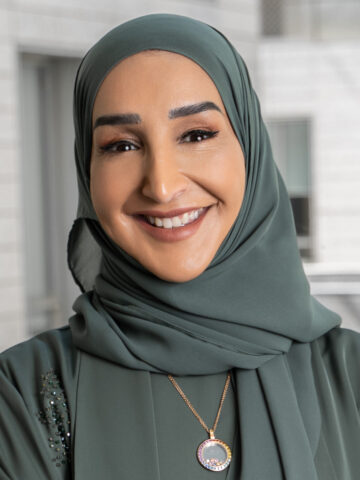
Jeehan advises boards and senior management teams of private and public, regional and international companies on their communications with internal and external stakeholders.
More from this issue
Crisis
Most read from this issue
Answering to the Truth

25 Years Later
You might also like
Oval Office Hemingway

Seeing China Clearly
