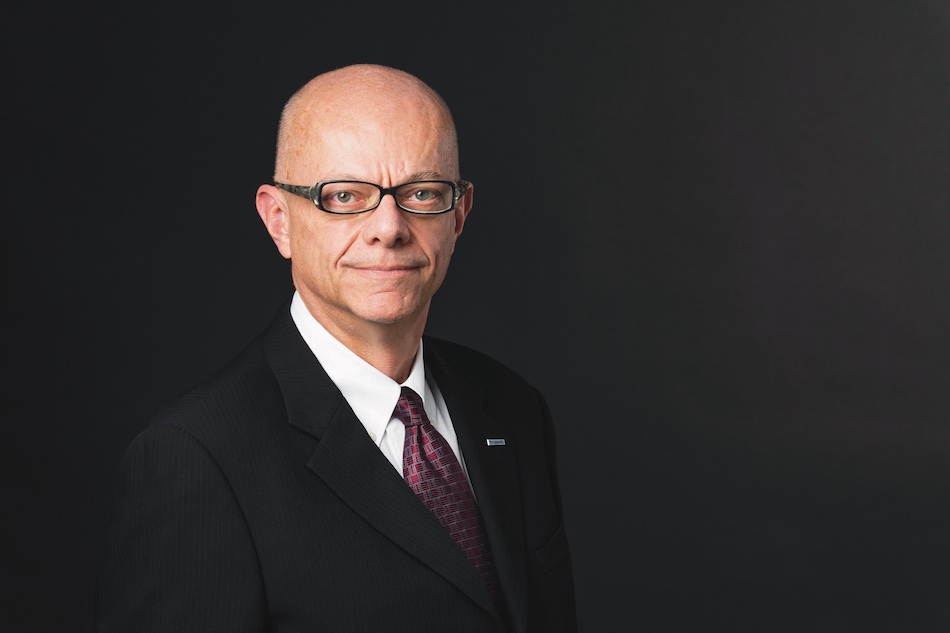
Sitara Merchant Carter leads a relatively small organization toward an enormous challenge: helping financial services protect people left behind by conventional finance. Amid climate change, Carter worries that hard-won gains could prove dangerously fragile.
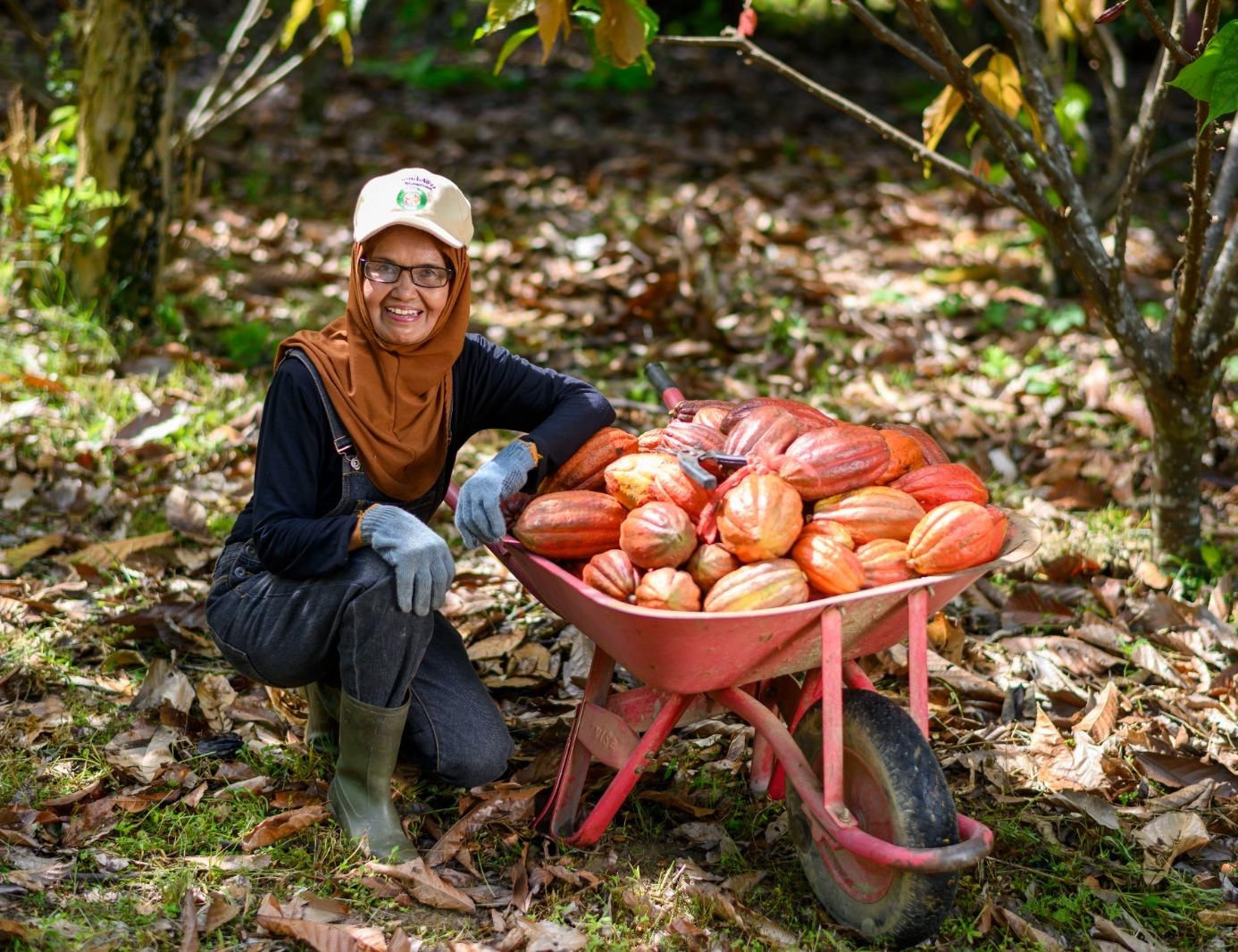
Above, Nurbaya, a cocoa farmer in Indonesia, is one of the 8.7 million people SCBF ‘s work has reached since its founding.
Sitara Merchant Carter runs an organization most people will never have heard of.
Its name, the Swiss Capacity Building Facility, reveals little about what it does. SCBF works behind the scenes, bringing together public, philanthropic and private-sector partners to help financial institutions and other organizations develop services for low-income people in emerging and developing markets. It was founded in 2011, and its original funding organizations included Credit Suisse, Swiss Re, Zurich Insurance Group and Allianz Reinsurance.
Its interventions are deliberately modest. Rather than trying to solve poverty at some systemic level, SCBF works project by project: helping an institution develop insurance that can protect a farmer when a harvest fails; supporting financial services designed around the realities of women’s lives; helping promising models prove themselves so that larger investors might eventually take them further.
One farmer protected from a failed harvest will not transform the global statistics. Neither will one woman gaining access to savings, insurance or affordable credit. But multiplied across communities and countries, those individual differences matter. Since its founding, SCBF says its work has reached 8.7 million people in more than 50 countries.
For Carter, a veteran development and inclusive-finance expert who joined SCBF in 2019, the question now is not simply how many more people can be reached. It is whether the progress already made can withstand what comes next.
Climate change is making the shocks facing low-income households more severe. At the same time, pressure on government development spending is changing how, and by whom, solutions will be funded. A family may have a bank account or access to credit and still be one flood, drought, illness or failed harvest away from losing years of economic progress.
That distinction sits at the heart of Carter’s argument. Financial inclusion has been focused for years on access. The next challenge, she says, is resilience: whether the financial system can do more than give people opportunities when circumstances are good, and actually protect those gains when circumstances turn against them.
For a relatively small organization such as SCBF, that means operating in an unusual place: between donors and investors, grants and commercial capital, experiments and scale. Its ambition is not to finance every solution itself, but to help good ideas survive long enough, and demonstrate enough, to attract others.
Carter spoke to Brunswick about why women so often become the shock absorbers when financial systems fail, why promising ventures struggle to find capital, what climate change means for financial inclusion and why the future of development may depend less on extending progress than on preventing it from being reversed.
When financial systems fail the most vulnerable, what does that look like in real life? Who absorbs the shock when there is no savings cushion, no insurance, no access to credit?
The pattern is consistent. When shocks hit without protection, assets are sold, income sources weaken, children leave school and debt accumulates. What begins as a temporary shock becomes a long-term setback.
Poverty is not, in most cases, a failure of effort. It is a failure of shock absorption: the absence of a buffer between a family and the worst version of a bad year. A single event, such as illness, drought or a failed harvest, can reverse years of economic progress. Families adjust, but often at significant long-term cost.
Who carries the heaviest share of that burden?
Women. Picture a flood in Pakistan. Or in India. The pattern is familiar. The husband cannot stop working. The family cannot afford to lose his income on top of everything else, so he goes to work. And she stays.
She is the one in the water, with the children, figuring out how to put the household back together while the machinery of economic life carries on around her. She is the shock absorber, not by choice, not by design, but by the quiet logic of how the system was built and who it was built around.
She does this, in most cases, with little insurance that covers what she has lost, limited credit available on terms she can meet, and few financial products designed with her specific life in mind.
There is plenty of capital in the world. Yet inclusive-finance ventures that serve low-income markets often struggle to reach scale. What is the structural flaw?
The flaw is not a shortage. It is misplacement: Capital that exists but sits one step away from where it is most needed.
Microfinance institutions need mid-sized growth capital but lack the balance sheets to access it. Banks see enterprises in these markets as too risky or too early-stage, with loan sizes too small to justify the cost. Venture capital is limited, and access to it depends on networks that most enterprises simply do not have.
The money is there. The connection is often missing. And in the gap between them, viable ideas stall.
Where this has worked is when that gap is actively bridged: When capital is paired with technical support, risk is shared and products are designed around real client needs. Then capital starts to flow. Financial institutions become more willing to lend, insurers can price products sustainably and enterprises can absorb and use funding effectively.
These are not new ideas. They have worked in microfinance, agricultural finance and index insurance when the right partners are aligned and early risks are managed.
The issue is not whether this can work. It is that it is not happening consistently, or at the scale required.
“Leadership in this context isn’t about vision alone. It’s about the patience to hold these tensions in view, create space for honest exchange and keep pushing toward alignment.”
The ventures you support have proven their models but aren’t yet attractive to mainstream investors. Why is this “missing middle” so persistently underfunded?
The missing middle isn’t about weak ideas. It’s about unpriced uncertainty.
This is often framed as a trade-off between impact and financial return, but that misses the point. The real issue is when and how returns can be generated, and who is willing to absorb the uncertainty along the way.
Investors fund proven scale because that is where returns are predictable. They do not fund uncertainty, not out of indifference, but because the system does not reward it.
What the missing middle needs is capital that can tolerate not knowing exactly when growth will come, or how quickly. Patient capital is the willingness to sit in uncertainty rather than flee from it.
It sounds simple. In practice, it is rare.
We describe emerging markets as high risk. But is the real risk market volatility, or a fundamental misalignment between what investors expect and what clients need?
Both matter. A Global North investor entering these markets faces real risks: foreign-exchange exposure, capital-repatriation challenges and operating in unfamiliar contexts. Those concerns are valid.
But there is another risk that rarely appears in investment memos: not knowing what you don’t know.
A foreign investor does not navigate what a local investor does as second nature. Local investors increasingly demonstrate the advantage, investing in markets they understand, without FX drag, without cultural distance and with operational agility rooted in lived experience.
SCBF deploys relatively modest capital, with maximum ticket sizes of around $200,000, yet aims to unlock significantly larger private investment. What makes capital catalytic rather than simply concessional?
SCBF’s capital is small by design, but catalytic in effect. The difference is not the size of the check, but what it signals.
Concessional capital sustains organizations. Catalytic capital changes their trajectory and who is willing to back them. When SCBF supports a model, backed by the Swiss Agency for Development and Cooperation and institutions like AXA, Swiss Re Foundation and Roche, it does more than fund. It validates. Risk is repriced. Credibility transfers. Investor conversations shift.
This works because SCBF is not a single donor; it is a platform that blends public purpose with private-market credibility. That combination makes opportunities legible and investable to commercial capital.
The goal is simple: Use grant funding to eliminate the need for more grants, by preparing organizations to attract and absorb private investment.
$200,000 is modest capital. But it is a powerful signal.
Climate change shows up for smallholder farmers and informal workers as income instability and debt stress. Has it fundamentally changed what financial inclusion must now deliver?
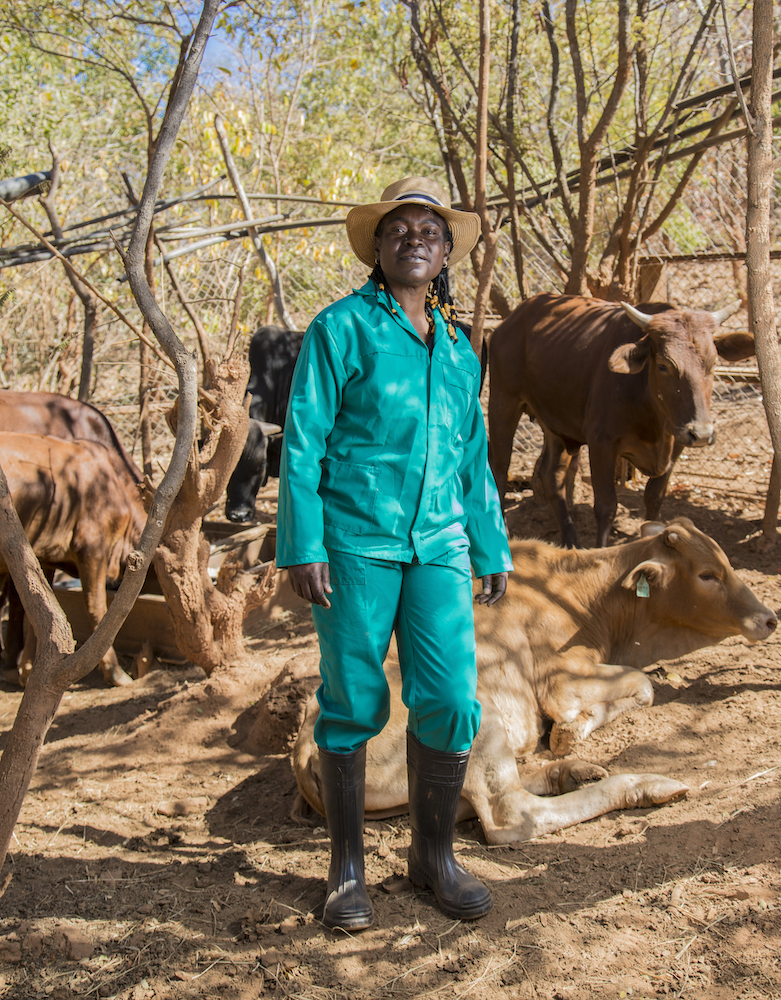
Climate change is already reshaping what financial inclusion must deliver. For smallholder farmers and informal workers, it shows up as income volatility and rising debt stress.
A drought, flood or failed harvest is no longer necessarily a temporary setback. It can erase years of progress in a single season, pushing households back into poverty and forcing reliance on high-cost debt. Without resilience, development gains are not just fragile. They are at risk of reversal.
Over the past two decades, expanding access to finance has been a real and hard-won achievement. But access alone is no longer enough.
Credit without protection can deepen vulnerability when shocks hit, exposing the limits of a system designed to extend opportunity but not always to sustain it. The question now is whether development finance is building systems that can absorb shocks, or inadvertently increasing exposure to them.
Financial inclusion must evolve accordingly. It is not just about access, but access to the right tools that achieve outcomes like resilience, especially insurance and risk-sharing mechanisms that protect livelihoods when climate events occur.
The task now is ensuring that financial access does not just expand opportunity, but protects it over time.
Has the development sector asked itself honestly whether some of its gains were fragile precisely because resilience was never the priority?
The sector has had to confront that question. But what matters now is what has been learned.
Earlier approaches often followed a phased path: expanding access and innovation first, then addressing resilience later. That delivered real progress. But experience has shown that resilience cannot be added on afterward. When shocks hit, the absence of protection can quickly undo those gains.
What is encouraging is that the model is evolving. Access, innovation and resilience are increasingly being designed together from the outset. Financial tools such as insurance, savings and risk-sharing are being embedded within everyday financial services rather than layered on top.
The opportunity now is not just to extend gains, but to make them last.
Who fills the gap now that governments are stepping back?
No single actor fills it. It is filled through coordination.
Private capital and philanthropy must operate as a continuum: grants at one end, commercial investment at the other, with capital deliberately sequenced so that what one actor starts, another can scale.
It is a relay, not a series of disconnected sprints.
SCBF is designed for this moment. It blends public and philanthropic funding with industry expertise from its members, including impact investors, insurers and pharmaceutical companies, to support solutions that can become commercially viable rather than grant-dependent.
That mix matters. Philanthropic capital absorbs early risk and validates models; industry partners bring the discipline, networks and credibility needed to shape those models into investable opportunities. Together, they help organizations move from proof of concept to scale.
In doing so, SCBF is not just filling a gap left by shrinking public budgets. It is building a pipeline of investment-ready opportunities so that private capital can step in with confidence and momentum is not lost.
You operate between donors, insurers, banks, regulators and entrepreneurs, none of whom fully control the system. What does leadership look like when progress depends on actors who don’t share the same incentives?
Operating across donors, insurers, banks, regulators and entrepreneurs means leading without control and with deeply misaligned incentives.
Twenty years ago, public and private actors wouldn’t even meet halfway. Today, platforms like SCBF show that genuine dialogue is possible, but only if those misalignments are named, not ignored. Incentives are skewed, measurement frameworks differ, and stated goals don’t always align with what institutions optimize for.
Leadership in this context isn’t about vision alone. It’s about the patience to hold these tensions in view, create space for honest exchange and keep pushing toward alignment.
Those conversations are happening every day within SCBF. The fact that different actors are finally speaking a shared language shows how far the system has come and why progress, while slow, is real.
If we looked back from 2030 and said that inclusive finance finally started working the way it should, what would be fundamentally different, not in the numbers, but in how the system behaves?
It will be working when shocks no longer erase progress.
When the smallholder farmer who loses a harvest does not also lose their children’s schooling. When the woman who walks miles to a bank finds something there built for her life, not borrowed from someone else’s. When the family that is flooded is still standing on the other side, not because they were lucky, but because the system held.
A family that weathers the storm. That is resilience. Not a word for conferences. Not a better report. The architecture underneath everything else.
That is the goal. A system, every institution, every instrument, every investor, oriented around one thing: Making sure that when the next shock comes, the gains do not go with it.
Meet the authors
-
Associate
London
Vishal is an Associate in the firm’s Foundations, Education and Global Health sector. He is based in London.
You might also like
Culture Catalyst

Vallée of Time