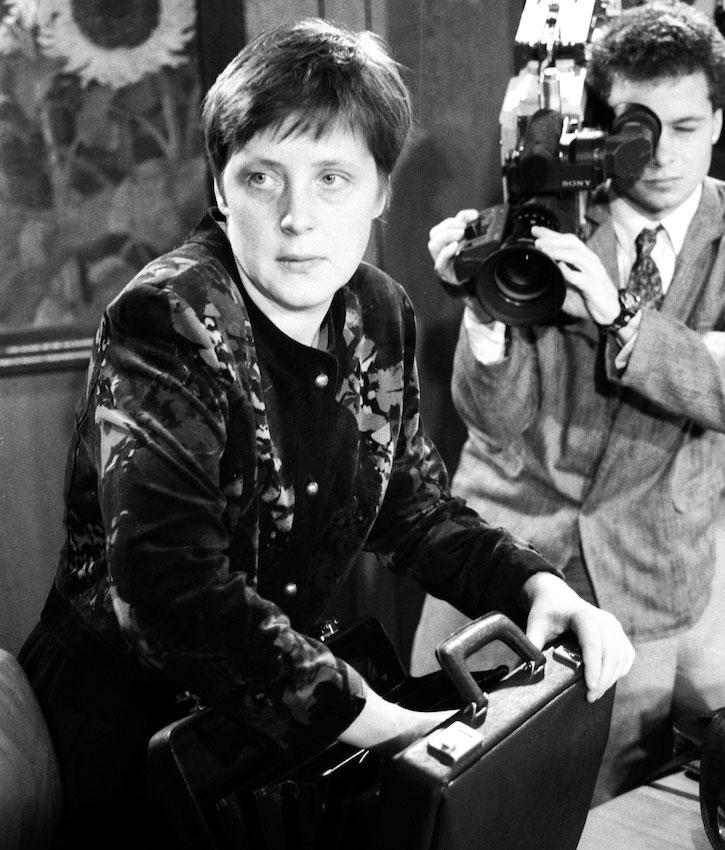

Jens Wiese, the Co-Founder and Managing Partner of transatlantic venture capital firm Leitmotif, talks to us about bringing AI to industry and the ties that bind Europe and the US. By Felix Morlock and Hannah Rückel
The prevailing narrative of 2025 frames Europe and the United States as economic blocs moving along increasingly divergent paths. Yet the strengths that distinguish them may be more complementary than conflicting, says Leitmotif Managing Partner and Co-Founder Jens Wiese.
“The US is great in software development,” he says. “But not so much when you talk about industrial AI. For that, you need the industrial backbone of Europe, a focus that the US over many decades has lost. To be able to compete against China, you’ll need to see those strengths working together.”
A native of Germany, Wiese started off his professional life in consulting, which led him, in 2018, to join Volkswagen. There he was in charge of Corporate Development for the group and helped develop its battery strategy and led a collaboration with Ford for electric and light commercial vehicles.
“The part of my role at Volkswagen that gave me most joy was working with all of the partners and facilitating these connections with the mothership,” he tells us in a recent interview. “It was interesting to me in part because it required a broader skill set: some cultural skills and understanding of how a small organization works, plus people skills to put the right teams together on both sides, in addition to mere commercial skills, orienting around common objectives.”
In 2023, together with his US Partner Matt Trevithick, Wiese founded Leitmotif, a venture capital firm headquartered in Palo Alto, California. Anchored by a $300 million commitment from Volkswagen, Leitmotif invests in startups on both sides of the Atlantic. The firm has a focus on decarbonization through “hard tech,” including innovations that marry robotics and AI in the industrial space. Its portfolio includes a mix of deployable and speculative technology, including fusion energy, battery development, circular materials and others, along with industrial AI and robotics.
While independent, Leitmotif maintains a close relationship with Volkswagen, to the benefit of some of the companies in its portfolio.
“There really are not that many firms out there that are able to bridge Europe and the US with pretty much equal footing the way we do,” he says. “I wouldn’t say we are unique, but in our model, I think we’ve got a number of things right.”
Can you talk about your professional journey?
When I finished my studies, in my very early days, I wanted to become an investment banker. But I wasn’t able to land a job at one of the top tier investment banks. And I was not ready to compromise. My second passion was in automotive and so I joined global consulting firm Roland Berger, where right from day one on I could concentrate on the automotive industry. But I never lost sight of the investment side.
During my consulting career I did several projects very closely related to investing. Then I joined VW. Working on partnerships there was my first responsibility, as part of the Corporate Strategy division. In addition, I subsequently took over corporate development, which was the global M&A side, plus all the investments. A long, winding, but entertaining road, without any regrets to get where I am right now. I am doing what I really love and enjoy.
The fun thing is that had I taken the straight road from university going into M&A and investment banking, I most likely would’ve gone to a private equity firm and would be in a role that suits me less. At Leitmotif, I can use all the experience that I collected along the way. So I’m very thankful for that opportunity.
Looking at the balance of investment power right now between the US and the EU, what are the trends you see there? How is that shifting?
Traditionally, the US captures most of the funding, particularly in venture capital. If you look at AI, it’s even more concentrated. The US is currently winning on all fronts in terms of technology, capital and talent. It’s leading across the board. It has a super-strong ecosystem in Silicon Valley that has long been dominant in software and now is leading in AI. What we will see going forward is an even stronger emphasis on physical AI. That is where Europe can play—and frankly has to. That’s the opportunity we focus on at Leitmotif. Take the capabilities of AI models and connect them with the physical world and industry. From proof of concept, to early pilots, to actually using these ideas to solve real-world problems.
The combination of AI and robotics enables us to automate tasks that so far could not have been automated. A lot of people talk about them in terms of the dull, the dirty and the dangerous as first priorities. Dull refers to highly repetitive tasks that have been somewhat hard to automate, maybe they have slight variations in the process for instance. Smart robots could do those. Dirty, refers to work environments that are not pleasant for humans, for example waste-handling or industrial cleaning settings. Dangerous, you can think about situations that you don’t want to or simply cannot send a human into, like hazardous inspection jobs on offshore platforms or high-risk industrial sites, such as nuclear power plants. Deployed in a robotics-as-a-service model, these robots work at lower cost than human labor and can work 24/7. If you go out far enough, you start looking at robots assisting your personal life. But I think the industrial applications are more realistic and profitable right now.
“That’s the opportunity we focus on at Leitmotif. Take the capabilities of AI models and connect them with the physical world and industry.”
Automation plans must meet resistance from employees. How do you approach that?
To some extent it will become a question of financial priorities and negotiation. In my mind, it’s not black and white—humans or machines. It’s a transition that will happen over time. You always have attrition, so you can automate to just replace attrition. As I said earlier, in today’s manufacturing environment, there are jobs that are unhealthy or dangerous for humans, and natural for automation. Those could be candidates as well.
New jobs will be created, jobs that don’t exist at present. But yes, a lot of basic jobs—and, I think increasingly also, higher-skill jobs—will go away over time. That’s a fact.
What should a policymaker or investor in Europe be looking at right now?
In terms of policy and regulation, you need a framework that provides guardrails around where AI development is going. It is becoming smarter and smarter, and thus more and more independent, which makes that harder. But it’s headed into uses where it won’t be directly supervised by humans, so it’s important to get it right. Data is a case in point. It can be a strong asset in industrial situations. You want to make sure that the data is appropriately protected and valued as the technology changes.
At the same time, there’s competition for speed. The US tends to regulate to a much lesser degree, and to rely more on marketplace mechanisms. In Europe, you often see strong regulation and safety guardrails that make development slower. I think it comes down to striking the right balance between the two. But you need to ensure that European companies can act at the same speed as the US players.
We talked about the arc of your career. But what inspired you to start Leitmotif?
I saw from the perspective of a large corporation how they struggle in their interactions with the startup community. At the same time, I saw a lot of opportunity for startups to better collaborate with large industrial players. That was kind of the nucleus. I started to think how that relationship should look. With Leitmotif’s independent setup but strong industrial backing, we are combining the best of both worlds. Going forward and starting with Fund II, we intend to further expand our base of industrial partners.
Some of your investment portfolio—the investment in batteries, for instance—have real tangible results being produced. But some, like fusion energy, look much farther out. Is there a criteria for deciding that balance?
Yes. When we thought about building out our portfolio, we set a couple of goals. First, we wanted it to be balanced geographically—two-thirds of our money in the US and one-third in Europe. And then we also balance about two-thirds of investment in near-term innovation, solving problems in existing markets, and one-third in frontier tech. Frontier tech has a longer time horizon, but if you solve the problems, the return can be much higher.
Leitmotif is set up as any traditional US venture capital firm and acts as a financial investor. Hence, most of our portfolio companies don’t have a connection with Volkswagen. But there is a smaller group for which we can leverage the strong link to Volkswagen, where we can open doors. We’re adding real value to the portfolio in the process. At the same time, we are connecting the US innovation ecosystem, which cycles faster, with the European industrial backbone and its wealth of experience and capability.
As an investment focus, we invest in hard tech and deep tech companies and founders that work on real, hard transformation problems, and that work on breakthrough technologies—from fusion energy to next generation batteries, to circular materials to advanced manufacturing. It’s not an easy space, but our differentiated model gives us a clear advantage.
“We are connecting the US innovation ecosystem, which cycles faster, with the European industrial backbone and its wealth of experience and capability.”
What do you think is the most misunderstood trend in the auto industry right now?
Electrification is for real. In that regard the direction that the US is taking, that is, going back to combustion engines, is wrong. Ultimately the industry is moving towards electric vehicles. And China has thrown that race into high gear, initially focusing on dominating batteries but ultimately aiming for the entire vehicle industry.
The European industry is at least keeping pace to a degree, but it’s hard to keep up with China, because China is just moving forward so aggressively.
The second trend is autonomous vehicles. That will be a huge market in the future. On the forefront are new players like Waymo in the US or Pony in China. Most of the established carmakers are working with technology providers on these autonomous systems. Getting your share of the business in that segment, breaking into that market, is a huge challenge.
Are you optimistic about Europe’s role in leading this technological shift, and in keeping up with China?
I am optimistic, because I’m always optimistic. As I should be in my job. Europe has a lot of opportunities. We’re coming back to the initial discussion, particularly in terms of industrial AI. Europe needs to put the right emphasis and also the right focus on this topic, with all of its industrial heritage, backbone and experience. There is a lot of talent in that sector. Europe has leading research organizations.
There are a lot of places where I’m optimistic that Europe has a right to win. It just needs to make it happen. The competition is super tough. Europe needs to up its game, to train harder, be more daring and more aggressive. Europe is still a fragmented economy with no common, fully orchestrated strategy.
Do you feel like the geopolitical situation has changed the scenario enough that it’s waking Europe up? Is there a change that you’re seeing?
Yes, definitely. I think for Europe this was a much-needed wake-up call. It’s necessary now to work out what fields you need to master, and the areas where Europe needs sovereign solutions. But they need to do that without losing the important international relationships that they have. This is what I miss in this conversation as we move from transatlantic cooperation or globalization, to now having individual deals country by country. There’s an opportunity—and a necessity—to maintain collaborations across regions, collaborating on a transatlantic basis, leveraging existing strong relationships. We need those complementary skill sets.
What are you most excited about in your investment portfolio or the horizon?
I’ve always worked in industry, for companies that produced real goods. So, I’m super excited to see how much technical progress there is, how much opportunity there is to advance the physical world. I’m really excited about all these deep tech and hard tech opportunities that are out there. That’s where my passion lies. And that’s what is needed to address a lot of the real-world problems, as a society.
Meet the authors
-
Partner
Frankfurt
Felix advises clients on financial and corporate communication issues with a special focus on public M&A, shareholder activism and investor relations. -
Director
Munich
Hannah's focus lies on data driven communications strategies, including media & social media analytics and stakeholder research & mapping as well as leadership positioning.
You might also like

A Washing Machine, and a Promise Kept
The Road from COP26