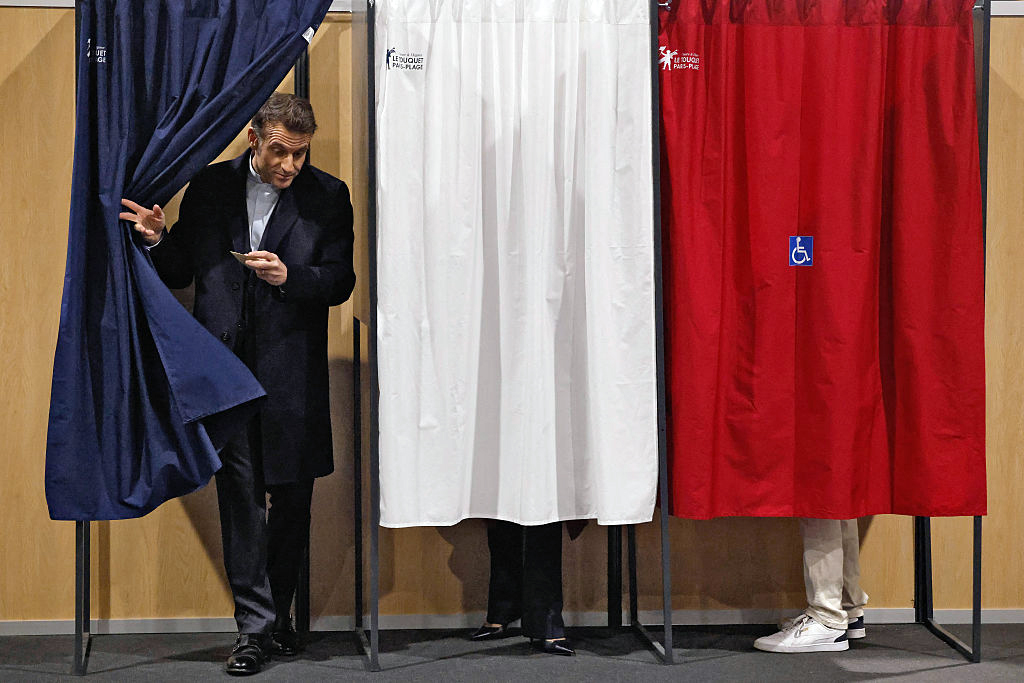
With no bloc able to govern alone and a presidential race wide open, businesses operating in France must prepare for a new era of coalition politics, shifting policy priorities and mounting uncertainty.
Macron’s Legacy
As France gears up for one of the most momentous general elections of its modern history, a decade of Emmanuel Macron’s leadership is coming to an end.
When he came to power in 2017, he promised to transcend France’s traditional left-right divide. In many respects, he succeeded: The Socialist Party and Les Républicains, which had dominated French politics for decades, have largely collapsed.
But rather than replacing them with a broad governing center, Macron leaves behind a political landscape that is more fragmented than at any time in recent decades. France is now divided into three durable political forces: a nationalist right led by the Rassemblement National (RN), a fragmented but electorally significant left, and a moderate center-right that has yet to define its post-Macron identity.
Ironically, the president who set out to overcome political divisions may ultimately be remembered for institutionalizing them. The snap legislative election of 2024 confirmed that France has entered a new political era in which no political force can realistically govern alone. This raises profound questions about the capacity of France’s next president—no matter who they are—to reform a country already constrained by the troubling trajectory of its public debt and the steady erosion of its economic policy levers. It also invites a broader debate about the long-term viability of the Fifth Republic as an effective framework for governing contemporary France.
Three Blocs, Three Visions
Attention is now turning to France’s next presidential election, scheduled for April 18 and May 2, 2027. The absence of an incumbent makes the campaign the first genuinely open contest in a decade. While the candidates have yet to be formally confirmed, the contours of the race are already taking shape.
On the nationalist right, the Rassemblement National (RN) remains the frontrunner. Despite being convicted on appeal for the embezzlement of public funds, Marine Le Pen has announced her intention to run while appealing the ruling before France’s Court of Cassation, the country’s highest court for civil and criminal matters.
The center is expected to rally behind one of Macron’s political heirs, with former Prime Ministers Édouard Philippe and Gabriel Attal widely seen as the leading contenders. Philippe comes from the center-right tradition, while Attal is more closely associated with the center-left of the Macron coalition. Another potential contender is Bruno Retailleau, leader of Les Républicains, who served as Macron’s Interior Minister from 2024 to 2025. He is positioning himself on a more conservative platform, seeking to recapture some RN voters while firmly rejecting any alliance with the party.
On the left, the picture remains more fragmented. Raphaël Glucksmann has emerged as the leading pro-European center-left figure, while Jean-Luc Mélenchon continues to dominate the radical left and former President François Hollande hopes to make a comeback. Whether the left can unite behind a single candidate remains one of the biggest uncertainties of the race.
Beyond the personalities, the candidates represent three distinct approaches to France’s economic model. A centrist presidency would largely preserve Macron’s pro-business agenda while continuing to champion European strategic autonomy. An RN government would place greater emphasis on economic patriotism, tighter scrutiny of foreign investment and national sovereignty. A left-wing presidency would favor greater state intervention, stronger labor and environmental protections and higher taxation, alongside a more active industrial policy.
The Issues That Will Shape France’s Next Presidency
The campaign will revolve around a handful of strategic questions that matter well beyond French politics.
The first is the balance between openness and economic sovereignty. After a decade of reforms designed to attract international investment, making France Europe’s top destination for FDI, the debate is no longer whether France should protect strategic sectors, but how far that protection should go.
A second debate concerns the role of the state. Across the political spectrum there is growing support for industrial policy and strategic investment in sectors such as defense, artificial intelligence, energy and critical technologies. The dividing line is not whether the state should intervene, but the scale and form of that intervention.
Finally, constrained public finances will force difficult choices regardless of who wins. France’s next government will need to reconcile ambitious industrial and defense objectives with mounting fiscal pressures, increasing the importance of private capital and public-private partnerships.
What This Means for Business
For international companies, the challenge has shifted from anticipating political shifts to operating in a France where political fragmentation has become the norm.
Relationships built solely around the executive branch are no longer sufficient. Businesses will increasingly need to understand the priorities of France’s main political blocs, anticipate coalition dynamics and prepare for policy likely to be shaped as much by negotiation as presidential leadership.
This requires assessing risks and opportunities under different political scenarios, identifying the policy issues most material to their operations, and adapting engagement strategies accordingly.
The 2027 election will determine who succeeds Emmanuel Macron. But for business, the more enduring story is the political landscape he leaves behind: one where governing is more complex, consensus is harder to build and strategic engagement requires a broader understanding of France’s evolving political landscape.
Meet the authors
-

Director
Paris
Drawing on more than 10 years of experience in politics and government, Aurélien advises companies in public affairs, corporate communication and crisis handling, often in… -

Partner
Paris
Claire specializes in advising clients navigating complex challenges at the intersection of regulation, politics, and reputation.
You might also like
The Triple Wave
The Making of Kontoor Brands