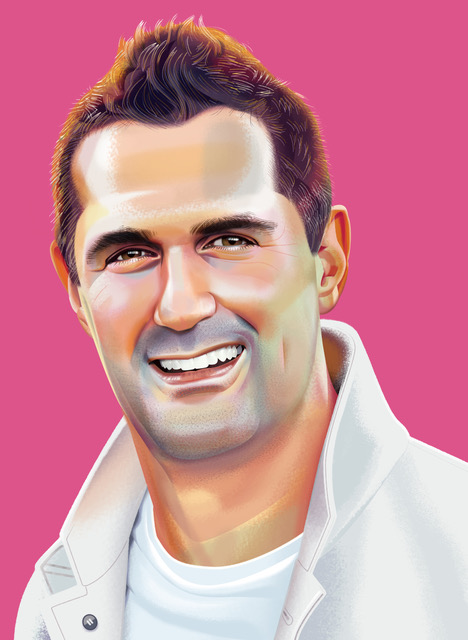
Alex Davis backs some of the most closely watched names in tech while his firm, Disruptive, remains under the radar.
Alex Davis doesn’t take pitch meetings or sit on boards. He doesn’t raise blind pools or charge management fees, and he invests in perhaps six companies a year—sometimes fewer. By the standards of modern tech investing, his approach is atypical.
For more than a decade, Davis’s Dallas-based investment firm, Disruptive, has quietly written large checks in Palantir, Airbnb, Spotify, Shield AI, Databricks, Stripe and Slack. In an investment landscape geared toward diversification and velocity, Disruptive has distinguished itself by proving that patience and concentration can be just as effective.
Disruptive does not back startups or take early-stage risk. Instead, it invests in companies already operating at or near public scale—businesses that have proven their models and are preparing for their next phase. The firm employs roughly 30 people, making it lean even by tech investing standards, and eschews the structures that often define modern asset management.
Each Disruptive investment is structured individually, with capital raised on a deal-by-deal basis. Its investors—major sovereign wealth funds, high-net-worth individuals, hedge funds and large family offices—are free to opt in or sit out each opportunity. “We actually try to design the investor group around the company,” Davis said during an interview at Disruptive’s offices, where floor-to-ceiling windows overlook Uptown Dallas. “The goal is to bring in people who can actually be helpful, not just capital.”
Disruptive, has quietly written large checks in some of tech’s most closely watched names, including Palantir, Airbnb, Spotify, Shield AI, Databricks, Stripe and Slack.
Disruptive has not sought to broaden its investor base in recent years, largely limiting new capital to existing backers and their affiliates. The approach is deliberate. The firm does not raise money through traditional banking platforms and is selective about who is invited to participate, cultivating what it describes as a structurally exclusive investor base. That discipline has resulted in unusual stability. Many of Disruptive’s investors have been with the firm for years, with little to no turnover—a rarity in private markets, where capital often rotates quickly.
The selectivity that defines Disruptive’s investor base shapes how Davis engages with the companies he backs. At any given time, he tracks roughly 20 businesses closely, often for years before Disruptive invests. When the firm does write a check, it is typically large. Most investors writing checks of that size seek board seats. In those, Davis is uninterested. “A lot of board meetings focus on stuff that’s already happened,” he said. “I’m interested in helping drive the outcomes reported in those meetings.”
For Davis, that means regularly connecting with founders and staying close enough to the business to know where and when he can be most useful. “I want to be a company’s favorite investor,” he said. “I know every firm says that. But if you’re serious about being helpful, you can’t do it at a quarterly meeting, and you can’t do it for 50 companies at the same time.”
Davis focuses on AI infrastructure, defense technology, and mission-critical enterprise software—and within those areas, is interested only in what he calls A-plus opportunities: those rare moments when the right business, timing, and price align.
“Funds that are investing in a lot of companies every year and sitting on management fees—how many A-pluses are in that portfolio?” he said. “So you do some A-minuses, some B’s, you might even settle for the odd C. I don’t have to do any of those deals, not even the A-pluses if the timing isn’t right.”
“I want to be a company’s favorite investor. I know every firm says that. But if you’re serious about being helpful, you can’t do it at a quarterly meeting, and you can’t do it for 50 companies at the same time.”
Alex Davis, Founder, Chairman, and CEO of Disruptive
Such an approach requires uncommon patience. Some of the companies he tracks may not want Disruptive’s capital, at least not yet. He is comfortable with that. Familiarity, he argues, is what allows the firm to move decisively when the timing does align—even if that means waiting years.
Such patience paid off in September 2025, when Disruptive led a $750 million funding round in Groq, committing nearly $350 million at a time when it was valued at $6.9 billion. The AI hardware company, which builds specialized inference chips and cloud systems designed to accelerate AI workloads, had been on Davis’s radar for years. Three months later, Nvidia agreed to pay roughly $20 billion in cash for a non-exclusive licensing agreement with Groq.
“When Alex backs a company, it’s personal,” Jonathan Ross, Groq’s Founder and CEO, told the Review. “He’s invested in the outcome and in the people. Some investors lean in during the exciting moments. Alex stays engaged throughout, and that’s where a lot of real value gets built.”
Years of following Groq and its peers helped Davis identify another opportunity: Reflection AI. Founded by former DeepMind engineers, the company is building a US-based open-source AI model at a moment when American leadership in the field has come under pressure. Open-source models are transparent and inexpensive to adapt, yet US companies are restricted from using Chinese models, and few domestic open-source alternatives offer comparable performance.
“You look at DeepSeek,” Davis said, referring to the Chinese AI startup. “It went from a company no one knew to producing a model that sent shockwaves through the market, to now being valued at $300 billion. I want to own the best US open-source model. Look at the trajectories you’re seeing in this space—that’s a $100 billion model within a year.”
Misha Laskin, Co-Founder and CEO of Reflection AI, told the Review how much he appreciated Davis’s approach. “Alex invests in relationships the same way he invests in companies: thoughtfully, and for the long term. People take his call because they trust him, and that credibility opens doors you couldn’t open on your own.”
Davis, who’s in his early 40s, moved to Texas during the pandemic—first to Austin, which he felt was better suited to early-stage investing, then to Dallas, a better fit for his business and his family.
“Alex invests in relationships the same way he invests in companies: thoughtfully, and for the long term. People take his call because they trust him, and that credibility opens doors you couldn’t open on your own.”
Misha Laskin, Co-Founder and CEO, Reflection AI
“I’m long Texas,” Davis said. “If you’re building a generational business, it matters where you put down roots. I want to be somewhere my family can stay forever. Dallas has this rare combination of generational longevity, food that’s as good as any city I’ve lived in, and I love the people we’ve been able to hire here. Dallas is such an undervalued commodity.”
Before the interview started, Davis was visible through the glass walls of his office, pacing as he talked on the phone. Occasionally he looked out at the city he hopes to never leave.
Later, during the conversation, he mentioned spending hours each day on calls with founders and investors, and joked about the miles he must unknowingly walk: “I’ve always been a perennial pacer,” he said. The irony was unintentional but unmissable: a founder who moves constantly, but has built a firm defined by its ability to wait.
Meet the authors
-
Director, Senior Editor
Dallas
Edward is a Brunswick Director and Senior Editor of the Brunswick Review, a business publication with readers across 68 countries. He's also written for some…
You might also like
Natural Capital

Trial & Error