

As the investment landscape transforms so are the smart companies by adapting fast.
Capital markets and the whole investor community continue to undergo consistent and transformative change. In a world that is not just evolving rapidly but feels more dangerous, there are few certainties. One thing I am certain of is that running anything has become, and is likely to continue to be, exponentially more difficult, and for public companies that includes effective investor engagement.
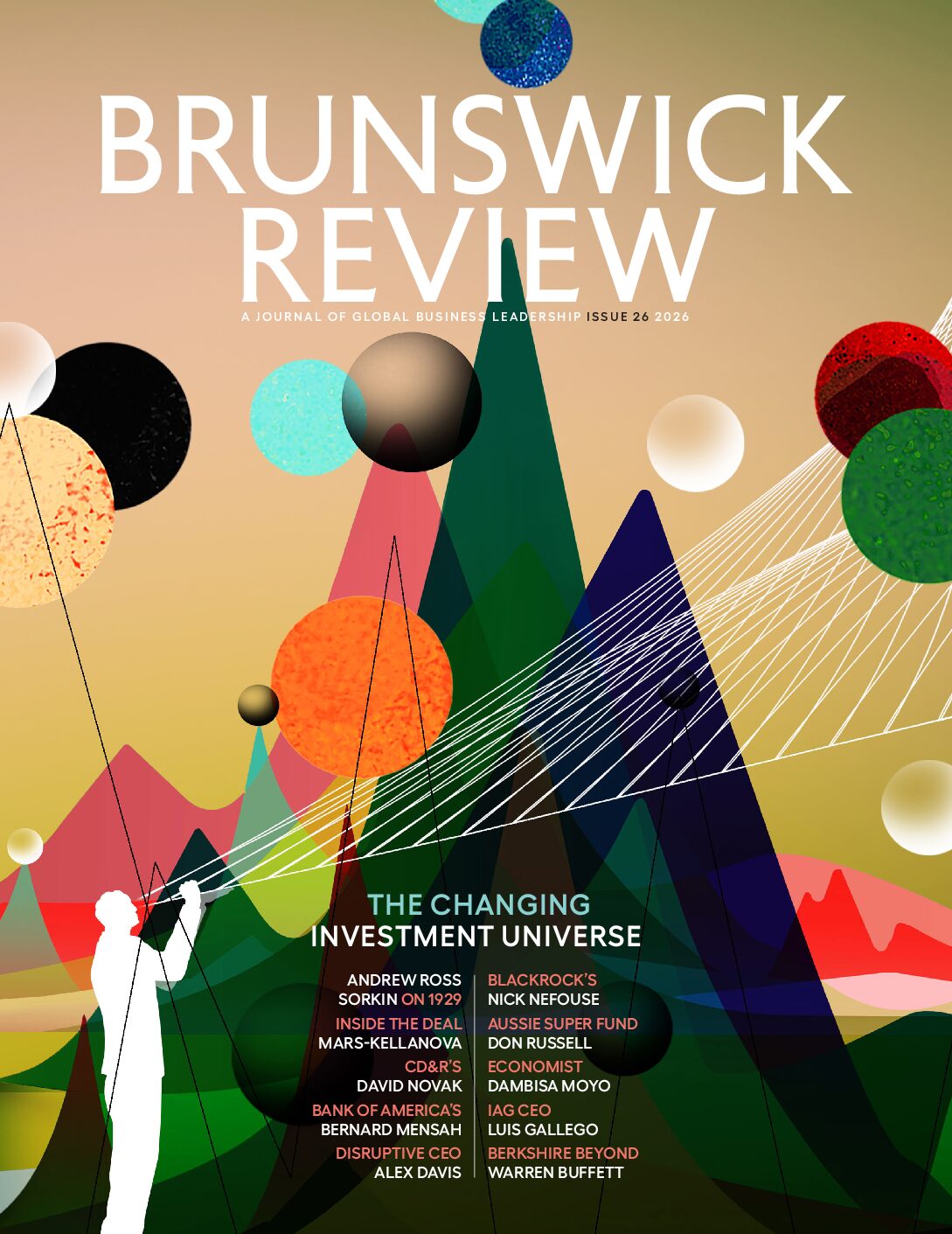
We built Brunswick to help companies on their most critical issues and to build trust and strong relationships with their most important stakeholders. For many clients, investors remain, if not the most important, then one of the most important stakeholders, and we are seeing more change in the last three years in how companies engage with them than in the previous three decades. That is why we have dedicated this edition of the Brunswick Review to the transformation of the investment community and how best to engage with them.
Some of the change is the increasing complexity of the markets, driven by the diversity of players and the range of specialists. Some is coming from technology, and these factors are then amplified by the sheer scale and increasing market concentration.
By the end of 2025, global equity market capitalization had reached $151.9 trillion—up from around $55 trillion in 2010—while global fixed income markets outstanding stood at $145.1 trillion, meaning total capital markets now exceed $295 trillion. Global assets under management reached $147 trillion by mid-2025 and are projected to reach $200 trillion by 2030. The concentration this has created is striking: The top 10 companies in the US now account for around 30% of the entire US market’s value. At the same time, five firms manage nearly two-thirds of all US mutual fund assets. In terms of activity, algorithmic and high-frequency traders now account for roughly 50-65% of all US equity trades, with Citadel Securities alone executing over 20% of all US equity trades and more than a third of all retail trades.
The currents in these markets are therefore far more difficult to navigate and we believe that with AI, the growth of local and global markets, activism and private capital all expanding rapidly, these trends will only accelerate.
From the corporate side, we see public company management investing more in investor engagement, not just to increase capacity but to raise its quality. At Brunswick, we are also investing more, like our clients, in people, services and particularly in technology. On both the client and consulting sides, new technologies are bringing exciting new data, increased analytics and enhanced presentation capabilities to support IR teams as they seek to engage more effectively.
“Data is table stakes, but the ability to drive momentum now lies in how effectively a company explains why it will win …”
The value of well-presented data and accurate models remains the bedrock of IR. The data in demand is shifting, however, and in the current environment we see investors increasingly looking for leading indicators rather than lagging ones.
What is also changing significantly is the recognition of the importance of coherent narratives and storytelling. Data is table stakes, but the ability to drive momentum now lies in how effectively a company explains why it will win, how it articulates its vision for its markets and strategy, the key drivers of value creation, and the milestones that signal progress. This came across clearly in Brunswick’s recent US Investor Survey (page 52), capturing the views from 100 of the leading buy-side investors.
Some companies see this as marketing their equity to the investor community. There is some truth in that. The discipline of good marketing can be valuable in this new world, particularly in investing properly to understand audiences, framing compelling stories and the investor case, presenting them clearly and measuring impact so they can be continuously refined.
However, we see effective investor engagement, like engagement with all key stakeholders, is more than messaging and marketing. It is achieved by earning trust and support through actions that are clearly explained and form part of a longer-term program. Through our recently launched Investor Brand, we are seeing more clients taking investors deeper into their businesses through higher-quality investor days and more consistent communication. Interestingly, we are also seeing an uptick in efforts to engage investors with broader management teams, demonstrating the strength of operational leadership and the culture that is likely to drive performance.
The quality of IR professionals is also rising. They should be recognized not just as backroom analysts but as important ambassadors of the company. They reflect not only the commitment to proper engagement, but also the style and culture of management.
Another encouraging marker we are seeing is better coordination between investor relations and other key functions such as corporate communications, strategy, and legal and regulatory teams. In a complex stakeholder environment, everything is connected and moving at speed. Siloed departments increase risk and are less effective than a joined-up, strategic stakeholder strategy that crosses departmentally.
The most advanced companies recognize this and coordinate communications across channels. One of the biggest areas of progress is the speed and reach of digital platforms to maintain engagement with stakeholders, particularly at critical moments. In a world where AI models draw on publicly available information, maintaining a consistent, accurate and up-to-date narrative is more important than ever.
At Brunswick, we have developed the concept of algorithmic relations (AR) and supporting tools. As investors, analysts and media turn to large language models for answers, they often receive a single, synthesized response. Companies need to understand what is shaping those responses and take responsibility for their accuracy and how they are represented.
“Like most sports, the game is won in training, more than just on the day.”
Many companies are also becoming more deliberate in shaping their shareholder base. Not all investors are seeking the same outcomes, so segmenting investors by type, including time horizon, return expectations and strategic alignment is becoming increasingly important. By dedicating resources to identifying and building relationships with aligned investors, companies can reduce exposure to short-term trading dynamics and create a more stable foundation of support.
Designing such a shareholder base takes time. It requires sustained engagement, careful relationship building and a clear understanding of the type of investors best suited to the company’s strategy. It also means building a pipeline of long-term holders who share leadership’s perspective, helping to mitigate volatility and reinforce strategic consistency.
The world feels more hostile, and capital markets more volatile and faster-moving than ever. This is seen clearly in the growth of activism. The number and variety of engagements continues to rise, while CEO turnover following activist engagement is increasing and overall tenure is declining. Over the past two years, 20% of activist targets saw their CEO resign within a year of campaign initiation, compared with average annual CEO turnover in the S&P 500 of 12%. Like most sports, the game is won in training, more than just on the day. So, preparation for different types of attack and building out frameworks becomes vital when the pressure is on.
At Brunswick, we are not in the business of predicting the future. As the saying goes, it is hard enough to predict the past. However, we spend more and more time planning for different scenarios and testing for different options. With the pressures of short-termism, market volatility and investor noise, the challenge is to keep the long view and take consistent action required to deliver sustainable growth. This is where investment in what we describe as “relationship capital” becomes particularly valuable.
Successful leadership relies on building trust and support among all key stakeholders. To that end, you need three types of capital: The first is “financial capital,” where IR and finance teams play a crucial role. The second is “reputational capital”—what people who do not know you think and feel about you. Such perceptions shape how news is interpreted, particularly when time or information is limited.
The third is “relationship capital,” that is the power of the people who actually do know you. We all know about net promoter scores, but we believe companies should also consider building what we describe as a “net defender score,” where Brunswick calculates how likely people are to defend a firm under fire. Like other forms of capital, relationship capital can be built over time so it is actionable when needed. It is as important for companies as it is for individuals in their careers and broader lives.
The commitment to open and honest engagement becomes more important in a tough and challenging world. The companies that succeed will be those that treat investor engagement not as a reporting function, but as a core strategic capability. It shapes perception, builds trust and ultimately determines access to capital and the ability for management to deliver its plans. In a market defined by speed, scale and scrutiny, the ability to define your own story, and have it understood and supported, may be one of the most valuable assets a company possesses.
Meet the authors
-

Chairman
London
Sir Alan Parker is Chairman of Brunswick, which he founded in 1987. Alan has worked on a wide range of assignments, acts as senior consultant…
More from this issue
Investment Universe
Most read from this issue

The Everything Exchange

Boardroom Breakthrough, Corner Office Bottleneck
You might also like

Beyond the Backlash

The Road from COP26