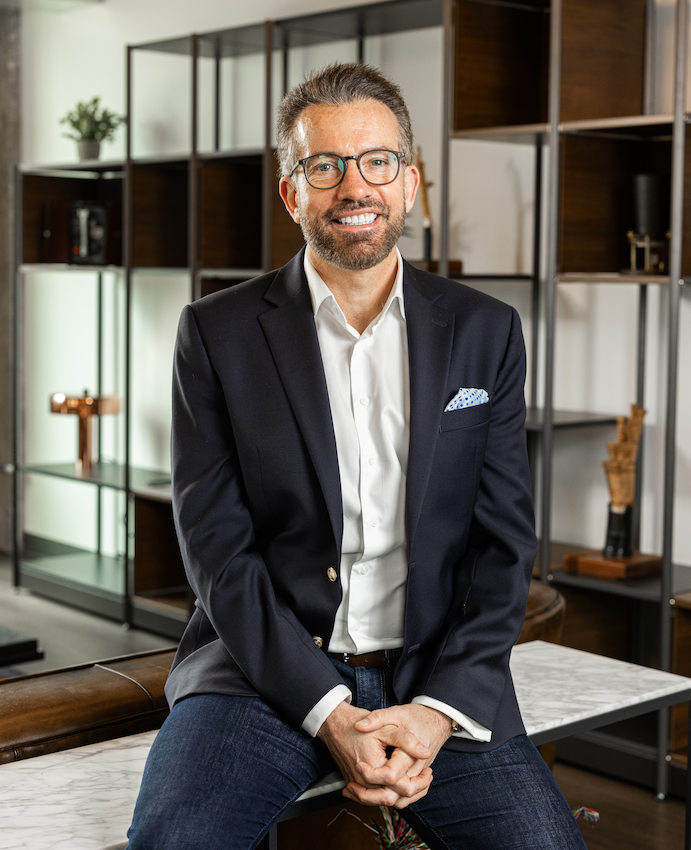
Discovery Limited Founder and CEO Adrian Gore is the author of a new book on multiplying our impact in business, leadership and life. He talks to Brunswick’s Dan Gladulich.
Adrian Gore is the founder and Group Chief Executive of Discovery Limited, which he has led from its earliest years as a South African startup to a global financial services group, impacting over 50 million lives in 36 markets worldwide.
Discovery was created for the purpose of making people healthier, and this singular focus has seen Discovery Health grow to become the largest private health insurer in South Africa, with over 57% market share for plans open to the public and more than 39% of the country’s total medical plan membership.
At the core of Discovery’s success is the Vitality Shared-Value Model, a pioneering approach to insurance that moves the insurer from being a static funder of claims to an active agent of prevention, incentivizing clients to pursue a healthier lifestyle and rewarding them for it. For more than three decades, the shared-value model has leveraged fintech, actuarial science and behavioral science to create benefits for the member, insurer and society. The model is now treated as a case study at Harvard Business School and has been recognized twice by Fortune magazine as a business model “changing the world.”
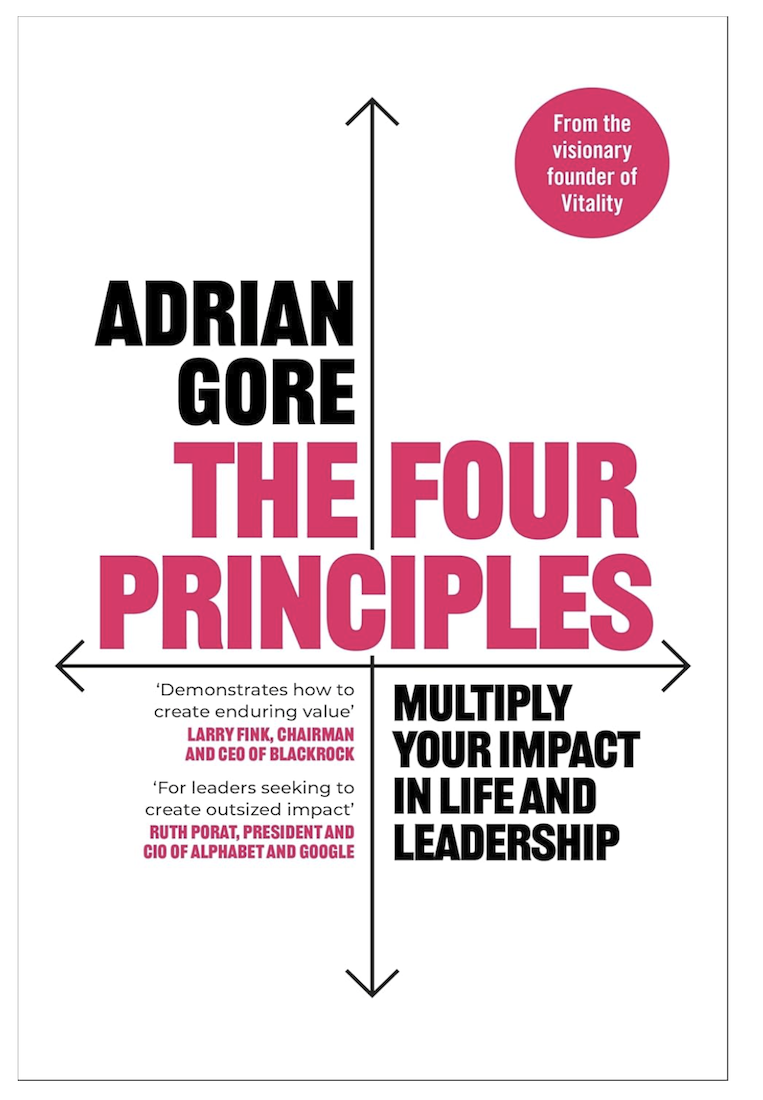
Drawing on his experience of building and scaling Discovery, Gore has written a new book titled The Four Principles: Multiply Your Impact in Life and Leadership, with journalist and award-winning author David Cohen, in which he outlines four science-backed behaviors that lead to greater impact. Drawing insights from behavioral science, network theory and mathematics, each principle is grounded in research and brought to life through examples drawn from Adrian’s real-world experiences.
The combination of data and storytelling is the same approach that Gore has used to build a dynamic social media presence.
“I’m not a CEO that’s peddling an idea,” he says of his LinkedIn account, which has well over 200,000 followers. “I’m the face of a group of people that have a deep conviction about creating a better world and measuring our progress. That actually makes it easy to communicate in a way that’s authentic.”
In recent posts, he shared his data and observations as a participant in the Boston Marathon, in which he found that running in barefoot shoes improved his performance.
“I’m trying to reveal intellectual debates that I think should be surfaced,” he told us. “I don’t shy away from the data and the complexity, but I try to apply it to things that are interesting and give people value. And again, it’s all on the basis of making people healthier, making the world better.”
The book outlines four principles for increasing impact: Disciplined Optimism, Focused Urgency, Declared Goals and the Pareto Tail. Also known as “the 80/20 rule,” the Pareto tail describes how statistical outliers are responsible for the majority of outcomes, a phenomenon that Gore says can be harnessed for greater impact.
In our edited interview below, Gore tells us how the book expands on a fundamental principle that built Discovery: bringing out the greatness in people.
How did The Four Principles book come about?
It’s a much larger amount of work than I thought it would be. The research has taken decades, a massive amount of work. But in the end, it’s a concisely written book. It’s been fascinating for myself and my team. So, I appreciated the opportunity.
My first idea for it was purely mathematical, to show that things we think are linear are not. All four principles have to do with this cognitive issue. You think time is linear, but it’s logarithmic. There’s a non-linearity to relationships. I became obsessed with the powerful implications of these cognitive errors.
We were also responding to people who were telling me, “You should write about Discovery and how it grew.” So in each of these principles, I cite stories and explain, for instance, how we worked with the government to fix the electricity crisis; how we’ve done partnerships on different issues. Settling on that as a rubric was a breakthrough—grounded in science, but illustrating the principles through stories. The math is there as an appendix at the end, for those that want to go further into it.
“Why is it that some people have a massive impact and others—with similar talents and abilities—don’t? The research shows it’s not about IQ, background or education. It is based on attributes and attitudes.”
Is it fair to say that important drivers of Discovery’s success were more behavioral?
Importantly, the driver is not behavioral; it’s people. Discovery’s been built organically on the strength of its people. We’re not an organization that has used mass amounts of capital to grow through acquisitions. We’ve never made an acquisition of any scale. It’s a business that’s grown organically off a business model to make people healthy.
A fundamental belief I’ve always had is that in every person there’s greatness. I’m interested in how you liberate that greatness, stimulate it and give it agency. That’s the journey I’ve been on from the start.
Later, that evolved into, how do you get people to have real profound impact in their own lives? I became obsessed with this question: Why is it that some people have a massive impact and others—with similar talents and abilities—don’t? The research shows it’s not about IQ, background or education. It is based on attributes and attitudes. That reinforced this idea that there’s greatness in everyone. That was the genesis of my thinking and over time, my team and I condensed this into four distinct principles.
Let’s talk about the first principle, Disciplined Optimism. You write that we are “miscoded for the modern world.” Can you tell us about that?
Human cognition was forged over hundreds of thousands of years for a very different world—one of physical threats and cause-and-effect relationships. To survive, we learned to identify the negative signals. Many positive people, those who may not have been as alert to the signs of danger, were eaten by lions. We are the children of the people that sought the negative. Research in behavioral science and evolutionary biology confirms this evolutionary bias towards seeking negative signals.
In South Africa, we get to experience this phenomenon first-hand, because we have easy access to a savannah environment. If you go out to the bush now and watch what the impalas and bucks are doing, they’re looking out for danger. They’re at risk of being eaten. We’re not that many generations removed from that life—not enough time for us to re-code through evolution.
But today, we live in a very different world. We no longer operate in linear, clan-based environments; we live in complex, networked systems, where the threats are less physical than systemic: failing healthcare and education systems, crumbling infrastructure, attacks on governance, financial crises, pandemics and more. In this context, our old instincts can work against us. To influence complex systems, we need leadership and collaboration built on positive cues. We need to motivate people dispersed across time and space. Negative feedback loops rarely create progress. Systemic challenges require an affirming framework: a clear vision, defined goals and positive feedback loops. That is the strength of optimism. Positive attitudes and pro-social behavior spread through social contact, building trust and multiplying impact. Formerly, success was survival; now, it is creating a shared vision, collaborating and building. All this requires seeking positive signals.
I’m not making an argument for forgetting the negative, but rather I’m acknowledging that we are coded to seek the negative and that we can choose to seek the positive as well. That’s the real sophistication, because you’re choosing to override your instincts. Seeking the negative is primitive.
In South Africa, we are often leading the country through moments of despair, in difficult circumstances where people are seriously asking, “Is there a future? What’s going to happen?” I’ve been a kind of lone voice in seeking the positive. People think I’m taking an optimistic view, which is not correct.
The common framing is that positivity is naïve and pessimism, the default, is sophisticated. And I wanted to understand why this is the case. I’ve seen the tactical power of seeking positive signals. It’s so evident.
The four principles are about re-coding ourselves. When you have Disciplined Optimism, Focused Urgency, Declared Goals, and you’re making decisions from the Pareto Tail, it changes the impacts you can have. These principles challenge some deeply engrained thinking.
The second principle is Focused Urgency. This principle dictates that time is logarithmic rather than linear, meaning that only around 20% of our lives are available to build a career, pursue opportunities and make a meaningful difference. We therefore need to act with focused urgency to maximize the effectiveness of time.
The third principle is about setting goals. This is a crucial issue, that most people don’t do for themselves. In sports, it happens naturally; the goals are set for you. In life, they’re not. People often don’t set goals for themselves in their own lives, even though you would think it would matter more to them. Behavioral economics shows that individuals are more strongly motivated by potential loss than by potential gain, and the act of setting and declaring goals is therefore critical in creating something meaningful to lose, which drives commitment, intent and follow-through. The Nobel Prize-winning work of Daniel Kahneman demonstrates that this effect results in an approximately twofold increase in motivation and execution.
Together, those three points—Disciplined Optimism, Focused Urgency, and Declared Goals—lead you into the Pareto Tail.
The Pareto Tail may be the least familiar aspect of the four principles. Can you describe its impact on leadership?
We were thinking about calling the book “The Tail Wags the Dog,” because of the prominence of the Pareto Tail. It’s the organizing architecture of the principles.
The concept here is that we tend to think that the distribution of things is bell-shaped and “normal” is defined as the center of the distribution. But it turns out that things that are interlinked always fall under power laws—and you get a tail in that distribution. The most important events, the ones that have the biggest impact, happen in that tail. The tail drives the mean.
You’re making millions of decisions every day. Where you parked this morning. Whether to have coffee or tea. But there are a few decisions and actions, in the tail of that distribution, that drive the greatest impact. It’s a great principle, because you realize that you can change your life in the tail.
I woke up one day and decided to start Discovery. That’s a tail event. I married my wife. That’s a tail event that determined a whole lot of things. Meanwhile, I’ve made 1,000 decisions just today that have no major effect. They’re in the rump of the distribution.
So the question becomes, “How do you make decisions in the Pareto Tail?” The way you do it is by employing the other three principles: Disciplined Optimism, Focused Urgency and Declared Goals. Those three get you into the fourth, the Pareto Tail.
“A fundamental belief I’ve always had is that in every person there’s greatness. I’m interested in how you liberate that greatness, stimulate it and give it agency. That’s the journey I’ve been on from the start.”
What do you understand now about leadership that you didn’t 35 years ago?
I’ve learned a lot of business skills that I think anyone in their journey learns. I’m a much more effective leader of the business today. But the core attributes have remained the same. I’ve been on a journey to prove and live the principles that I suspected existed.
You’ve said that businesses have an obligation to work with governments to improve society. What do you say to those who argue that activism for social outcomes is a distraction for businesses?
It’s a very complicated question, because I do believe a business has to meet shareholder expectations, and to do that you must be focused on your purpose and your goals, and you have to deliver. That’s a given. But there are a few other points.
Teams are at their best when they believe the business is fulfilling a powerful purpose. If a business is simply about making money in a focused way, you lose the support of your people. Having a stakeholder mindset about improving things is a tactical issue, not only a moral one. It has value. In the emerging markets especially, there’s a natural asymmetry of skills between the private and public sectors. Helping build a country requires working between the two. There are often ideological issues. There are struggles, there’s poverty and inequality. Your license to operate is that you are helping to build a country. That’s not necessarily the scenario in developed markets, but even there, you still have good reason to be involved in creating a better society.
Discovery by its nature builds societies and strengthens healthcare systems. Our model is about making people healthier, making health insurance and life insurance a platform that extends healthspan and helps governments fund healthcare. The business imperative and the social imperative align. There’s no dissonance. In our world, when people are healthier, we’re more profitable. It’s the most profound alignment. In any market, that’s a good thing.
What concerns you about the trajectory of global healthcare systems?
Global healthcare systems are facing considerable strain. With AI, the acceleration of technology for healthcare is going to be unbelievable. Drug discovery, for instance. It’s going to be amazing. But the ability to pay for that is problematic.
Depopulation, aging populations, higher chronicity, the rising number of people dependent on a pension compared to working contributors—this kind of pay-as-you-go system is very difficult. Governments face real fiscal difficulty, with climbing debt and so on. It’s a massive obligation—and it’s an opportunity for private social security systems, like health insurance and life insurance, to take on some of the burden of helping to ensure people can live healthy lives at any age.
The role of causality is now so clear and well-evidenced—lifestyle interventions and behavior change make a huge difference to length and quality of life. If we can compress morbidity so that people live really well into old age, with a high quality of life right up until they die, that’s a much better outcome than people living for very long but spending it in poor health. The goal is to make healthspan and lifespan the same and extend them, so even in old age, you can be healthy and productive. That’s our model: get people to be healthier and expand healthspan.
We can’t count on technology to help control costs. Technology in healthcare has never driven costs down. In every other industry, technology drives costs down. But in healthcare, technology has driven costs up. It may be that with agentic AI we will be able to do much more for less. But I think spend on healthcare will just increase.
How should leaders be thinking about AI?
I think we should embrace it. There are all kinds of risks associated with it, including threats to employment. We can’t dismiss those. But I think business leaders need to embrace it. The most profound use of AI will be at the core of our business models.
For Discovery, that means making people healthier. How can we hyper-personalize? How can we really get people to be healthier? A more customer-centric approach that can make your products and services better and their impact more profound is one of the most exciting things about AI for us.
But we also come back to the idea of being miscoded. If you think about the revolutions human society has been through—agricultural, industrial, the rise of technology and social media—as a revolution, AI is going to be faster than any of those. So the dissonance that I speak about in the book caused by our miscoding will be greater. And that relates to all the other aspects of our changing society that I talk about: networks becoming more complicated; individuals having a much greater span of influence; we’re not living in a simple linear clan; and so on.
So the questions we should be asking are, “Where is our miscoding? How do I have to adapt in order to use these opportunities properly?” We have to re-examine how we think about knowledge, how we think about leadership. It’s a fascinating time.
Meet the authors
-

Director
Johannesburg
Dan leads Brunswick South Africa’s Social Media offering, where he specialises in developing innovative digital strategies to address complex communications challenges across various sectors.
You might also like

Gillian Tett

In Conversation: Nithi Patarachoke